


Table of contents
Get in touch
Expect response in 4 hours.
%20(1).png)
Most agencies think AI threatens their deliverables. That’s not the real risk. The real risk is that clients are quietly recalculating what they should pay for before the agency has explained where its value now lives.
To give further context, we will relate an anecdote. A colleague of ours runs a 12-person performance agency. Pretty solid business with predictable revenue. The kind of agency that doesn’t panic.
One of their longest-standing clients, three years in, books a quarterly review, which on the surface seems quite routine.
Except this time, the client walks in with a deck.
One that is replete with six weeks of internal exploration on
- Content workflows tested using ChatGPT
- Reporting automated into a central dashboard
- AI-assisted bid adjustments tested in paid media
Then they pose the next logical question, “Why should we be paying for things we can now partially do ourselves?”
All they are rightly seeking is clarity, and that’s what makes it dangerous.
Fortunately, he didn’t lose the client, but he lost 30% of the retainer.
Not because the work got worse, but simply because the narrative shifted and he wasn’t the one driving it.
Understanding that this isn’t about AI adoption but about owning the narrative
Simply said, clients are not waiting for you to figure this out, as they have already started experimenting with AI tools.
Here are some data points to drive the point home;
- According to McKinsey’s State of AI report, 88% of organizations now use AI in at least one business function
- Marketing and sales are among the fastest-moving categories
To put this in perspective, your clients are already testing tools, watching competitors, and comparing outputs.
And more importantly, they are forming opinions on the value that you are bringing to the table and billing them for.
So, if you don’t steer that conversation and take it by the reins, something else surely will!
Decoding what the agencies charging ahead are doing differently
Now, what makes this conversation particularly uncomfortable is that the agencies that are well ahead of their game aren’t necessarily more advanced on AI than anyone else.
Nor have they built proprietary technology or hired a team of machine learning engineers. Instead, they have capitalized on the following two things;
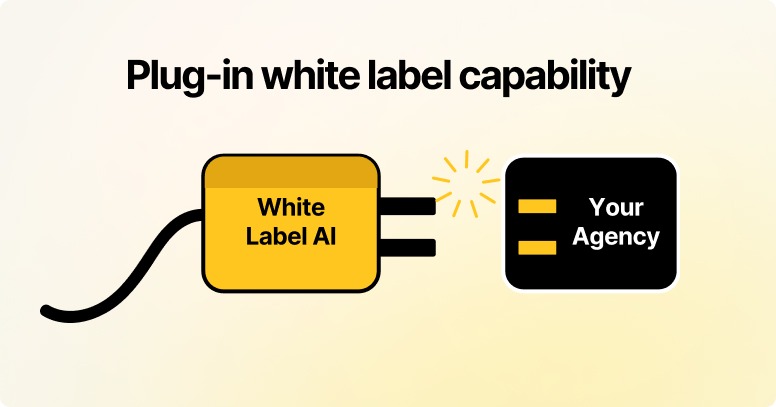
- They've gotten access to genuine AI delivery capability through white-label partnerships,
- They've made a habit of bringing that conversation to the client before the client brings it to them.
That combination, capability plus proactive communication, is what differentiates the agencies growing through this period from the ones quietly losing ground.
What this conversation actually looks like (when it’s conducted properly)
Now most agencies open on the wrong foot. They begin by saying, “Here’s what we’re doing with AI…”
Clients don’t care yet. The ones who get this right flip the script and own the game by saying, “Here’s where AI is already changing your category, and here’s what your competitors are quietly improving.” The moment the client sees movement around them, the conversation becomes urgent. This is what they do differently.
- Come in with a position instead of a question
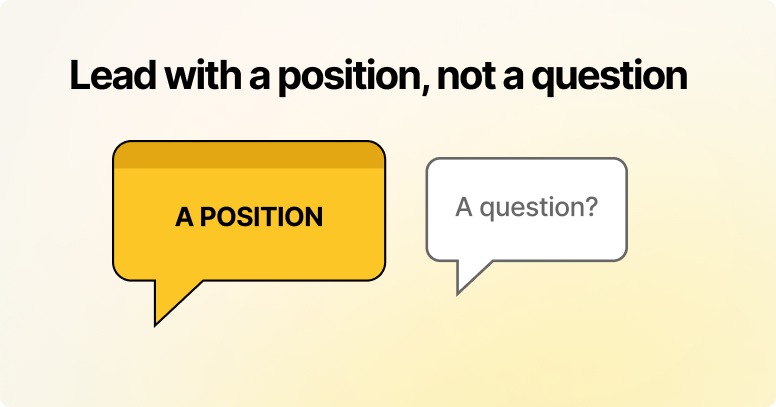
Asking “what are your thoughts on AI?” hands over control, and strong agencies don’t do that. They tell the client what should be automated, what shouldn’t, and where human judgment still drives outcomes. No hedging, or vague exploration, just a clear point of view.
Because clients are not neutral anymore. A Salesforce report found that 73% of customers expect companies to understand their needs and expectations, which increasingly includes how new technologies like AI will be used to improve outcomes.
- Draw a hard line between where AI helps and where it breaks
Generic commentary doesn’t land anymore. What clients respect is specificity, where automation will improve performance, and where it will introduce risk if left unsupervised.
Here is what that risk looks like when it is real.
In February 2024, a British Columbia tribunal held Air Canada liable for inaccurate information its website chatbot gave a grieving customer about bereavement fares, ordered the airline to pay damages, and flatly rejected its argument that the chatbot was a separate entity responsible for its own answers. An unsupervised bot invented a policy, and the brand owned the consequences. The same pattern shows up in performance marketing in a quieter form: an automated bidding strategy will keep scaling spend toward “conversions” that are spam form fills if nobody checks the signal it is optimizing toward. The AI did its job. The judgment around it was missing.
That is the line worth drawing for a client. Not “AI is risky,” but “here is exactly where it earns its keep, and here is where it needs a human between it and your customer.”
That distinction matters more than most agencies realize. Gartner predicted that over 30% of generative AI projects will be abandoned after proof of concept by 2025, largely due to poor execution and unclear value.
If you can show where AI fails before the client experiences it, you position yourself as the filter, not the follower.
- Replace “we’re exploring” with “we’re already doing”
This is where most agencies quietly lose ground. If your answer sounds like you’re catching up, you’ve already ceded authority. The agencies winning this conversation show what’s already live, what it’s producing, and where it’s being applied in similar accounts.
This is exactly what our published AI use cases are for. Each one names the stack, the cost per run, and the outcome, so the conversation moves from claim to evidence. Three you can put in front of a client today:
- Competitor emails into ready Klaviyo campaigns (Klaviyo, n8n, OpenAI): live competitor email signal turned into ready-to-launch campaign drafts for under a dollar a campaign.
- Phone photos into listing-ready property images (Gemini, Google AI Studio): enhanced, de-cluttered and virtually staged at $0.039 an image, CMS-ready.
- An outbound pipeline that drafts, sends and reports itself (Apollo, n8n, HubSpot): one ICP, live pipeline visibility, zero rep hours.
When you can put a named stack and a real number on the table, “we’re exploring AI” becomes “we already run this,” and the client stops wondering whether you are the one who’s behind.
Because execution, not intent, is what clients are benchmarking now. According to PwC, AI could contribute up to $15.7 trillion to the global economy by 2030, which means clients are actively looking for partners who can translate that potential into actual performance.
In case you are looking for a detailed download on white-label digital marketing, we recommend reading ~ Everything agencies need to know about white-label digital marketing (Complete guide)
4. They reframe AI before the client does
AI isn’t removing agencies. It’s filtering them. The ones built on production and hours get squeezed, while the ones built on judgment and outcomes expand.
This shift is already visible. A Harvard Business Review analysis highlights that as automation increases, the value of human work shifts toward decision-making, creativity, and strategic judgment, rather than execution alone.
If you don’t make that distinction explicit, the client will, and the conclusion that they reach might not be to your liking.
They lead a strategy session, not a defense. The moment the tone becomes “here’s why you still need us,” positioning drops. The conversation should feel like direction, “Here’s how we’re using new capabilities to improve your outcomes.”
5. They understand that timing carries as much weight as content
Clients who hear this from you first credit you for the insight. Clients who figure it out on their own start questioning what else you’re behind on.
And they are figuring it out quickly. By the time they bring it up, they’ve already formed an opinion, and you’re working against it.
6. They anchor the conversation in something real
You don’t need to have built the capability yourself. But you do need to show that it exists, that it’s deployed, and that you understand how it maps to the client’s goals.
Here is how that looks in practice.
Take a client drowning in inbound support email. You do not open with “we could use AI for that.” You bring a specific, deployed workflow such as an AI triage system (n8n, Sheets, OpenAI) that reads every inbound message, scores it for sentiment and urgency, and surfaces only the escalations that need a human, as a dashboard rather than an inbox. Then you map it to their goal: faster response on the accounts that matter, fewer missed escalations, support hours redirected to retention. The capability is real, the cost is known, and the outcome is theirs, not a feature you are selling. That is the difference between showing a tool and anchoring a decision.
Because ultimately, clients are not buying tools, they’re buying outcomes.
That’s why Deloitte reports that organizations using AI for decision-making and operational improvement are seeing measurable gains in efficiency and performance, not just cost reduction.
And most agencies still can’t demonstrate that clearly.
Because the goal here isn’t to defend your role.
It’s to change it, from vendor to navigator.
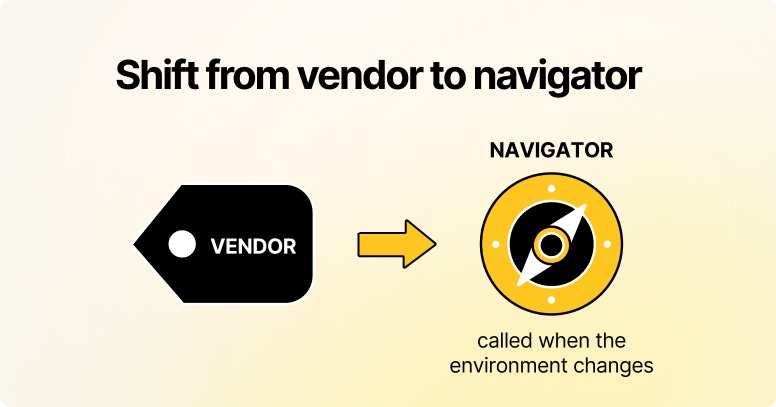
A vendor gets compared when something cheaper shows up, while a navigator gets called when the environment changes.
This conversation, done early and with clarity, is what makes that shift stick.
What happens next
The direction of travel is already set, and it is worth saying plainly so the client hears it from you and not from someone else.
- Retainers tied to manual production will come under pressure. Once a client can see that a deliverable is largely automated, they will stop paying production rates for it.
- Agencies that package strategic judgment with AI-enabled execution will gain pricing power, because they are selling a decision, not a task.
- Clients will increasingly want proof that AI is improving outcomes, not just reducing effort. “We made it faster” will not hold. “We made it faster and it moved the number that matters” will.
- The agency moat will shift from headcount to systems, data, and decision quality. Whoever owns the better workflows and the better judgment pulls ahead of whoever just owns more hands.
And honestly, none of this, rewards waiting.
The next logical steps for agencies to take
The agencies that are ahead of the game aren’t waiting; instead, they are diligently following these four steps;
- Book a proactive AI strategy conversation with your top accounts before their quarterly review, not after it.
- Map where AI actually touches each client’s funnel, specifically, so the talk is about their business and not AI in general.
- Put real, deployed use cases on the table, with named stacks and real costs, instead of theory or a POV deck.
- Reprice around judgment and outcomes, so what you charge for is the decision and the result, not the hours.
Also, no webinars or vague decks, just direct, applied conversations, backed by work they can actually show.
The closing note
Our colleague had the right relationship, the right track record, and the right instincts. What he didn't have was the conversation prepared. He walked into a room where the client had already spent six weeks forming a view, and he spent the meeting reacting to it.
The agencies that won't find themselves in that room are the ones having the conversation now, on their own terms, before the client's deck is built.
That window is open, but not for too long.
We now recommend reading ~ 10 AI bubble warning signs agency leaders must know.


.png)