


Table of contents
Get in touch
Expect response in 4 hours.
.png)
As an agency owner, you know that you don’t lose clients all at once.
There’s no dramatic fallout. No single moment you can point to and say, "That’s where it broke."
It’s a lot more subtle than that.
A delayed deliverable that needed an apology, a report that required a follow-up call to explain, or a small miss that got brushed off because “overall, things are fine.” And then, slowly, something shifts.
The client becomes harder to reassure, or takes a call they wouldn’t have taken six months ago.
By the time you feel it, the cookie has already crumbled.
Most agencies explain this away as competition, pricing pressure, or “client-side changes.”
But after working with 1000+ agencies, we’ve seen a consistent pattern emerge.
Agencies don’t lose clients because their creative isn’t good enough, and they don’t plateau because their positioning isn’t sharp enough.
According to Setup’s survey, clients end their relationships with agencies because of the following reasons in descending order;
- Dissatisfaction with delivery,
- The agency did not understand the client’s business,
- Dissatisfaction with the strategic approach,
- Dissatisfaction with value,
- Change in the client team's leadership,
- Dissatisfaction with the relationship,
- The client’s team had budget cuts,
- Change in the agency's personnel,
- The agency did not challenge them enough.
They stall because what they promise and how they deliver quietly drift apart.
And when that gap becomes visible to the client, the decision is already made.
This blog is about understanding that structural gap, where it actually comes from, why most agencies underestimate it, and how the agencies that continue to grow, quietly, consistently, have built their entire model around closing it.
Because the agencies pulling away right now aren’t better at selling.
They’re better at something far less visible and far more decisive, as they’ve turned delivery into their real product.
Why clients actually leave (it's rarely the work)
A creative director we know lost a client he’d held for four years.
Not to a bigger agency, definitely not to a cheaper one, but to a shop with a fraction of his creative reputation.
When asked why, the client was quick to point out that, “Your work is better. But working with them is easier.” Interestingly, 49% of US consumers who left a business cited feeling unappreciated as a reason.
That’s it.
No mention of strategy, critique of output, or a comparison of results.
Just the experience.
Now that sentence is the essence of the whole article.
What partnering with 1000+ agencies taught us
Across markets (the US, UK, and Australia), models, and maturity stages, one pattern shows up with uncomfortable consistency.
The agencies that grow steadily, without constant churn or dependence on spikes in new business, are rarely the ones you’d expect from the outside.
They're rarely the most awarded or the most sharply positioned. They're the most structurally sound.
They figured out something most agencies delay, which is that delivery is the product. Everything else is the story woven around it.
Most agencies invert this.
They invest heavily in how they are perceived and assume delivery will catch up.
It rarely does.
Instead, what forms is a gap between what is promised and what is consistently experienced.
That gap is where growth stalls and the cracks become evident. And it is almost entirely structural.
What clients actually remember
Clients do not remember the fancy campaign or the breathtakingly beautiful strategy presentation that everyone agreed was stellar.
They remember the texture of the day-to-day engagement.
Simple yet important things like whether calls got returned quickly. Whether reporting made sense without needing to be explained. Whether the agency flagged a problem before the client noticed it, and whether deliverables arrived when promised or came with an apologetic email and a revised timeline.
This is what positioning actually means to a client. Not the words on the website, but the experience of the working relationship compounded over months.
These are not small details.
This is the product.
Because from the client’s side, there is no separation between your strategy and your delivery system.
Both are experienced cumulatively.
And over time, that experience forms a very simple conclusion, “Is this easy to continue?”
If the answer is consistently yes, you grow.
If it becomes even slightly uncertain, the relationship starts to weaken long before it ends.
In simple terms, the agencies whose positioning holds up under that scrutiny are not always the ones with the best creative.
They are often the ones where a clear brief produces a predictable output on a predictable timeline.
Where client confidence is built not through occasional brilliance but through consistent delivery that never makes the client feel like they have to chase, check, or worry.
That is not a creative capability, but a clear reflection of infrastructure capability.
The delivery gap most agencies won’t admit
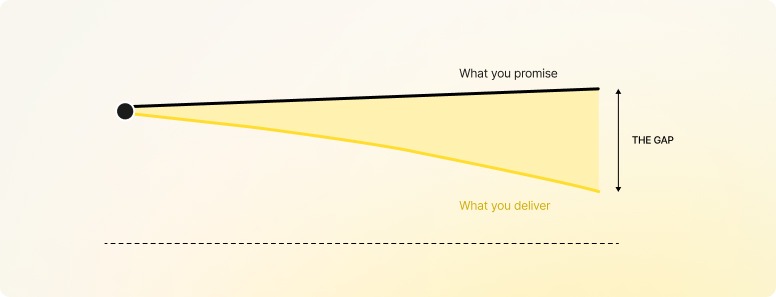
Now, most agencies have a solid positioning system in place, but very few have a delivery system that can withstand scale.
The words are pretty flowery and confident-sounding, such as full-service, performance-driven, and strategically led.
The delivery, for many agencies, is held together by stretched hires, contractors with no redundancy behind them, and the hope that nothing breaks at the wrong time.
When it does break, the client generally does not make a scene. They start taking calls they would not have taken six months earlier. And by the time the agency notices the temperature has changed, the decision is usually already made.
Building genuine delivery depth across every discipline an agency wants to position around credibly requires either significant hiring, which destroys margin, or access to specialist capability that does not sit on the permanent payroll.
This is the gap white-label infrastructure closes. When delivery is backed by real specialist depth, this is what tends to happen;
- Full service stops being a claim and becomes a reality.
- Speed stops being a personality trait and becomes a function of the system.
- Consistency stops being aspirational and becomes what the client experiences every week.
- Specialist capability in AI, performance, SEO, or development does not require a new hire. It requires access to the right partner.
What agencies that don't churn do differently
The agencies growing fastest at Mavlers made one call early that most others kept putting off. They treated delivery as the product, not the back office.
That decision matters more every year. The digital marketing outsourcing market hit $25.4 billion in 2024 and is on track to reach $74.76 billion by 2034, an 11.4% compound annual growth rate. More budget is moving to outside teams, which means more agencies are chasing it. In a market tripling in size, the thing that separates the winners is not who pitches best. It is who delivers without the wheels coming off.
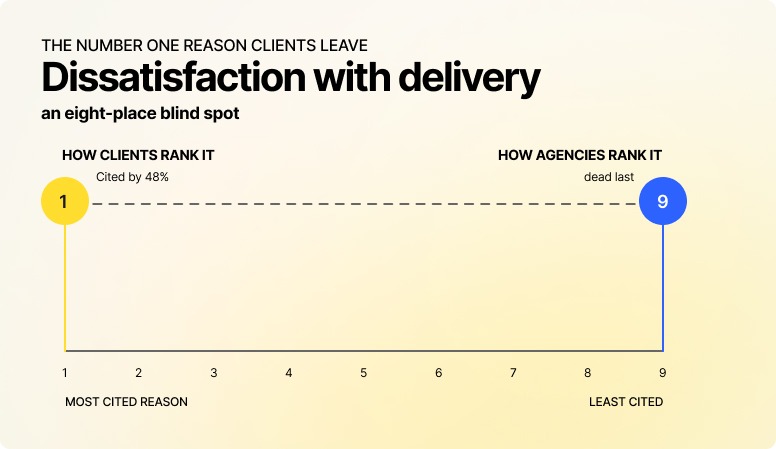
Most agencies miss where the risk actually sits. Setup's 2024 survey puts dissatisfaction with delivery as the number one reason clients leave, cited by 48% of them, up 14 points in a single year. The same agencies rank that reason ninth. They blame budget cuts and leadership changes instead. But the clients walking out are rarely leaving over money. The 4A's and ANA found 90% of clients weigh value and long-term ROI over cost when they pick an agency. They leave because the work slipped.
So the agencies that hold on, fix delivery before it breaks. They pull out single points of failure. They build enough depth that no account hangs on one person being available or one handoff landing clean.
Here is what that looks like in practice. On the Ogilvy Social.Lab engagement, Mavlers scaled the embedded team from one specialist to twenty in under four months, with a standby buffer that absorbed attrition, and cut costs by roughly 35% versus in-house hiring.
The client did not get a sharper pitch. They got a delivery model that could absorb more work without stalling, so the retainer grew instead of going out for review.
The payoff is quiet. Clients stay longer. Retainers expand because the account can take on more, not because someone keeps re-selling it.
Churn drops without a retention playbook, because nothing is quietly pushing the client toward the door. None of this comes from being dramatically better. It comes from being reliable when most agencies are not.
Closing thoughts
Most agencies are still competing on how compelling their pitches sound.
While the ones growing are competing on something far less visible and far harder to replicate.
How easy they are to work with once the work begins.
That’s not branding, nor storytelling; that’s operational design.
And right now, it’s the clearest line between agencies that grow and agencies that stall.
In case you’d like to delve deeper into the intricacies of white-label digital marketing, we have the perfect read for you ~ Everything agencies need to know about white-label digital marketing (Complete guide).


.png)
.png)