


Table of contents
Get in touch
Expect response in 4 hours.

For years, agencies had the luxury of being slow, and nobody questioned it.
A content brief took three days. A campaign strategy stretched across a week. Reporting delays, internal back-and-forth, and last-minute fixes were all just "part of the process." It worked because there was no benchmark for speed, clarity, or efficiency. Clients had nothing to compare you to.
That benchmark now exists. A client can generate a content brief in under a minute, build a keyword strategy in minutes, and automate reporting before your team has scheduled the review call.
Generative AI is no longer fringe; by 2026, roughly 87% of marketers report using it in at least one workflow, up from about half just two years earlier.
So the narrative quietly shifted from "How do we improve execution?" to something far more uncomfortable: "What exactly were we doing all this time?"
That's where most agency execution problems are being exposed. Not created, but exposed. The agencies stuck in a loop aren't short on strategy.
They're stuck because they never made the structural decisions that execution actually depends on.
Debunking the comfortable lie that keeps agencies stuck
There's a popular story in agency circles right now, and it goes like this: AI is making founders lazy.
They're generating strategies instead of executing them. What agencies need is more accountability, courage, and willingness to act on what they already know.
It's a clean narrative. It keeps the problem personal and the solution motivational, which is to just try harder, care more, push through.
The problem is that it points you in exactly the wrong direction.
The constraint in most agencies isn't willpower. It's architecture. When you accept the "lazy founder" diagnosis, you start fixing the wrong thing, and that is auditing your mindset, your discipline, your effort, while the real issue remains untouched, which is how the business is built.
And a wrong diagnosis doesn't just waste time. It deepens the problem, because the structural cracks keep compounding while everyone's busy looking inward.
This isn't a motivation gap. It's a design gap. As agency advisor David C. Baker,r who has worked with more than 1,000 firms, puts it, the single thing he'd change across the industry is getting owners to "run their businesses better": the unglamorous fundamentals of people, process, structure, and pricing. None of that is about trying harder. It's about building differently.
The execution problem in most agencies didn't start with AI. AI just turned the lights on.
Lifting the curtains on what AI actually exposed
The real disruption of AI in agency operations isn't speed, it's visibility.
When timelines collapse, inefficiencies become obvious. When outputs are instant, delays become questionable. And when clients can see what's possible, they start evaluating what they're actually paying for.
So the honest question isn't about founder psychology. It's this: What was your agency doing with the six days a brief used to take?
For many agencies, the answer wasn't strategy or craftsmanship. It was managing the complexity their own structure created, such as chasing briefs between people, waiting on approvals, and reworking deliverables that were never properly scoped.
The pace was slow, not because the work was hard, but because the system was inefficient, and nobody had ever been forced to confront it.
That's where most agency workflow problems live: not in the work itself, but in everything surrounding it. The old model was built for a world where clients couldn't see the gap. That world is long gone.
AI didn't create that inefficiency. It exposed it quite clearly, quickly, and in a way clients can now measure, compare, and act on. That's what most AI agency challenges are really about: not adoption, but exposure.
The hidden metric: execution debt
What agencies are dealing with right now isn't disruption. It's accumulated execution debt.
Execution debt builds slowly and quietly. It accrues every time you say yes to work you don't fully control, every time delivery depends on a single high-performing individual, every time the scope is flexible but the price is fixed, and every time a process exists in someone's head rather than in a system.
None of those decisions feels critical in isolation. But they stack up to friction, dependency, and instability until they become full-blown agency scalability issues.
For years, that debt was invisible, so it was manageable. Clients couldn't see it, so it didn't cost you deals. Well, now they can. The interest came due the moment execution became measurable.
Shedding light on the three structural decisions that unstick agencies
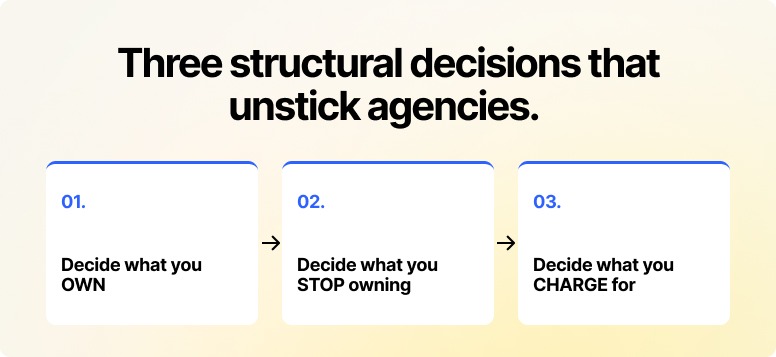
Stuck agencies aren't short on intent or awareness. They're missing three structural decisions that no amount of effort can replace.
1. Decide what you actually own
Begin by being honest about what you can deliver repeatedly and profitably without escalation and without the founder stepping in at midnight. Not what's listed on your website, but what you genuinely own.
Most agencies have never drawn this line. They operate in a reactive mode, selling first and figuring it out later. That worked when execution was opaque. It doesn't work now that AI has made output faster, cheaper, and directly comparable. If you don't truly own the outcome, you're competing against something that does.
2. Decide what you will stop owning
This is where most agencies freeze, because it feels like surrendering control. In reality, it's removing risk.
Every service propped up by a stretched hire, a freelancer who isn't embedded, or a founder firefighting after hours isn't proof of capability; it's exposure. And exposure is what breaks execution at scale. This is the root of most agency workflow problems: not a lack of talent, but fragmented ownership.
The market has already voted on the fix. Roughly three-quarters of agencies now use white-label or outsourced delivery in some form, and agencies that outsource a meaningful share of delivery have been found to grow markedly faster than those that keep everything in-house.
The point isn't to hand off responsibility, it's to extend capacity. As one operations breakdown puts it, the safest things to externalize are services with clear inputs, clear outputs, and workable QA.
The honest audit of what should move to a structured delivery layer is the conversation most leaders avoid and the one that makes everything else executable.
3. Decide what you are actually charging for
This is where the model either evolves or breaks.
If your pricing is anchored to time, output, or volume, AI is already undercutting you, quietly but consistently. When a task that took five hours now takes one, hourly billing loses its logic. Clients aren't paying for effort anymore; they're evaluating outcomes.
The only durable position is to charge for judgment, direction, and accountability. The agencies that make the shift see it in the numbers: one design firm that moved to value-based pricing alongside a tighter focus reported profit margins climbing from 11% to 20% and average project value rising 65%.
Most agencies, though, are still pricing like execution shops while hoping to be seen as strategic partners. That gap is exactly where margins collapse.
Execution debt is a structural problem that must be treated structurally
Most agency leaders already know what they should do, which is to raise prices, niche down, fix delivery, and stop saying yes to the wrong clients.
But knowing was never the bottleneck. Structure is.
The current system actively resists those decisions, as you can't raise prices if your delivery is inconsistent. You can't niche down if your overhead depends on volume.
And you can't fix delivery if it rests on two individuals.
Yet that's exactly where most agencies sit. It's also why AI adoption in agencies feels harder than expected, as you're layering AI onto systems that were never designed to scale execution in the first place. The structural decisions come first, and everything else follows.
What winning agencies are doing differently
The agencies pulling ahead aren't doing more. Instead, they're doing less, with more precision, and they've made structural moves that the stuck ones keep postponing. A few patterns show up consistently.
1. They productize their expertise
Instead of bespoke scoping for every client, they package repeatable offers with defined deliverables, fixed scope, and clear pricing. Productized services let an agency take on more clients without a proportional increase in cost, which is why they've gained traction precisely as market volatility has become the number-one obstacle for over half of digital agencies. Standardization here isn't mediocrity; it's the removal of avoidable inefficiency.
2. They standardize delivery instead of relying on individuals
Winning agencies turn "how Sara does it" into a documented workflow anyone trained can run. That's what removes the single points of failure that quietly cap growth, and it's the difference between an agency that can scale and one that can only stay busy.
3. They convert fixed delivery into flexible capacity
Rather than hiring ahead of demand and praying utilization holds, they lean on white-label and specialized execution layers to flex up and down. It reduces dependency, improves quality, and lets them say yes to the right clients without burning out the team, which is a real concern when junior production roles are already contracting due to AI.
Following decision #3 above, they price for the result and the judgment behind it. That reframes the relationship from vendor to partner and protects margin from the commoditization AI accelerates.
Notice what unites these moves: none of them is about working harder. Execution improves when the system changes, not when effort increases. White-label infrastructure and externalized delivery layers matter here not as a cost play, but as an execution play, as they reduce dependency, improve consistency, enable confident pricing, and let you be selective about who you take on.
That's what actually resolves agency scalability issues. Not hiring more or pushing harder, but designing a system that can deliver.
What happens if nothing changes
One needs to be clear-eyed about the trajectory. If execution stays broken, this is what stands to happen:
- Margins shrink as AI compresses perceived value.
- Timelines get harder to justify to clients who know better.
- Pricing models come under open question.
- Teams burn out compensating for system gaps.
- Growth stalls because delivery can't keep pace.
This is how agencies plateau, not because demand disappears, but because execution becomes the bottleneck.
The agencies that will still matter
AI isn't the enemy of good agencies. It's the enemy of the stories agencies told themselves; that slow delivery meant thorough work, that high headcount meant capability, that complex workflows meant sophistication, that long-tenured-but-flat clients meant success.
Those stories survived in a low-visibility world, but they don't survive in one where outputs are instant, and clients evaluate not just what you deliver, but how efficiently you deliver it.
So the real question was never "How do we use AI better?" It's; "What in our structure makes execution inconsistent and why does it still exist?"
AI didn't break your agency. It highlighted the inefficiencies your agency was built to tolerate. Answer that question honestly, and the path forward becomes obvious.
On that note, you might want to explore ~ 10 AI bubble warning signs agency leaders must know.
The final word
As AI unveils the hidden execution problems in your agency, it does something far more valuable than disruption; it gives you clarity.
What you do with that clarity will determine whether your agency scales or stalls, held back by a system never designed to execute in the first place.

.png)
.png)
.png)