




Table of contents
Get in touch
Expect response in 4 hours.
.png)
As a paid search professional, you know that one creative that every account has, and its journey ends the same way.
And you don’t need to defend it as the numbers do that for you.
CTR holds above benchmark
CPA stabilizes
Conversion volume is predictable
And before you know it, it quietly becomes the backbone of the account.
You scale it, protect it, and then stop questioning it.
And then, one day, it starts slipping.
There are no structural changes to place the blame on, no obvious trigger, and definitely no clear explanation in sight.
All you get to witness is a slow and uncomfortable erosion.
Most teams hit the wrong nerve at this point: they go hunting for the truant bolt in the machinery, when in reality, nothing is actually broken.
You just held on longer than the creative was designed to last.
Below are 10 reasons your “winning creative” has stopped working, some you’ve probably suspected, and some that have only become true since Google Marketing Live 2026 reset the rules of the game.
On that note, let’s hit the gas!
1. You called it a “winner,” and that was your first mistake
There is no such thing as a winning creative in isolation. There are only creatives that are perfectly timed, contextually aligned, and temporarily differentiated.
The industry calls it a “winner” because it simplifies reporting. Operators know better.
A creative works because, at that moment:
~ The audience hasn’t seen it before
~ The message answers a live question
~ The platform is finding the right pockets of demand
~ Competitors haven’t caught up yet
Remove any one of those, and performance starts leaking. The myth of the “winning creative” is dangerous because it makes you optimize for preservation rather than replacement.
2. Familiarity killed your CTR long before frequency did
Most teams wait for frequency to spike before flagging fatigue. By then, you’re already late.
Creative decay starts earlier, with recognition. The moment a user can identify your ad instantly, they stop processing it. Not because they’re annoyed, but because there’s nothing new to extract.
Nielsen research consistently shows that creative quality especially distinct, engaging storytelling is the primary driver of attention, recall, and in-market performance. Novelty drives attention, and once novelty fades, effectiveness follows.
This is the real ad fatigue problem: not overexposure, but predictability.
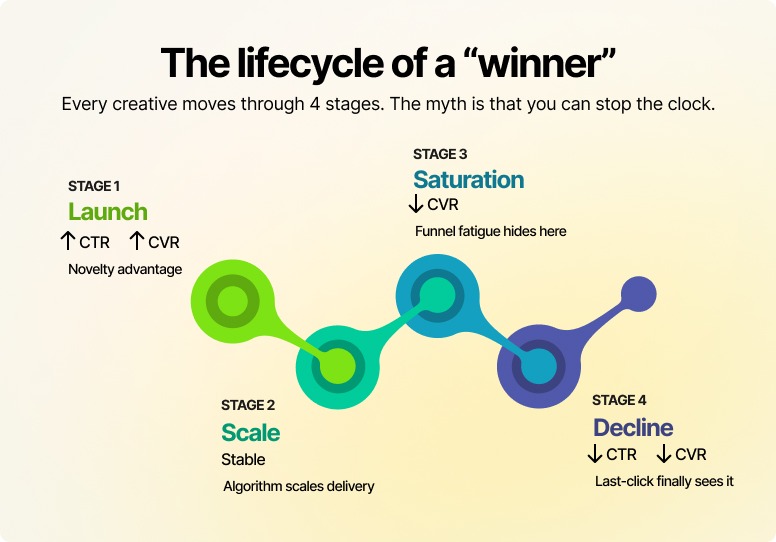
3. The algorithm quietly changed your creative’s job
In the early phase, your ad finds high-intent users, conversions are efficient, and CPA looks strong.
Later, those users are exhausted. Delivery expands outward. Intent drops.
Interestingly, the creative stayed unaltered, the same cannot be said about the audience it’s now being shown to. Performance weakens, not because the creative has degraded, but because its role changed without your input.
You’re running the same ad. The algorithm is running a different campaign.
4. Your audience already learned what you were trying to teach
Users don’t stay static. They keep moving and evolving.
The first time they see your message, it answers a question. The second time, it reinforces. The third time, it adds nothing new. After that, your message stops progressing the decision.
That’s where most teams hit the wall and start asking, “Why did our ads stop working?”
They’re not working because they’re no longer advancing anything. Even if demand still exists, the message no longer moves the buyer forward. Performance drops not from boredom, but from informational redundancy.
5. Competitors absorbed your angle until it became invisible
You find an angle that works. Competitors replicate it. Offers start blending. Visual patterns repeat.
If your ad isn’t distinctive, it’s invisible, and invisible ads don’t convert. Kantar’s data makes that painfully clear.
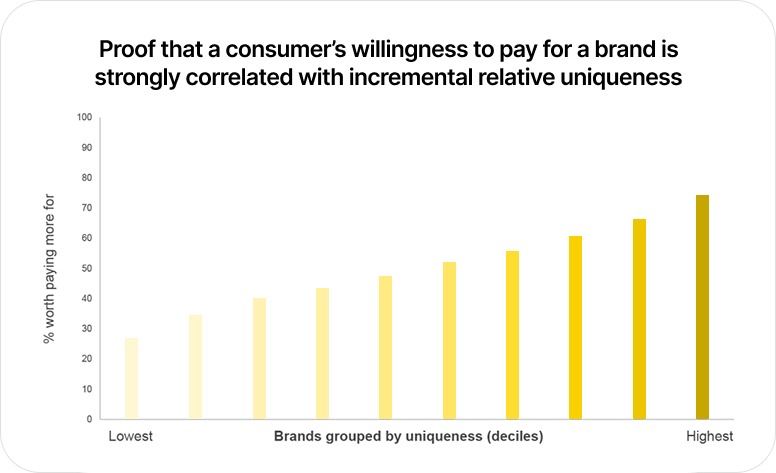
While your creative hasn’t changed, the environment around it has.
What once felt distinctive becomes table stakes, and ads that rely on contrast suffer most when contrast disappears.
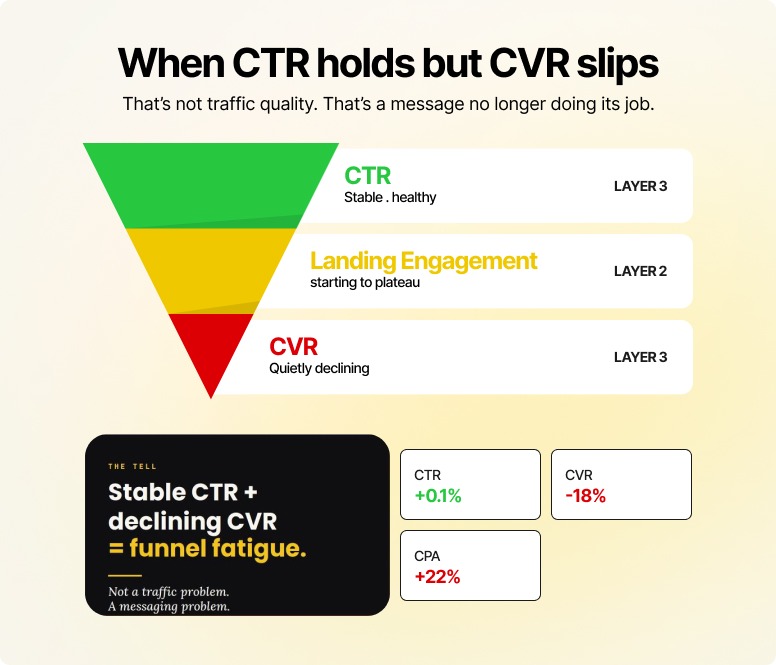
6. Funnel fatigue is hiding behind a stable CTR
This is where most performance decay actually hides and where most dashboards miss it.
Your creative communicates one layer of value. Once that layer is absorbed, repeating it doesn’t move the user forward. What you see is a stable CTR and a quietly declining CVR.
That’s not traffic quality. That’s messaging stagnation.
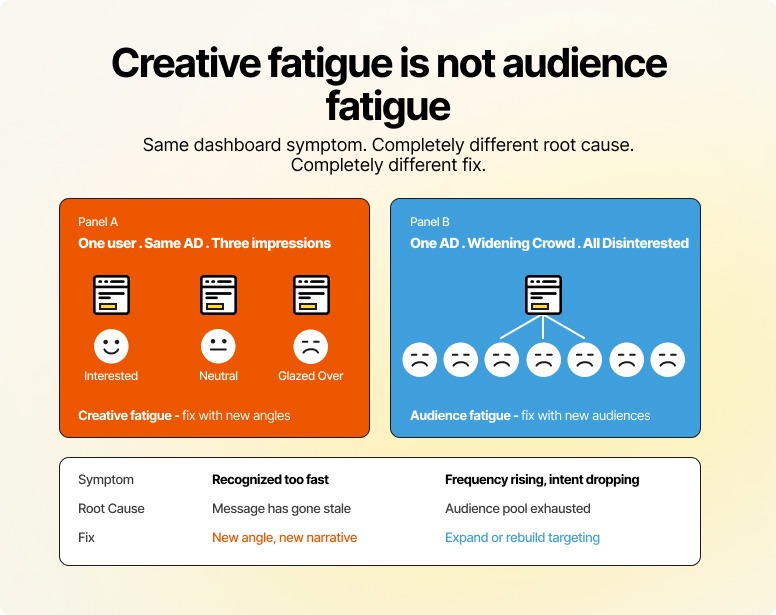
7. You’re treating creative fatigue and audience fatigue as the same problem
Most teams blur this line. Top-performing teams don’t. Here’s the mistake you must avoid:
Refreshing creatives when the audience is saturated.
Expanding audiences when the message is stale. Both feel like action. Neither fixes the problem.
Understanding the difference is what separates reactive accounts from controlled ones and is where most budgets are quietly won or lost.
8. You’re forcing one ad to do five different jobs
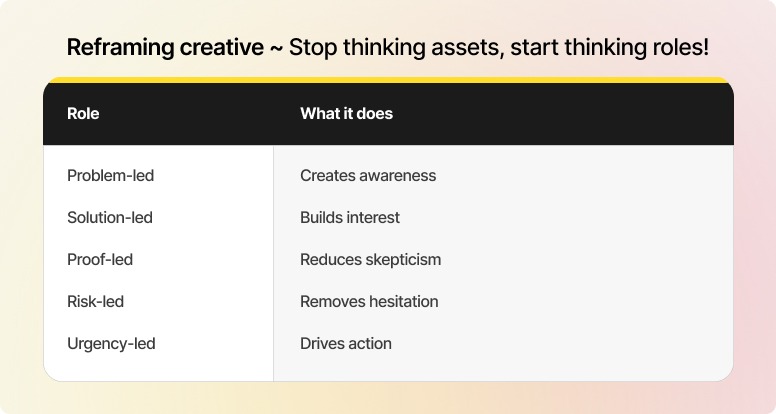
Here’s the shift high-performing accounts have already made: they don’t optimize creatives. They design creative systems, where each creative has a job.

Most accounts have one creative trying to be all five: awareness, interest, proof, reassurance, and urgency, stretched across the funnel until it snaps.
When one creative is forced to do all of this indefinitely, it fails. Not eventually, albeit inevitably.
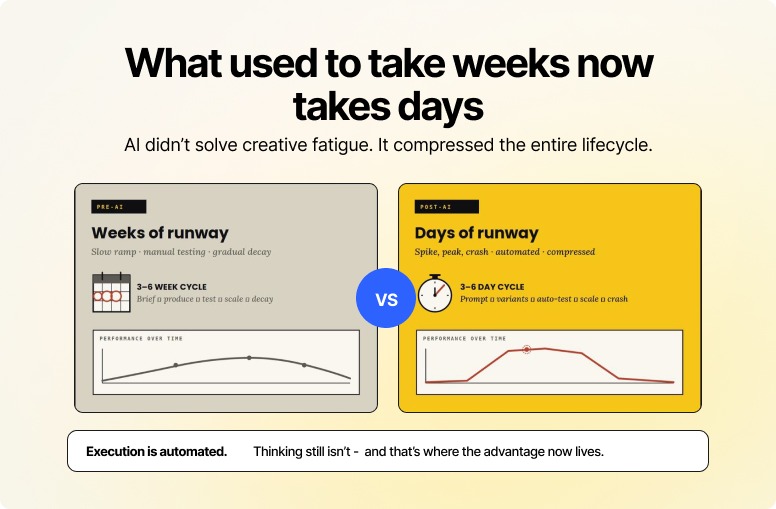
9. AI is burning your creatives in days, not weeks, and GML 2026 just shrank that window again
AI hasn’t solved creative fatigue. It accelerated it. And at Google Marketing Live 2026 (May 20, 2026), Google made that compression explicit.
Here’s what changed at GML 2026
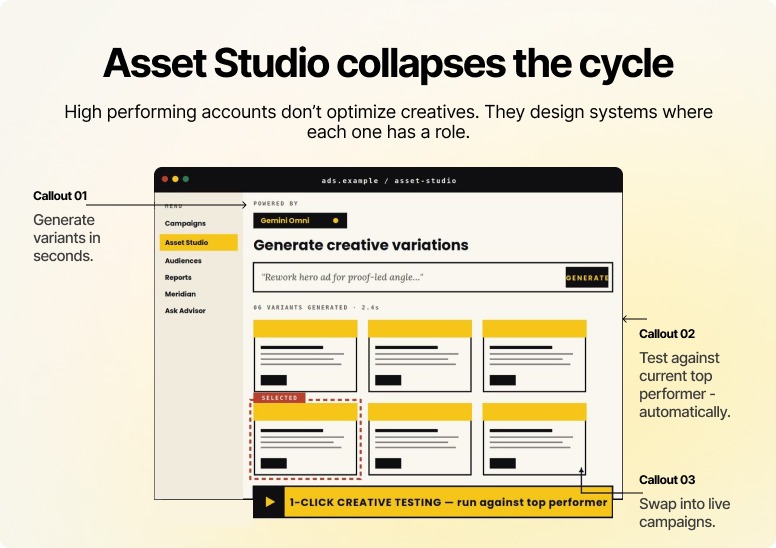
Asset Studio is now powered by Gemini, Veo, and Nano Banana, with Gemini Omni rolling in this summer. Google can generate creative variations across Search, Display, YouTube, and Shopping directly inside the campaign workflow.
More consequentially, Google introduced 1-Click Creative Testing, which automatically runs new assets against your current top performers. The structural shift is that creative production is now wired directly to live campaign execution; the gap between making an ad and deploying it has collapsed.
Google’s own framing was that creative drives nearly half of all incremental ad sales. That’s the rationale. The consequence for you is unavoidable:
Here’s what this means for your account;
~ Faster scale leads to faster decay. Platforms identify and scale high-performing creatives almost instantly. Faster reach, faster saturation, shorter lifespan. What used to last weeks now burns out in days.
~ Stability is now an illusion. AI can temporarily sustain performance by finding new audience pockets and rebalancing delivery, but when decline hits, it’s sharper, because the system has already run out of room.
Execution is automated, thinking isn’t. AI generates variations. It cannot build narrative progression, anticipate audience learning, or design message sequencing. That’s still human work. And that’s where the advantage now lives.
10. You’re diagnosing decline with last-click while buyers decide in the messy middle
By the time CPA spikes, the damage is done. The earlier signals are more subtle:
~ Conversion lag increases
~ Assisted conversions drop
~ Incremental lift weakens
~ Frequency rises without CTR collapse
By the time you’re measuring the last click, the decision is already half made. Google’s ‘Messy Middle’ research makes one thing amply clear: buyers are shaped long before they convert.
Those signals don’t show up in standard dashboards, which is why most teams miss them. GML 2026 introduced two changes worth paying attention to here:
Meridian, Google’s open-source Marketing Mix Model, is now built directly into Google Analytics 360. It lets you model the contribution of upper-funnel and assisted touches without standing up a separate MMM project.
Qualified Future Conversions (QFCs) is a new predictive reporting metric powered by Gemini that forecasts likely future conversions from current behavior, essentially a leading indicator instead of a lagging one.
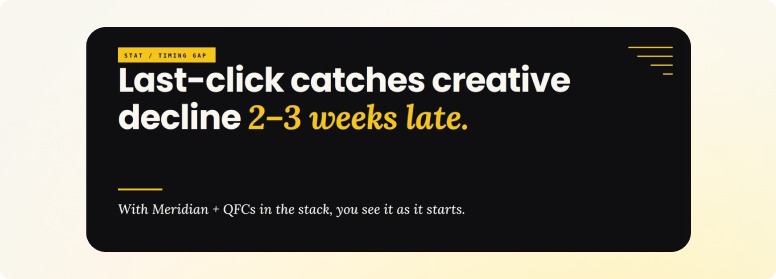
If you’re still reporting on last-click CPA alone, you’re catching creative decline two to three weeks after it actually starts. With Meridian and QFCs in the stack, the gap shrinks significantly, but only if you’re using them.
Unveiling the real risk of dependency
Declaring a “winner” creates three problems instantly:
- It becomes the benchmark
- Testing slows down
- Creative diversity collapses
And now your account depends on something designed to decay.
That’s how accounts stagnate while still “performing.”
Not because performance crashes, but because nothing new replaces what’s fading.
Reframing role-based creatives
Now, this is where you see the shift occur.
High-performing accounts don’t optimize creatives.
They design creative systems, where each creative has a job.
When one creative is forced to do all of this indefinitely, it fails.
Not eventually, but inevitably.
How AI is changing the game (and compressing your margin for error)
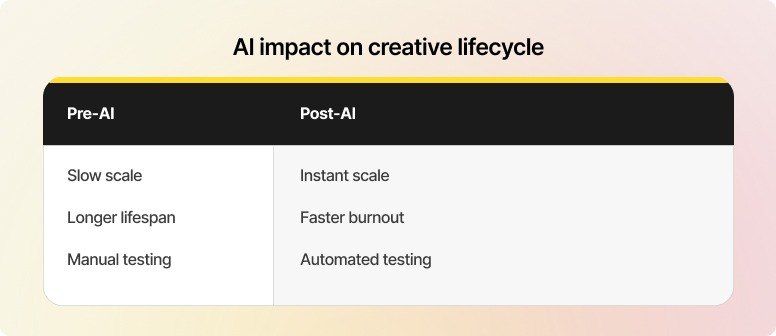
AI hasn’t solved the problem; on the contrary, it has accelerated it.
- Faster scale leads to faster decay
Platforms like Meta and Google now identify and scale high-performing creatives almost instantly.
Which ultimately translates to faster reach, faster saturation, and shorter lifespan.
What used to last weeks now burns out in days.
- Stability is now an illusion
AI can temporarily sustain performance by finding new audience pockets and rebalancing delivery
But when decline hits, it’s sharper because the system ran out of room.
- Execution is automated, thinking isn’t
AI can generate variations.
However, it cannot build narrative progression, anticipate audience learning, or design message sequencing.
That’s still human work.
And that’s where the advantage now lives.
What actually works instead of chasing “winners”
You don’t need better creatives.
You need creative continuity.
That means;
~ Rotating angles, not just visuals
~ Progressing messages, not repeating them
~ Planning decay, not reacting to it
The goal is not to find something that works but to ensure something always works next.
How to build a sustainable creative system
This is what stable accounts do differently:
1. They build pipelines, not campaigns
There is always something testing, scaling, or phasing out.
2. They design for progression
Each creative builds on the last, not duplicates it.
3. They accept short-term inefficiency
Because long-term stability is more important than short-term spikes.
4. They detach from “winners” early
If you’re emotionally attached to a creative, you’re already late.
How to fix declining ad performance (without guessing)
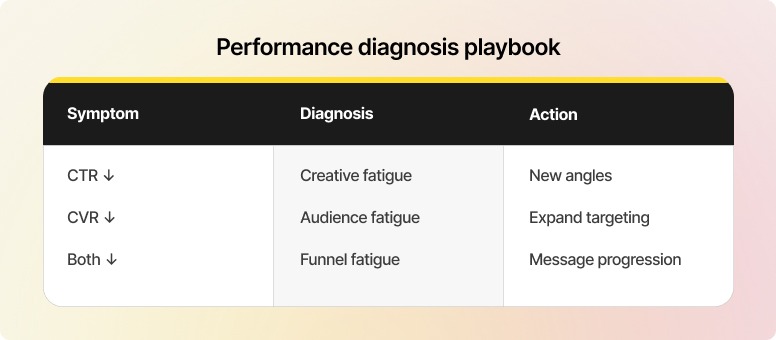
When ads stop performing, instead of panicking, proceed to diagnose the issue.
Here’s how;
Step 1: Identify the failure layer
A dip in CTR indicates creative fatigue, while a drop in CVR shows audience/funnel fatigue.
Step 2: Change the message, not just the format
New colors won’t fix a tired narrative.
New thinking will.
Step 3: Introduce progression
If your current ad says, “Here’s the solution.”
Next ads should say, “Here’s proof”, “Here’s why it works for you”, “Here’s why now”.
Step 4: Replace before collapse
You don’t wait for failure; instead, you phase out proactively.
In summary
To sum up, there is no such thing as a permanently winning creative.
There are only creatives that are temporarily aligned, contextually effective, and structurally limited.
So when performance drops “for no reason,” don’t look for a fix; instead, look for a replacement.
Because your creative didn’t fail, it finished its job.
And the only mistake you made was expecting it to keep doing it forever.


.png)