




Table of contents
Get in touch
Expect response in 4 hours.
.png)
A Mavlers point of view.
If you watched Google Marketing Live and walked away thinking about new features, you missed the point.
The whole keynote was Google quietly telling marketing teams that the work they bill for is being absorbed into the platform. Yes, you read that right - ABSORBED. Keyword research, ad copy variants, asset production, manual campaign builds, dashboard reporting, media planning - all of it is moving inside Google's stack.
That line, said by a Google leader from a Google stage, is the whole keynote. The rest is just unpacking it.
Mavlers Agency prediction:
Within 18 months, the median digital marketing retainer will look fundamentally different from the one signed in 2024. Half the line items on a 2024 SOW will be gone, replaced by strategy, brief writing, measurement architecture, and the specialist work the platform still can't do. The agencies and in-house teams that don't restructure around that reality will lose budget to ones that do.
We're saying this from 12 years of operating across 7,000+ brand engagements and more than 10,000 campaigns. We've lived through three platform shifts of similar magnitude (the move away from manual keyword bidding, the rollout of Performance Max in 2021, the GA4 migration). The pattern is always the same. There's a 12-month window where the early movers compound, and a long tail of teams pretending nothing changed until it's too late to catch up.
This time the window opens now.
1. PPC: Keywords are over
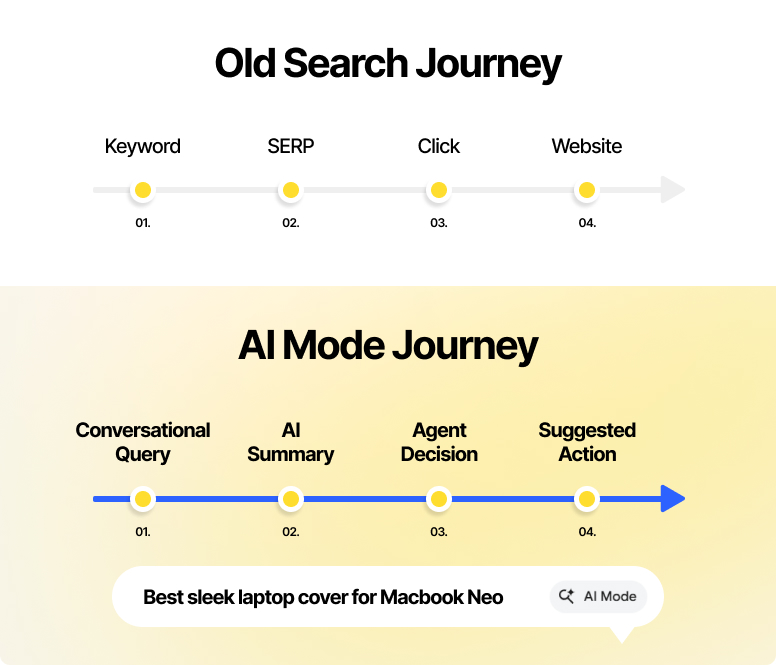
Three different Google speakers said it: you can't think in keywords anymore. AI Max for Search is out of beta, globally available, and the new ad formats they previewed (conversational ad units inside AI Mode, Direct Offers, agentic lead-gen formats for education, automotive, real estate) are exclusive to AI Max and PMax. That's not a soft launch. That's a mandate.
Queries in AI Mode are 3x longer than traditional searches. Brainstorming-style queries are growing 30% faster than the AI Mode average. No human is keyword-matching a query like "I'm looking for a walking pad for my home office, I love hiking, I want it reliable and quiet, what are the best options for me?"
But here's what gets lost in the highlight reel:
AI Brief is Google quietly admitting they took too much control away.
Vidya called it "the control you've been asking for": a conversational way to give the system brand voice, audience guardrails, and creative guidelines. Translation: enough advertisers complained loudly about AI Max being a black box that Google had to build a control panel back in.
What this means in practice:
- For brands, time your team used to spend on keyword research and campaign hygiene is now spent writing AI Briefs. That's a different skill. It's closer to writing a creative brief for an agency than configuring a campaign in Google Ads.
- For agencies, this is the moment to stop billing for execution hygiene and start billing for the brief. If your retainer is structured around campaign builds and keyword expansions, you're billing for something the platform now does for free.
- For everyone, reporting changes shape. Campaign Type Attribution and Qualified Future Conversions (QFC: Google's projection of conversion value up to six months out) mean your quarterly report looks fundamentally different. Crew Clothing nearly cut a YouTube campaign that looked flat over 30 days, then saw 70% long-term lift through QFC. That's going to be the standard CFO conversation. Whoever can have it credibly wins the budget fight.
One caveat nobody on stage will say: QFC is a projection from Google's own model. Directionally useful. Not ground truth. Bring third-party validation (Meridian-powered MMM, TransUnion, your own incrementality testing) to anchor it.
2. SEO isn't dead, it's been quietly rewritten, and it's harder, not easier.
Vidya walked through what it takes to show up in AI Mode organic results and used the phrase "expertise and experience" deliberately. That's Google saying the quiet part loud. E-E-A-T is no longer a ranking signal among many. In AI-generated answers, it's the gatekeeper.
What survives:
- Brand-led content that AI summaries are forced to cite. Original research, first-party data, named experts, real reviews, distinctive POVs.
- Structured data, schema, and product feeds as primary SEO deliverables. Merchant Center accuracy and Google Business Profile hygiene used to be footnotes. They're now headlines.
- Content built for agent retrieval, not just for humans. Same content has to work for a reader, a ranking algorithm, and an autonomous agent pulling structured fields. Most websites are not built this way.
The agencies still selling "four blog posts a month" are about to have a very rough year. The ones selling "we'll build the content infrastructure that makes your brand the source AI cites" are going to compound.
3. Where the craft moves: up the stack.
Asset Studio with Veo, Nano Banana, Pomelli, and now Gemini Omni this summer means a small team can generate headlines, descriptions, images, video, and aspect-ratio variants in minutes. Pull assets from Canva or Adobe directly into Asset Studio. Run one-click A/B experiments on creative. Scale through the API for thousands of SKUs.
The same goes for web development.
Vidya's "users, systems, and agents" line was a directive. Schema markup, accessibility, semantic HTML, customer-facing feeds, agent-readable product data: these are no longer optional. If an AI agent visited your site tomorrow on a customer's behalf, could it find, understand, and transact with your products? For most sites, the honest answer is no.
The pattern across creative and web dev is identical: production at the asset level is being commoditized across the entire market at once. Whether you're a DTC founder or a Fortune 500 brand manager, you can generate ten variants of an ad in the time it used to take to brief a designer. You can spin up a landing page in hours. The bottleneck is no longer making things.
So where does differentiation move?
Up the stack. To brand voice, narrative architecture, distinctive visual systems, structured data design, accessibility-first frontend, conversion flow strategy, and the kind of judgment that decides what to say before how to say it. The agencies and in-house teams anchored on strategy and craft will be fine. The ones whose value was "we make the asset" are going to find themselves competing with a prompt.
One real caution: velocity tempts everyone to produce more, faster. That's a trap. More mediocre creative does not beat fewer pieces of distinctive creative. Use the velocity to test more, not to ship more.
4. Commerce: UCP is the announcement nobody is talking about enough.
In the middle of an event full of headline features, Google quietly mentioned that Amazon, Meta, Microsoft, Salesforce, and Stripe have all signed onto the Universal Commerce Protocol.
When Vidya said "This may just be the first time we all agree on something," she wasn't joking. That's the entire e-commerce stack agreeing on one standard for how agents talk to merchants. Companies that have never agreed on anything are now co-steering a shared protocol. This is the kind of industry consolidation that happens maybe twice a decade. The last one was OAuth.
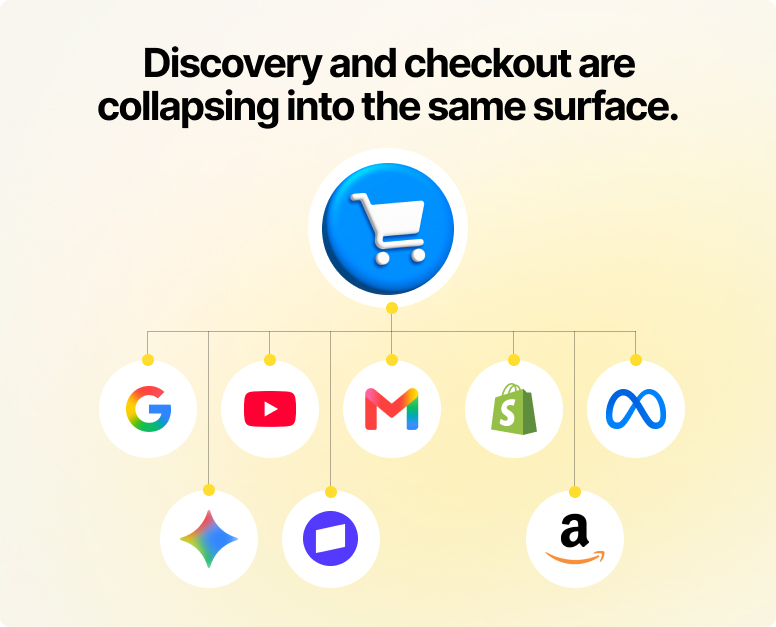
What UCP enables in practice: a Universal Cart that travels across search, YouTube, Gemini, and Gmail. Native checkout inside ads. Agent-driven food and travel booking. Discovery and transaction collapsing into the same surface.
What this means:
- For brands:
if your Merchant Center feed is incomplete, your inventory is stale, or your loyalty program isn't connected, you're about to be invisible in the highest-converting surfaces Google has ever shipped. The fuel for everything (search ads, AI Mode answers, YouTube Shoppable, Universal Cart) is the feed. Get it right. - For agencies:
the merchant feed engineer, the catalog manager, the structured data specialist. These are the new senior roles. They used to live in IT. They're now central to revenue. - For everyone:
if your site is the destination, you're building for a world being phased out. The new destination is the agent surface. Your brand needs to perform on content, pricing, reviews, and availability before the consumer ever clicks through.
In our own work building full-funnel commerce ecosystems (the kind that helped brands like Adina Eden lift revenue 30% through integrated email and paid, or Sur La Table drive 20% YoY growth on a unified email and SMS engine), one thing is consistent: the brands that win invest in the connective tissue between channels before they invest in the channels themselves. UCP is connective tissue, externalized. Treat it like infrastructure, not a feature.
5. Measurement: from rearview mirror to predictive engine.
Measurement is moving from "here's what happened" to "here's what's about to happen." Attributed Branded Searches (ABS) gives you a real-time signal that an ad created intent. QFC projects long-term value six months out. Meridian, Google's open-source MMM, is becoming the unified command center for cross-channel measurement.
These tools are powerful, directionally trustworthy, and they're also Google's projections about Google's surfaces. That doesn't make them wrong. It makes them one input. Teams that use ABS and QFC alongside their own incrementality testing, alongside third-party MMM, alongside actual sales data, will pull ahead. Teams that treat Google's forward-looking metrics as ground truth will over-invest in channels that look great on Google's dashboards and merely fine in reality.
Two things every marketing team should do this quarter:
- Get the data plumbing right. Google Tag Gateway, Data Manager API, offline conversion uploads, CRM integration. Unglamorous. Compounding.
- Stop arguing about attribution and start running incrementality tests. Always-on causal measurement is the only honest answer to "did the ad actually drive that?" Everything else is a story.
Here's what we don't believe.
A POV is credible because it picks both winners and losers. Three places where we disagree with the Google narrative:
1. AI Brief will not meaningfully restore advertiser control.
It's a UI patch on a deeper loss of agency. Brands trying to use it to recreate 2023 workflows will be frustrated within two quarters. The right mental model isn't "give AI Brief your old playbook." It's "rebuild the playbook for an environment where Google makes the matching call and you make the strategic call." Those are not the same job.
2. Ask YouTube won't replace YouTube search the way AI Mode is replacing Google Search.
People come to Google to find. They come to YouTube to watch. The intent is different. Ask YouTube will be useful for product research within the platform, but the structural shift won't be nearly as steep as Google is signaling. Don't restructure your video strategy assuming it will.
3. Most advertisers will misuse Qualified Future Conversions in its first year.
The temptation to defend any underperforming campaign with "but look at the projected QFC lift" will be irresistible. The Crew Clothing case study is real and it's important. It's also the best-case use, not the median use. Treat QFC the way you'd treat any forward-looking model from a vendor with skin in the game: useful, directional, never decisive on its own.
We could be wrong on all three. We'd rather take the position and find out.
What we'd do tomorrow
If you're a brand:
- Audit your Merchant Center feed this week. In our experience auditing brand-side commerce setups, the majority have structural feed gaps silently capping reach. Fix this before you optimize anything else.
- Re-scope your agency relationships. If you're paying a retainer for campaign hygiene, you're overpaying. If you're paying for strategic counsel, brand stewardship, measurement architecture, and specialist depth, you're underpaying. Most retainers were structured for the old world. Fix that.
- Stop treating your tech stack (Merchant Center, GA4, Google Tag Gateway, schema, feeds) as back office. It is the front line of your visibility.
If you're an agency:
- The "we handle execution" pitch is dying. The "we are your strategic partner with the specialist depth to operate the new stack" pitch is the one that wins.
- Specialists are more valuable, not less. Merchant feed engineers, schema strategists, CRM data architects, MMM analysts, AI Brief writers: these are the senior hires that decide who survives the next two years.
- Hours-for-execution as a billing model doesn't make sense when the platform does the execution. Outcome-based pricing, retainers anchored on strategy and measurement, and clearly-priced specialist pods are where the market is moving.
The Mavlers position
We sit on both sides of this table. We work white-label with marketing agencies who need specialist depth they can't keep on payroll, and we work directly with brands who need an execution partner that doesn't waste their time. We've built full-funnel systems for hundreds of brands, run paid media for thousands of campaigns, and rebuilt the underlying data stack for clients across categories.
From both vantage points, GML 2026 looks like the same shift: the floor of what's possible has risen, and the ceiling of what's required has risen faster.
The brands and agencies who will lead the market over the next two years aren't the ones with the loudest takes on AI. They're the ones quietly retooling their stack (feeds, schema, data plumbing, brief writing, brand voice) while everyone else is still reposting the keynote highlights.
That's the work. It's not glamorous. It compounds.
If your operation looks the same in October as it does today, you've already lost the next two years. Move.

.png)