


Table of contents
Get in touch
Expect response in 4 hours.

We don't run an agency. We work inside them.
For 13 years, we've been the team behind the team. The white-label delivery layer that agencies lean on when their capacity breaks, their margins compress, or their client demands something they can't staff for.
We've worked with boutique shops of five people and mid-sized agencies billing eight figures. We've watched the giants scale, the hopefuls stall, and the failures slip away behind the polite fiction of a LinkedIn "restructuring" post.
So when the conversation turns to which agencies will survive the next two years, we're not guessing. We're pattern-matching.
And the patterns are worrying.
Here's something we've noticed among agency owners we speak to:
Closing rates have dropped. Quietly, incrementally, but measurably.
Services that used to close in a single call now stall in follow-up.
Proposals go silent.
Repeat clients who once renewed without question have started asking harder questions or stopped asking altogether.
(1).png)
And the instinct many founders have - that something feels structurally different, not just cyclically slow - is right.This is why agencies are struggling unlike any they’ve survived before: This isn't a temporary market softness. It's a repricing of what agency work is worth.
Here's what we've seen from the inside.
1. They're selling time they don't have and margin they've already spent
The retainer model isn't broken. But the way most agencies run it is.
Scope that was never clearly defined.
Deliverables that kept expanding without a change order in sight.
Senior time getting absorbed by accounts that only pay for mid-level.
It sounds operational. It is. But it's also a financial leak that multiples, until a client churns and suddenly three months of revenue vanishes in a weekend.
Many digital marketing agencies operate with net margins in the 10–30% range. Best-in-class players push higher by tightly controlling delivery costs and scope. Most aren't doing that.
2. Weak positioning doesn't scream. It just makes everything a grind
We've worked with agencies who could not clearly tell us what they stood for.
Not that they lacked confidence, they had plenty of that. But they'd grown by saying yes too many times to too many things.
Generalism is one of the most common agency growth challenges we see. It's a liability when the market tightens.
Clients under pressure make sharper decisions. They consolidate. They ask harder questions about ROI. They don't cut the agency they see as essential to their category, they cut the one that does "digital, content, social, and a bit of paid."
Because that agency is interchangeable.
The agencies we see winning right now are uncomfortable to compete against because they own something specific:
- A vertical
- A channel
- A methodology
- A type of client
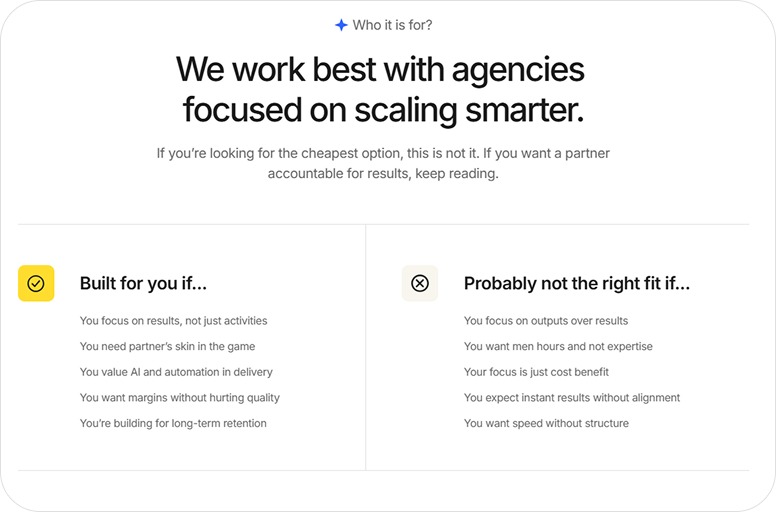
They can say "we're not the right fit for you" without flinching, because they know exactly who they are the right fit for.
That confidence doesn't come from a brand exercise.
It comes from a hard decision about declining the wrong-fit client.
3. AI is widening the gap, not just changing the game
When ChatGPT and Claude landed, most agency leaders saw automation. The math looked clean - do more with less, keep the difference.
Clients ran the same math and reached a different answer.
If they can spin up decent output in a few prompts, why are they paying for it?
Retainers are shrinking.
Deals are taking longer to close.
And expectations have gone up, not down - clients want pipeline, attribution, real revenue impact.
The real threat isn't AI replacing agencies. The deeper impact of AI on agencies is that it's making execution cheaper, and agencies are splitting into two camps.
We've seen both up close.
One camp is using AI to think more per engagement, reinvesting the time into strategy, relationships, the upstream work that's hard to commoditize.
The other is using it to quietly cut hours and deliver the same work with a thinner team, right as clients start asking why everything feels templated.
How agencies survive AI comes down to a single decision: are you using it to go deeper, or just to go faster?
4. The in-housing wave is real, but it's also an opportunity most agencies are missing
Post-2020, brands invested heavily in building internal teams. Performance, content, data, strategy, more and more of it moved in-house. Agencies felt it.
But here's what we've seen that often goes unsaid. In-house teams max out:
- They get comfortable.
- They lack the cross-industry exposure that only comes from working across dozens of clients simultaneously.
- They struggle to scale for peak periods.
And the internal politics that come with building an in-house capability are real.
Brands haven't stopped needing agency support. It's just that they need it for more strategic tasks.
(1).png)
The opportunity for agencies is to stop competing with in-house teams and start complementing them.
That means showing up as:
- A specialist resource
- A strategic challenger
- An overflow partner with serious delivery infrastructure
Not as a generalist hoping to run the whole account.
The agencies getting this right have adopted what might be called the post-AI agency model. They’re getting longer, more embedded relationships, often at better margins, because they've stopped trying to own everything and started being genuinely excellent at something specific.
Stop competing with in-house teams. Start being what they can't replace.
5. Referral-only growth is a bet on good luck holding
We're not being harsh here. Most agencies were built on referrals, and many of them built something real that way.
But referral pipelines are also the first thing that give up when the market tightens.
Clients become more conservative.
Decision-makers change.
The contact who always sent work moves on. And the pipeline that once appeared reliable feels very thin.
The agencies that weather this tend to have at least one proactive growth channel that isn't dependent on existing relationships. Not necessarily outbound at scale, sometimes it's:
- A very targeted content strategy
- A genuine partnership with a complementary service
- A position in a specific industry community that generates consistent attention
The point isn't to abandon what works.
It's to not build the entire future of the business on the assumption that what worked yesterday will keep working.
6. Culture breaks in silence, then all at once
When agency margins compress, the first casualty is often investment in the team: training, time, headspace.
That's understandable in the short term. But it intensifies.
The best people have options. When they don't feel developed, challenged, or respected, they leave. And they tend to leave at the worst possible times. Taking institutional knowledge and client relationships along with them.
We've seen agencies lose key people mid-pitch, mid-campaign, mid-transition.
It seldom ends well.
There's a dimension to this that's specific to the moment we're in. Agencies adapting to AI are giving their teams more interesting, higher-leverage work to do.
The agencies that will survive AI disruption long-term are the ones that are:
- Honest with their teams about what was happening
- Able to give people a reason to stay that wasn't just money
- Running a tight enough operation that the business didn't feel like it was falling apart
Culture isn't a values wall. It's what happens to your team when the business is under pressure.
What the agencies that come out stronger have in common
The agencies that come out of a difficult market stronger aren't necessarily the best marketers or the ones with the biggest names.
They're the ones that made hard choices before they had to.
They:
- Have clearer positioning.
- Have robust financial controls.
- Are built on a delivery model that scales without breaking.
- Run a growth engine that doesn't depend entirely on luck.
They also, and this matters more than most would admit, know what they are for and who they are for.
That clarity doesn't just help you win pitches. It helps you decide which pitches not to take, which clients not to keep, and where to actually invest your energy.
The next two years will not reward agencies that are busy.
They will reward agencies that are focused.
The question is whether you're going to make that call, or wait for the market to make it for you.

.png)