




Table of contents
Get in touch
Expect response in 4 hours.

A year ago, Google launched AI Max for Search. It became the fastest-growing AI-powered Search ads product the company had ever shipped.
On April 30, 2026, Google made its next move. AI Max is now coming to Shopping campaigns and Travel formats. Two new controls came with it: AI Brief and Text Disclaimers.
Most coverage is telling you what the update does. We are telling you what it means, and what to do about it now.
What is Google AI Max, and what changed on April 30, 2026?
AI Max is not a new campaign type. It is an AI layer you switch on inside existing campaigns. It changes how your ads match to search queries.
Standard campaigns match on keywords and rules. AI Max matches on intent. It reads what a query actually means, not just its words.
The April 30 announcement covers four updates. Each one matters on its own. Together, they are Google's clearest signal yet: keyword-based campaign structure is being replaced - systematically, across every campaign type.
The four updates are:
- AI Max for Shopping campaigns
- Search Campaigns for Travel via AI Max
- The AI Brief control interface
- Text Disclaimers for Final URL Expansion
What are Google AI Max features for Shopping campaigns?
AI Max for Shopping starts with your Merchant Center feed. Product titles, descriptions, pricing, availability, attributes - all of it goes in. The AI turns that into dynamic Shopping ads that can respond to conversational and discovery-phase queries.
Standard Shopping was built for transactional searches. It catches the searcher who already knows what they want.
It was never built for what Google calls the discovery phase. Here is how Google described it themselves:
AI Max for Shopping adds three capabilities to your existing Shopping campaigns:
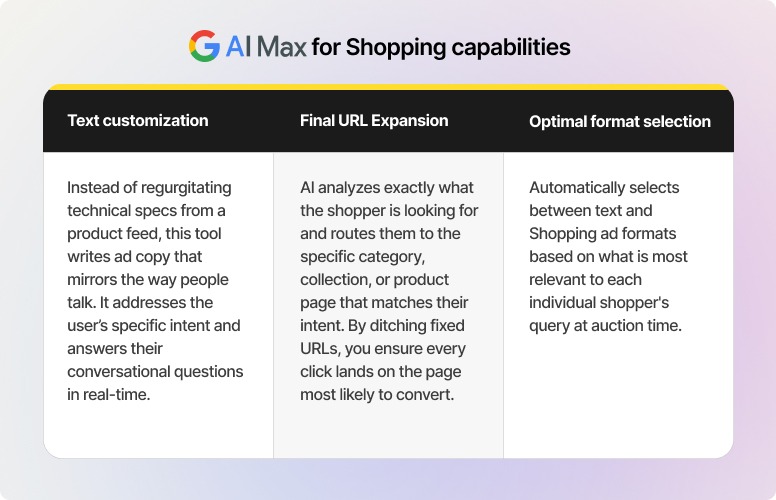
Two things to know before you opt in:
- The same conversational query-matching is coming to Performance Max campaigns. Intent-based matching is becoming the standard across all campaign types.
- You keep your existing product targeting and bidding controls. Final URL Expansion can be turned off at any time.
AI Max for Shopping is live in closed beta globally across all languages. Not seeing it yet? Speak with your Google rep and request prioritized access.
What are Search Campaigns for Travel via Google AI Max, and why should travel advertisers care?
For hotels, airlines, OTAs, tour operators, and destination brands, this is a structural overhaul. Not a feature tweak or a UI refresh. A fundamental change to how you run and measure Google advertising.
What problem does Search Campaigns for Travel actually solve?
Here is what travel advertisers have been dealing with for years.
The problems:
- For years, travel advertisers have had to manage a fragmented multi-campaign structure.
- Hotel campaigns, flight campaigns, destination-based formats, and standard Search campaigns each lived in their own interface. With separate reporting logic, bidding rules, and feed configurations.
- Managing hotel, flight, and travel formats required operating distinct campaign types. There was no unified view of how a traveler's journey across those touchpoints performed end-to-end.
Search Campaigns for Travel fixes this. It brings travel feeds and formats into standard Search campaigns. One interface. One set of bidding controls. One reporting view.
According to Google's Travel blog, the upgrade delivers three things:
- Benefit 1: A single buying door
Hotel ads, flight ads, destination formats - all in one campaign. Full feature parity. Advanced controls across every travel format in one place.
- Benefit 2: Real-time enhancements
Use your feed for text ads. Use keywords for travel formats. Both work alongside AI Max capabilities simultaneously, automated creative and dynamic landing pages included.
- Benefit 3: Unified reporting
One performance view across all travel ad formats. Search term reporting across campaign types. In one interface, so no more toggling between tools to understand what is converting.
Will travel ads now appear inside Google AI Overviews, and what does that mean?
Yes.
With AI Max, travel formats are eligible to appear inside AI Overviews and AI Mode. That is where Google generates a direct answer to a travel query on the results page itself.
A user searches "best boutique hotels in Lisbon for a long weekend." Google's AI Overview generates an answer. Your hotel ad can now appear within that answer, not below it.
That’s how travel advertising just got flipped on its head. For years, we played a rigged game of keyword scarcity. The highest bidder takes the prize. But with AI Overviews, that rulebook is officially trash.
The AI evaluates the soul of your brand - brand authority, review sentiment, feed data quality, and relevance signals. A high bid on a keyword won’t place you inside an AI Overview. Being the most relevant, most credible, best-fed result will, says Amit Roy, Team lead, Performance marketing at Mavlers.
The Mavlers take - AI Overviews for travel
If you have been optimizing purely for keyword auction dominance, that lever is weakening. The new leverage points are:
- Feed completeness - live pricing, availability, rich property, and itinerary data
- Landing page quality and relevance
- Review signals that build brand authority with Google's AI
Start auditing those before you migrate a single campaign.
How does Search Campaigns for Travel handle non-linear travel search intent?
Travel search intent is never a straight line. A user does not type "flights to Tokyo" and book on the spot.
They search "Tokyo in October worth it." Then "Tokyo 10 days itinerary budget." Then "cheap flights Tokyo October." Then "Shinjuku hotel near station."
That is four different search moments and four different intents. Under the old structure, that was four different campaigns, with no unified view of the same user.
Search Campaigns for Travel is built for this. It interprets intent across the full arc, from inspiration to booking. One campaign structure that travels with the user through the planning journey.
Watch out - the risk specific to travel advertisers
What does Final URL Expansion mean for travel landing pages?
or hotel groups, OTAs, airlines, and tour operators, this one has real teeth.
A user looking for "family-friendly all-inclusive resort Maldives under $3,000" should land on your curated family packages page. Not your homepage. Not a generic "Maldives" destination page.
That routing decision used to be made by a human. Now AI Max makes it at every auction, at scale.
Your job is to make sure the pages it routes to are worth landing on. Destination pages, room-type pages, package pages, itinerary content - they all need to be coherent, conversion-ready, and relevant to how real travelers describe what they want.
The bottom line: FUE is a traffic firehose. Pointing it to slow or generic pages hurts Quality Score and conversion rate at the same time.
What is AI Brief in Google AI Max?
AI Brief is powered by Gemini. It is a plain-English control interface. You guide AI Max with natural language instructions instead of keyword lists and rigid campaign settings.
It has three input modes:
- Messaging guidelines. Tell the AI what your ads should and should not say.
- Matching guidelines. Define the search territory you want to own or avoid.
- Audience guidelines. Tell the AI who to prioritize and how to speak to them.
Before anything goes live, you see a preview of the assets and queries your instructions would produce. You refine before committing. It is a feedback loop, not a black box.
AI Brief launches in English for AI Max for Search first, then rolls out to Performance Max and AI Max for Shopping.
What are Text Disclaimers in Google AI Max, and which advertisers need them?
For a long time, regulated industries couldn't use AI-driven landing pages because they needed legal disclaimers on every ad. And you cannot guarantee your mandatory disclosure text appears when the AI is dynamically choosing landing pages.
Google solved this with Text Disclaimers.
Now, you can define a mandatory disclaimer that appears regardless of which page the AI chooses. This is a massive "unblocking" feature. If you’re in a regulated space, your "compliance excuse" for avoiding automation just disappeared.
This matters for:
- Financial services: APR and risk disclosures
- Healthcare and pharmaceuticals: regulatory caveats
- Legal services: compliance statements
- Age-restricted products
If you work in any of these verticals, the compliance objection to AI Max is gone. Get your disclaimer language approved by your legal or compliance team now. Be ready to move when FUE rolls out.
How does Google AI Max for Shopping differ from Performance Max and Standard Shopping?
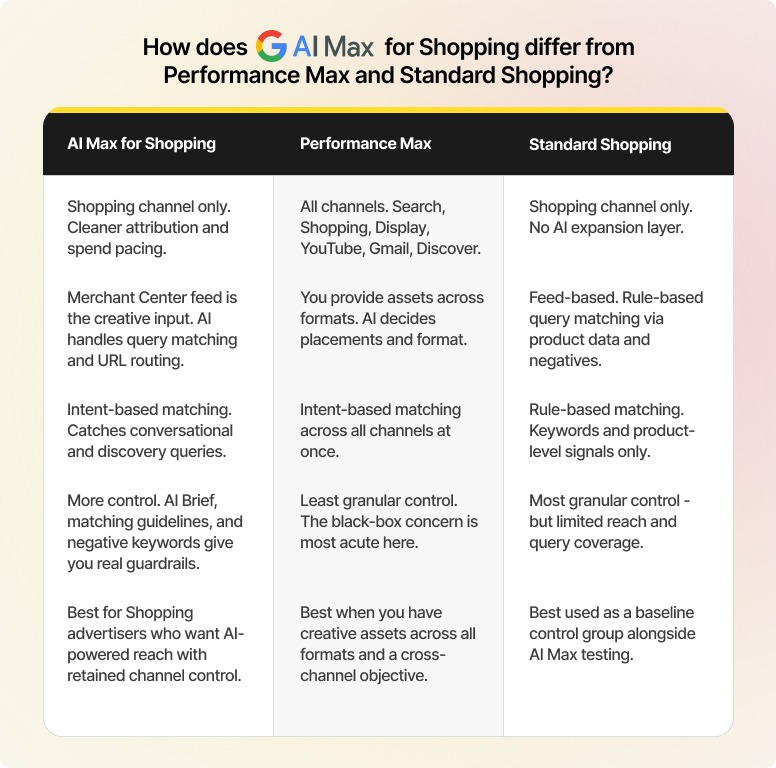
What does the Google AI Max expansion mean for the future of performance marketing?
The work that used to define good performance marketing is being absorbed by the AI layer. Exhaustive keyword lists. Dozens of ad copy variants. Manual landing page selection. Reactive search term analysis. The AI does all of that now.
What replaces it? Upstream work.
- Briefing AI systems with enough precision that they do what you actually intend.
- Reading AI-generated output critically - and knowing when to push back.
- Building the data infrastructure that determines what AI can do with your account.
What are the real opportunities and risks of Google AI Max for Shopping and Travel campaigns?
What is the biggest opportunity - and why are most advertisers missing it?
Your standard Shopping and Travel campaigns catch transactional searches. They were built for shoppers who already know what they want.
They miss the bigger, messier search universe. "Gifts for a minimalist who has everything." "Best time to visit Japan with kids on a budget." These are shopping and travel intents expressed in conversational language.
That entire category of search volume was previously only reachable through broad-match Search (with all its waste) or full Performance Max. AI Max is built to seal this gap.
Why is Merchant Center feed quality the real Google AI Max competitive moat?
This is the one that will separate winners from losers over the next 12 months. Almost no one is talking about it properly.
In standard Shopping, a thin product title means you miss some searches. In AI Max, a poorly built feed means the AI draws wrong conclusions about your product, your audience, and your category, at every single auction.
How do you manage budget risk when turning on Google AI Max?
More query coverage without more budget means the algorithm has to make harder trade-offs. And those trade-offs may not match your commercial priorities.
For travel advertisers: the risk is the budget flowing toward high-volume destinations or travel periods that are easy to fill - not the low-season inventory or high-margin packages you actually need to shift.
What should you do with Google AI Max this week?
- Request beta access through your Google rep if AI Max for Shopping is not yet visible in your interface.
- Audit your Merchant Center feed before touching any campaign settings. Description depth, attribute completeness, image quality - for Shopping. Live pricing, room-type data, amenity tags, and destination detail - for Travel.
- Pull 90 days of search term data from your existing Shopping and Travel campaigns now. Build a negative keyword baseline and CPA benchmarks by query theme. Do this while you still have full granularity.
- Write your AI Brief messaging and matching guidelines in a document first. Test them against your own search behavior. Then paste them into the interface.
- Audit your category, collection, destination, and property landing pages. Load speed. Relevance match above the fold. Conversion elements. Structured data. Fix these before you turn on Final URL Expansion.
- Pilot on two or three campaigns only. Daily budget capped at 20% above baseline. Monitor spend daily for 30 days.
- For regulated verticals: get your Text Disclaimer language compliance-approved now. Be ready to move the moment FUE rolls out.
- For travel advertisers: start optimizing for AI Overview eligibility now. Feed quality, review signals, and landing page relevance determine placement - not bid levels alone.
The bottom line
AI Max for Shopping is not a magic bullet, nor is it a threat.
It is a powerful system that rewards the performance marketers who take the time to understand it, set it up precisely, and manage it intelligently.
The advertisers who will see the most benefit are those who bring their strategic thinking upstream - into feed quality, AI Brief precision, and measurement rigor - rather than trying to manage AI Max the same way they managed a standard Shopping campaign.

.png)
.png)