







Table of contents
Get in touch
Expect response in 4 hours.
.png)
As an agency owner in 2026, you probably know that disintermediation has made its way into your clients’ offices.
It shows up as a quiet edit to a workflow you never see. A marketing manager who used to send you a brief opens a tab instead, gets a usable draft in under a minute, edits it, and ships it.
Nothing gets canceled, the monthly call still happens, the invoice still clears, and the client still calls you their agency.
But the retainer is being unbundled one line item at a time, and by the time it surfaces at renewal, the decision has already been made without you.
Most agencies are bracing for the wrong fight. They are getting ready to prove their work beats whatever a tool produces, when quality was never where they were losing.
The shops that make it through 2026 will not be the ones with the best craft. They will be the ones willing to stop charging for the part of the job that a subscription now does for free.
What is actually replacing your retainer?
Interestingly, the tools eating into your scope are not enterprise platforms locked behind six-figure contracts; they are consumer subscriptions sitting in your client’s browser.
Content teams choose to push first drafts through Jasper, which starts around $59 a month, then score them in Surfer SEO at roughly $99 to $299. The ones with deeper pockets might choose to experiment with Clearscope, the premium option, which runs about $129 to $399 per month.
Now, performance managers automate the bid adjustments that once justified a weekly strategy call. Brand teams generate concepts in Midjourney and Adobe Firefly before design is briefed, and sometimes choose not to brief at all. Reporting that was once an erstwhile three-hour deliverable simply refreshes on a dashboard.
But none of these match a strong team with full context and enough runway. Every one of them clears a lower bar the client cares about more; it is there the moment they need it. That is the real competitor, and not the quality of the output, but the latency of getting it.
The brief that takes your team six days takes the tool forty seconds, and that gap is where the relationship silently reprices itself.
Call it the briefing tax. Every job an agency does carries an invisible surcharge, one that accounts for the time to write the brief, wait in the queue, review the draft, and route the approval.
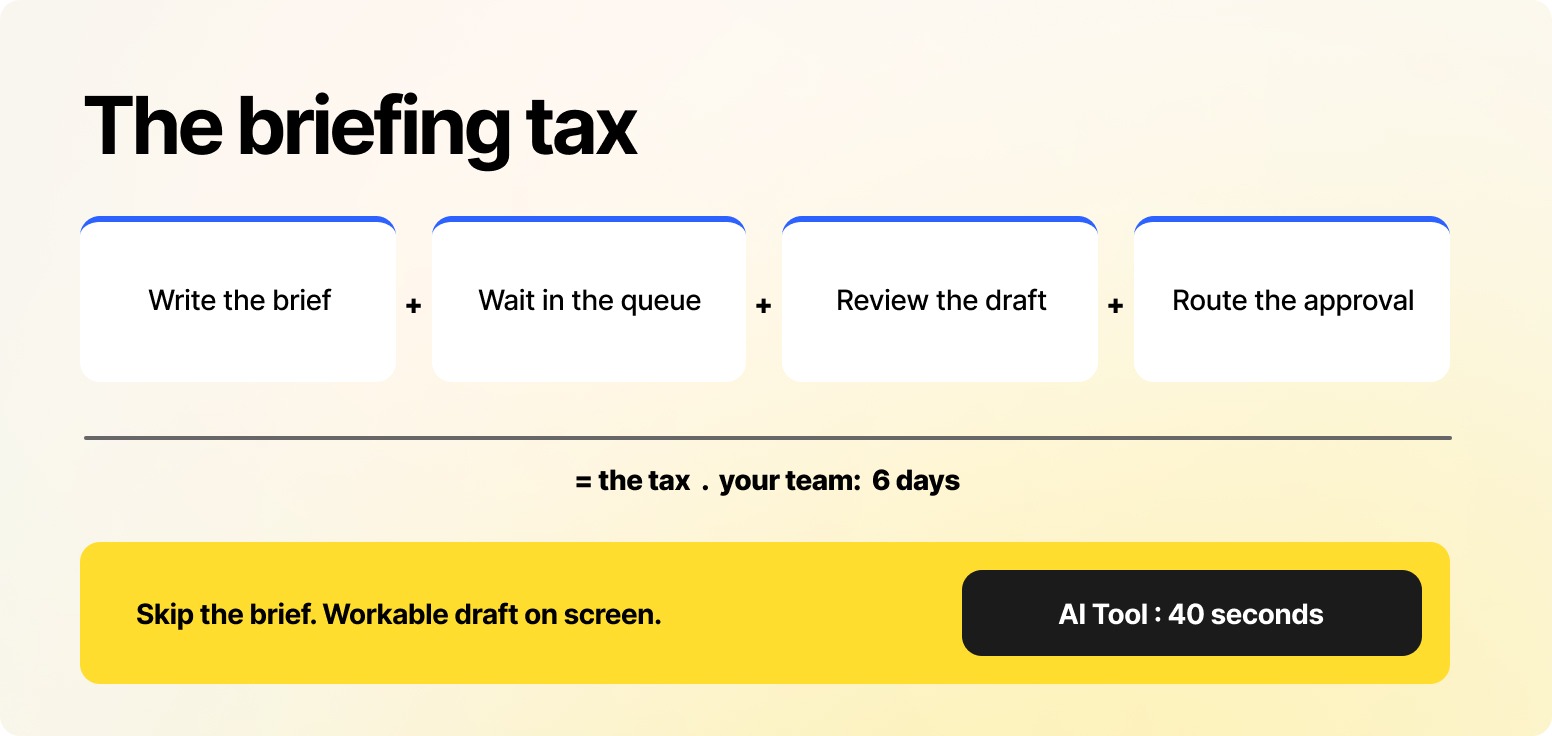
For years, clients coughed it up without noticing, simply because there was no alternative. AI tools did not beat agencies on craft; instead, they quietly removed the tax.
The moment a manager can skip the brief and get something workable on screen, your craft advantage is suddenly competing with the tool’s speed advantage. And on the small, repeatable jobs that fill most of a retainer, speed consistently wins.
The pattern is now measurable. A Typeface survey of more than 200 senior marketing leaders found that 60% would spend less on agencies in 2025 because of AI, and 83% said they would cut most or all of their agency spend if content creation could be fully automated. Among teams that have actually deployed AI agents, 73% have already trimmed their agency spending on content.
Why your client never has that conversation with you
This is the conversation you never get to sit in on, so let us narrate it, because we have watched it play out more times than we can count.
It does not begin as a decision. It begins as a deadline and a tool that was simply closer to hand than you were. Someone tries it because waiting on your team would blow the timeline, it works well enough, and they move on. With no strategy and no statement of intent, it’s simply a problem solved on a busy afternoon and filed away as a small win.
Renewal season is when it surfaces. The budget owner lays out your last three months' deliverables alongside what their team now produces without you. The important thing is that they are not building a case to fire you; instead, they are trying to justify a number to a CFO.
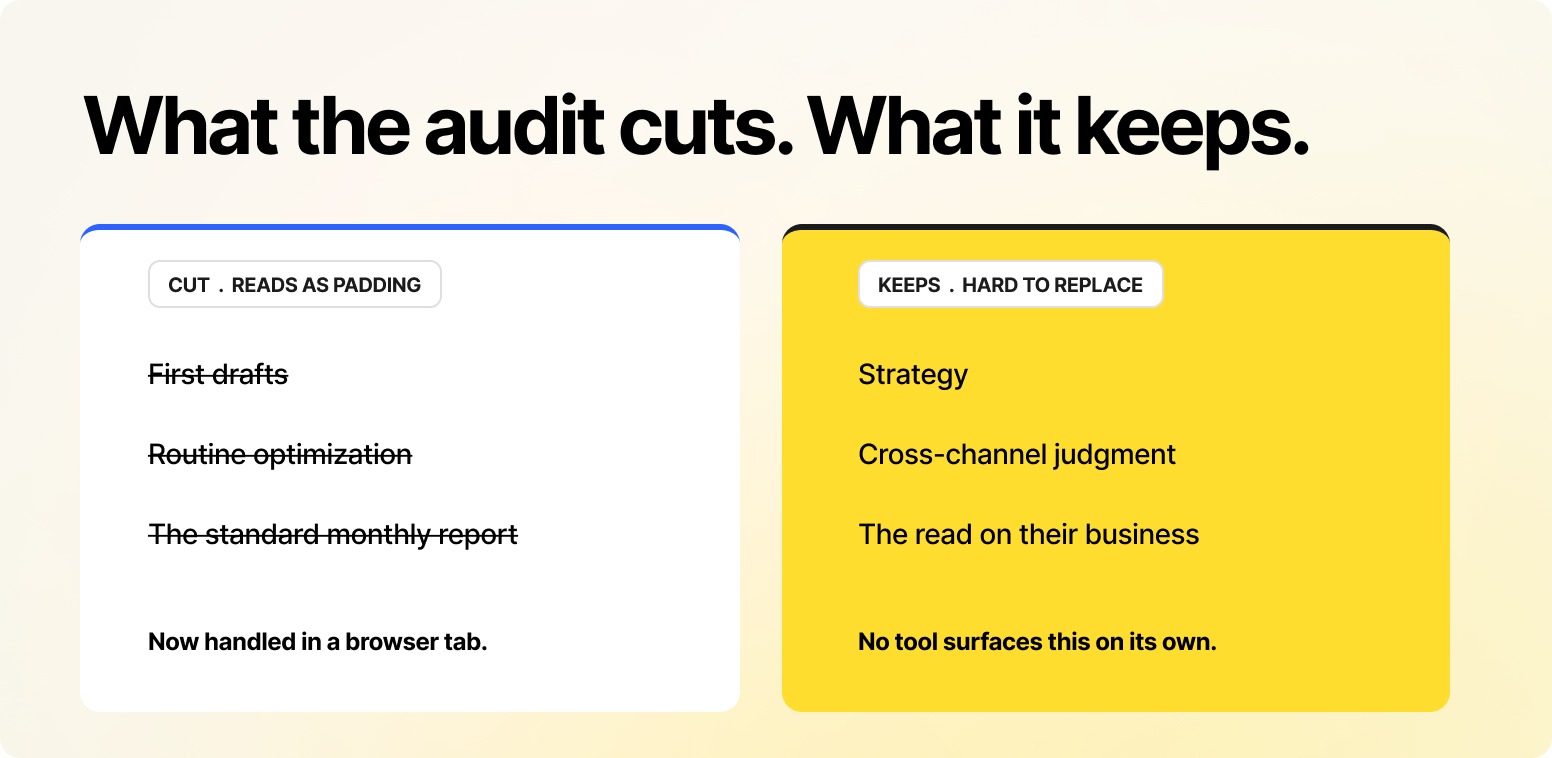
And the parts of your scope they have quietly learned to cover, the first drafts, the routine optimization, the standard monthly report, stop reading as value and start reading as padding.
The work that survives that audit is the work that was always hard to replace, such as the strategic call, the cross-channel judgment, the read on their business that no tool will surface on its own. That part is genuinely safe.
The trouble is that it sits buried under a mountain of execution that they grow more comfortable handling alone every month. By the time anyone says "rightsizing" out loud, the audit has been running silently in their head for two quarters, and you were not in the room for a second of it.
The number game the industry is trying not to say out loud
Step back, and the trend stops looking like a run of bad luck at a few big shops. Through 2025, global ad spending kept climbing while the holding companies built to live on it contracted, with WPP in turmoil amid falling revenue and a leadership shakeup, and Dentsu moving to sell its international holdings. The market for marketing grew. The companies that have always served it have contracted. That money did not vanish; it rerouted.
Forrester put a number on the rerouting that is hard to wave away, predicting that 15% of agency jobs will be eliminated in 2026 alone.
The underlying economics explain its speed. AI-native micro-agencies are reportedly operating at 50 to 80% margins, compared with the 15 to 20% typical of traditional shops, largely by removing the junior execution layer that AI now handles.
That margin gap is actually the whole game. It is what lets a leaner competitor underprice you and still profit, and it is what your client feels, indirectly, every time a subscription does in seconds what used to carry a line item.
What clients will still pay an agency for
The honest read is that AI has not ended the case for agencies. It has narrowed it to the work that does not compress. The same research showing budgets shrink also shows where they hold, which is roughly 36% of marketers still rely on agencies for content planning and 62% for AI-enabled paid media, the parts that demand orchestration and accountability rather than raw output.
Two-thirds of marketing and communications staff worldwide now frequently or consistently use AI for content, so the question is no longer whether clients use the tools. They do, daily. The question is; who turns that activity into results they can trust?
The trap is assuming “strategy and judgment” is a moat on its own. It is not, because every agency on earth claims it. As per Typeface's Signal Report (2025), CMO Jason Ing put it plainly, “Too many AI projects stall in the pilot phase because teams treat them like tools, not transformations."
It's pertinent to understand that clients are not short on access to AI; however, they are short on the operational layer that turns scattered tool use into reliable, on-brand output at speed, with one team accountable when something ships wrong.
That layer does not fit inside a $99 subscription, and it is the one thing your client cannot stand up on a Friday afternoon.
The one position we have watched stand the test of time
The agencies holding their ground did not argue with the tools. They walked into the room with AI already inside their delivery, not as a line on a capabilities slide but as output the client could see.
The leverage is that you do not have to build any of it. Through a white-label delivery partner that already runs the AI infrastructure, you can offer what a free trial never will. The client gets the speed of the tools and a team that owns the outcome when something looks wrong.
The client never sees the tools. They see an agency that finally moves at the speed they have started to expect, with someone to call when a number looks off. That experience is what a subscription cannot sell, and it is what keeps the renewal conversation from ever starting in their heads.


.png)
.png)
.png)