


Table of contents
Get in touch
Expect response in 4 hours.
.png)
Any service line that takes three or more disciplines to deliver, a dedicated team beats a single in-house hire in the first 90 days, because the team produces from week one, while the hire is still onboarding. A mid-level marketing hire needs 3 to 6 months to reach full productivity, and the average role now takes 63 to 68 days to fill. This piece names the six lines (paid media, SEO, email and automation, web and CRO, content at scale, and analytics and RevOps) where that gap is widest, gives you a test to score any line yourself, and marks the roles where an in-house hire is still the right call.
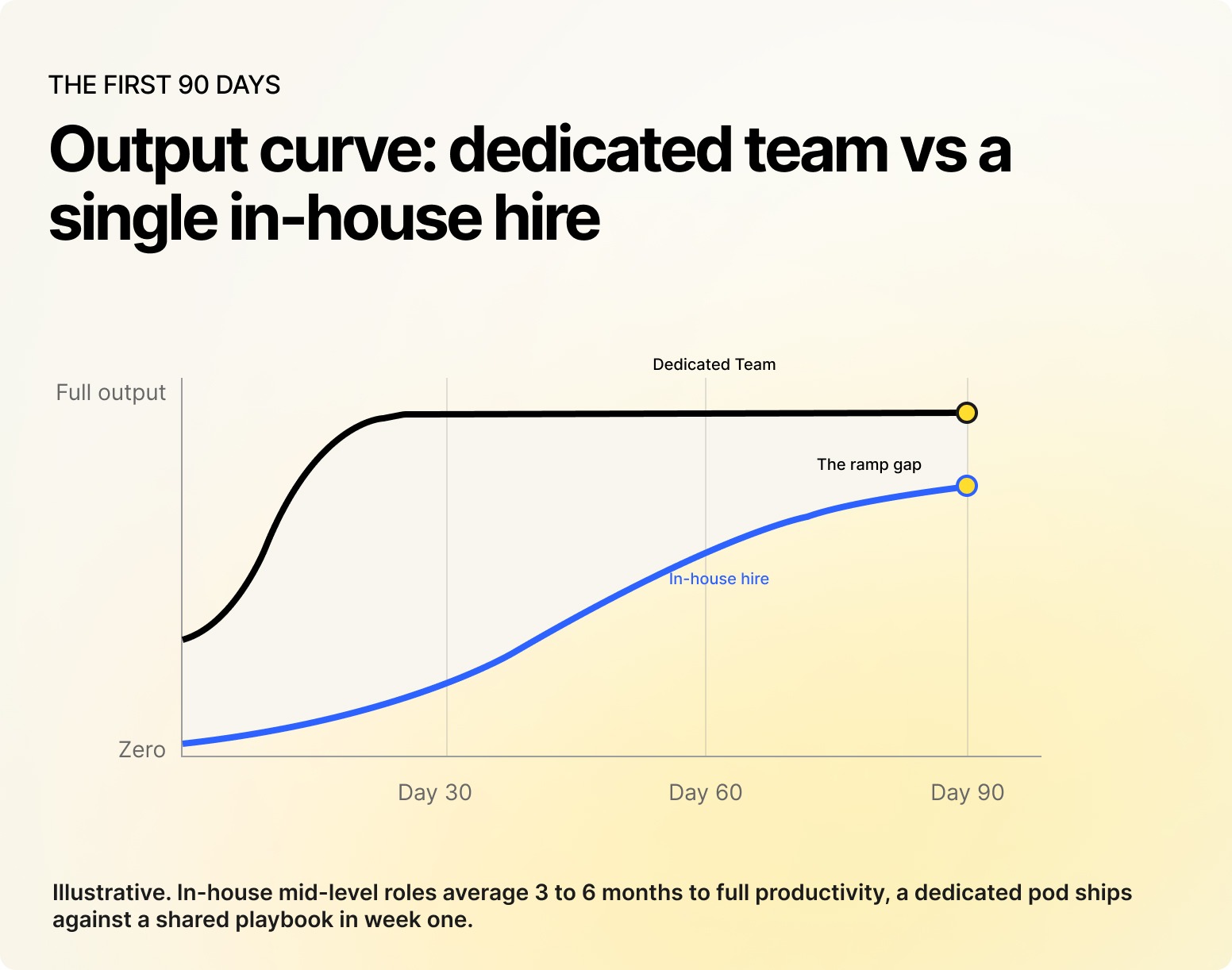
Dedicated team vs in-house hire: what actually changes in the first 90 days?
The honest comparison is two ramp curves over the same quarter. A single hire climbs slowly; recruit, onboard, learn the tooling, earn account context, then produce. While a dedicated pod inherits a shared playbook, live QA, and platform certifications on day one, its output starts high and plateaus fast.
The cost side widens it. The average cost per hire is nearly $4,700, and a mis-hire costs 25% to 30% of the first-year salary once you factor in rehiring and lost output, per CGS Immersive.
The key takeaway is that you are not buying headcount, you are buying an output curve. On multi-disciplinary lines, the dedicated team curve wins the quarter every time.
So, how do you decide between a dedicated team and an in-house hire?
Instead of guessing, it is recommended to score the line.
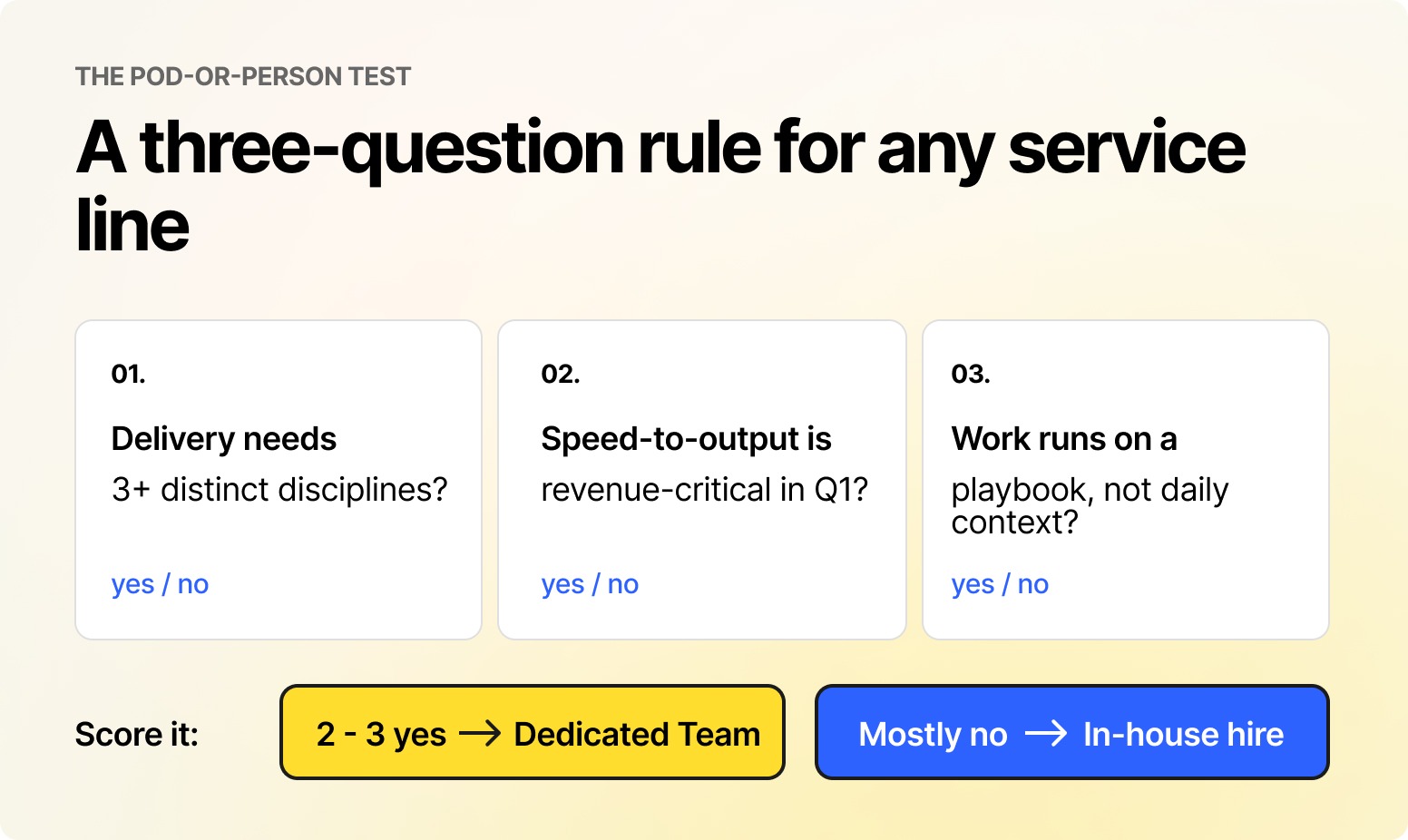
We use a three-question rule internally at Mavlers Agency, the Pod-or-Person Test, to sort any brief in under a minute.
1. Disciplines. Does delivery need three or more distinct skill sets (technical, creative, analytical)?
2. Speed. Is speed-to-output revenue-critical in the first quarter?
3. Repeatability. Does the work run on a documented playbook rather than a daily institutional context?
Two or three “yes” answers point to a dedicated team. Mostly “no” points to an in-house hire. Every line in the next section scores at least two, which is precisely where the ramp gap costs you the most.
Key takeaway: The decision is a portfolio call, line by line, not a company-wide policy. Score each brief on disciplines, speed, and repeatability.
Which service lines does a dedicated team win in the first 90 days?
1. Paid media
Performance marketing is not limited to a single channel. A real program usually runs Google, Meta, LinkedIn, and often a retail or programmatic layer, each with its own bidding logic and creative format.
While a single hire picks a lane, a dedicated team fields a strategist, a channel buyer, and a creative at once, so campaigns launch across platforms in week one. B2B teams also lose signal at the offline conversion tracking stage, which a specialist closes early instead of after ROAS drops.
First 90-day edge: Live campaigns across two or more platforms inside two weeks, with a second set of eyes on spend before budget scales.
2. SEO (Search Engine Optimization)
An in-house SEO hire spends the first 30–45 days doing audits, stakeholder alignment, and tool familiarization. By the time execution begins, momentum is already lost.
On the contrary, a dedicated team doesn’t start with discovery; instead, they begin with pattern recognition.
They are already aware of the following;
- What technical debt actually impacts rankings (vs what doesn’t)
- Which content formats drive topical authority in your niche
- How to prioritize fixes for the fastest traffic recovery
In the first 90 days, here’s what a dedicated team typically delivers;
- Technical SEO fixes deployed in weeks, not months
- A mapped topical cluster strategy (not just keyword lists)
- Content velocity that compounds (not sporadic publishing)
3. Email and marketing automation
Lifecycle work is platform-specific and can be quite unforgiving. For instance, Klaviyo, HubSpot, and Braze each demand certified hands, and deliverability, segmentation, and template design rarely live in one person.
A dedicated team pairs a lifecycle strategist with a platform specialist and a designer, so flows ship while a solo hire is still auditing your sender reputation. Deliverability errors compound daily, which makes ramp speed a revenue question.
First 90-day edge: You get to experience core automated flows rebuilt and live, with deliverability and segmentation owned by specialists instead of one overloaded generalist.
4. Web development and CRO
This involves catering to multiple roles, such as building a landing page or a rebuild that needs design, front-end build, and QA. A dedicated pod parallelizes the build and folds conversion rate optimization in from the first sprint. It also runs the math a solo hire often skips, for instance, a valid A/B testing needs roughly 1,000+ monthly visitors per variation, so low-traffic pages move to qualitative CRO instead of underpowered tests.
First 90-day edge: Your pages are designed, built, and QA'd inside the same sprint, with experiments live while a solo hire is still scoping the first ticket.
5. Content production at scale
A content operation is a conflation of strategy, writing, editing, SEO, and design on a cadence. While a single hire produces a trickle while learning your voice, a dedicated team runs an editorial line, brief to publish, at volume, against a documented style system. In an AI-search world, the bar is higher as content has to be built to be cited. The output difference across the first quarter is measured in multiples rather than single-digit percentages.
First 90-day edge: You stand to get a published content engine at volume, held to a house style, in place of a handful of pieces from one ramping writer.
6.Marketing analytics and RevOps
Attribution, dashboards, GA4 configuration, and data hygiene hide under one vague title. Each is a specialist’s work, and a lone hire ramps slowly on your stack. On the other hand, a dedicated team stands up, reports, and cleans the pipeline in parallel, so leadership sees trustworthy numbers in weeks. Roughly two-thirds of North American IT leaders told IDC that skills gaps have already cost them revenue growth, and reporting blind spots feed straight into that. For AEO specifically, the right measurement tooling only pays off when a team acts on it.
First-90-day edge. You get to experience clean dashboards and a working attribution view early, so budget decisions are driven by signal rather than guesswork.
When should you still hire in-house instead of outsourcing?
If you are still on the fence, this should help you decide. You should still hire in-house when the role runs in a daily institutional context and long-term brand judgment. As brand leadership, product marketing tied to the roadmap, and executive strategy reward a permanent in-house team that accrues context over the years. Framing the decision as in-house or outsource treats it as a portfolio call; instead, we recommend that you keep the context-heavy core inside, and place a dedicated team on the lines where speed and specialist depth decide the first quarter.
Our own delivery bears this out. When Ogilvy Social.Lab needed capacity, Mavlers Agency scaled from one specialist to twenty inside a 15-day deployment window and cut costs by 35%. That is the dedicated resource model working where it belongs: multi-discipline output, live fast, at a lighter fixed-cost load.
Key takeaway. Hiring vs outsourcing is not an either/or decision. It is recommended to own the brain in-house and rent the specialist hands where ramp speed is the whole game.
On that note, you might find the following read enriching: The complete guide to white-label digital marketing.
FAQ
Dedicated team vs in-house team: which reaches results faster?
On multi-disciplinary lines, the dedicated team gets you results faster. A mid-level in-house hire needs three to six months to reach full productivity, while a dedicated pod ships against an existing playbook in week one. The gap is widest in the first 90 days.
Should I hire in-house or outsource to an agency?
Split by role type. Keep context-heavy, brand-defining work as an in-house team. Use agency outsourcing for lines that are really a stack of specialisms, such as paid media, SEO, and lifecycle email.
Is a dedicated resource model cheaper than an in-house hire?
Often, once you count the total load. Average cost per hire sits near $4,700, and a mis-hire costs 25% to 30% of first-year salary (CGS Immersive, 2026). A dedicated team also converts a fixed salary into a variable cost.
What is the difference between a dedicated team and staff augmentation?
A dedicated team is provider-managed and delivers as a unit against outcomes. Staff augmentation embeds individual specialists under your management. Both involve adding an in-house team without a permanent hire, which is why the dedicated resource model sits at the center of most hiring vs. outsourcing decisions.
When does hiring vs outsourcing favor the in-house hire?
When the role depends on the daily institutional context and long-term brand ownership. Executive strategy, product marketing, and brand leadership reward a permanent in-house team over any outsourced arrangement.

.png)