


Table of contents
Get in touch
Expect response in 4 hours.
.png)
Over the last 12 to 18 months, we have watched the same pattern repeat across dozens of agencies.
We’ve seen a wave of agencies rush to add AEO for agencies into their stack, usually triggered by AI Overviews, ChatGPT visibility conversations, or client pressure around “AI search.”
An agency owner reads that AI search is eating organic search, adds “AEO” to the services page on a Monday morning, and ships a proposal by Wednesday. The client agrees and signs on the dotted line.
By month three, that same client is asking why traffic has not moved, and the engagement quietly comes apart. The service was rarely the problem. The packaging, the pricing, the scoreboard, and the promises around it usually were.
Answer Engine Optimization is the most real new line item agencies have had in a decade. Forrester’s 2024 Buyers’ Journey research found that 89% of B2B buyers now use generative AI at some point in their research. Conductor’s State of AEO/GEO 2026 report puts enterprise spend at an average of 12% of digital budgets in 2025, with 94% of leaders planning to spend more this year. Meanwhile, Ahrefs’ analysis of 300,000 keywords shows AI Overviews cutting position-one organic click-through by 58%. The demand is here, and the old scoreboard is breaking. What’s missing are operators who run AEO as a business rather than a buzzword.
We’ve shipped enough of these programs to know exactly where they break. Here are the eight mistakes that show up earliest, and what to do about each.
1. Running AEO as SEO with a new label
This is where most agencies start their AEO journey and where cracks begin to appear.
The point worth considering is that AEO is not the same as SEO. While SEO optimizes for rankings, click-through, and SERP visibility, AEO optimization for clients is more about being;
- cited or referenced in generated answers
- part of synthesized responses
- associated with authoritative entities.
Google has already moved in this direction with AI-generated summaries in search. As outlined in Google’s official documentation on AI features in Search, these systems don’t just rank pages; they compile answers from multiple sources.
Here’s what agencies get wrong: they apply keyword-first thinking to a system that prioritizes entity understanding and contextual relevance.
2. Selling AEO before the delivery system is in place
Interestingly, most agencies are selling AEO services before they know how they’ll deliver them, and that’s where margin takes a hit.
AEO is a system, and it has to be built like one. A working onboarding sequence usually covers an entity and brand-footprint audit, a reclassification of existing content rather than a light optimization pass, structured data and schema mapping, and a gap analysis based on question-level intent.
Without this, delivery becomes inconsistent, hard to replicate, and dependent on individual talent.
What agencies get wrong is that they improvise delivery after closing deals. On the other hand, what actually works is they productize inputs, workflow, and outputs. Because AEO only scales when it’s systemized.
3. Pricing AEO like SEO
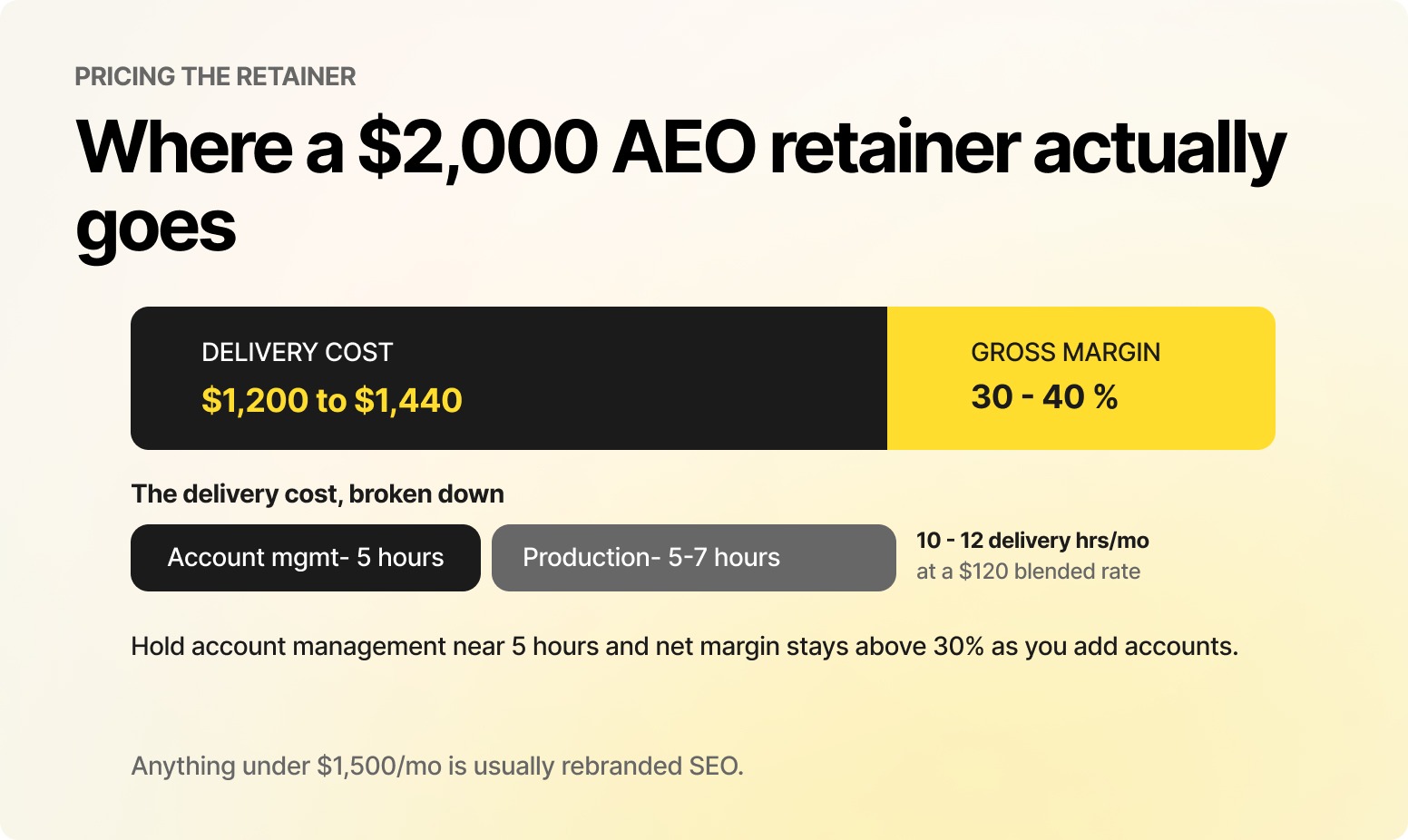
Two pricing failures stand out early and clearly. The first is charging AEO at SEO rates because it “feels similar,” which leaves real money on the table. In contrast, the second is the opposite trap, cost-plus pricing, where the retainer is mostly a markup on resold tools, which a CFO can catch on the first audit.
Here is the math most agencies never make visible:
A typical AEO retainer model looks like this;
- Total delivery time: 10–12 hours per client/month
- Account management: ~5 hours
- Production: 5–7 hours
Cost structure
- Blended internal cost: $120/hour
- Direct delivery cost: $1,200 – $1,440/month
Pricing benchmark
- Productized retainer: ~$2,000/month
Resulting margins
- Gross margin: 30% – 40%
- Higher margins come from templated workflows and systemization at scale
Keep the two margin numbers separate when you model this. Gross margin is the retainer minus direct delivery cost. Net margin is what survives after overhead, meaning tools, software licenses, and management time. Quote one and mean the other in front of a client, and you will lose the room. Holding account management near 5 hours a month is the lever that protects net margin above 30% as you add accounts.
Anything under about $1,500 a month is almost always rebranded SEO with an AI sticker on it, and the market knows it.
4. Promising placements no one can control
This is one of the fastest ways to destroy trust and occasionally invite legal trouble.
Simply because no agency can guarantee placement inside platforms like ChatGPT, Google AI Overviews, or Perplexity. These systems are non-deterministic, meaning:
- Outputs vary based on prompt phrasing
- They change with context and conversation history
- They are influenced by model updates you don’t control
If someone is promising “we’ll get you featured in ChatGPT,” they’re either misunderstanding how these systems work, or selling something they cannot deliver.
Instead (and what actually sells long-term) you could try shifting from offering guarantees to probability and measurable movement.
Try seiting expectations like this:
- “We improve your likelihood of being cited across high-intent queries”
- “We track how often your brand appears across a defined prompt set”
- “We measure your share of answer versus competitors over time”
Because what one can control is;
- Entity clarity and consistency
- Content structured for answer extraction
- Presence across trusted third-party sources
- Coverage of high-intent question clusters
However, what one cannot control is;
- Exact inclusion in a specific AI response
- When or how often a model selects your brand in a single query
The agencies that retain clients don’t promise placement; instead, they show movement in citation rate, visibility, and assisted conversions and tie that back to revenue.
5. Reporting traffic when they should report citations
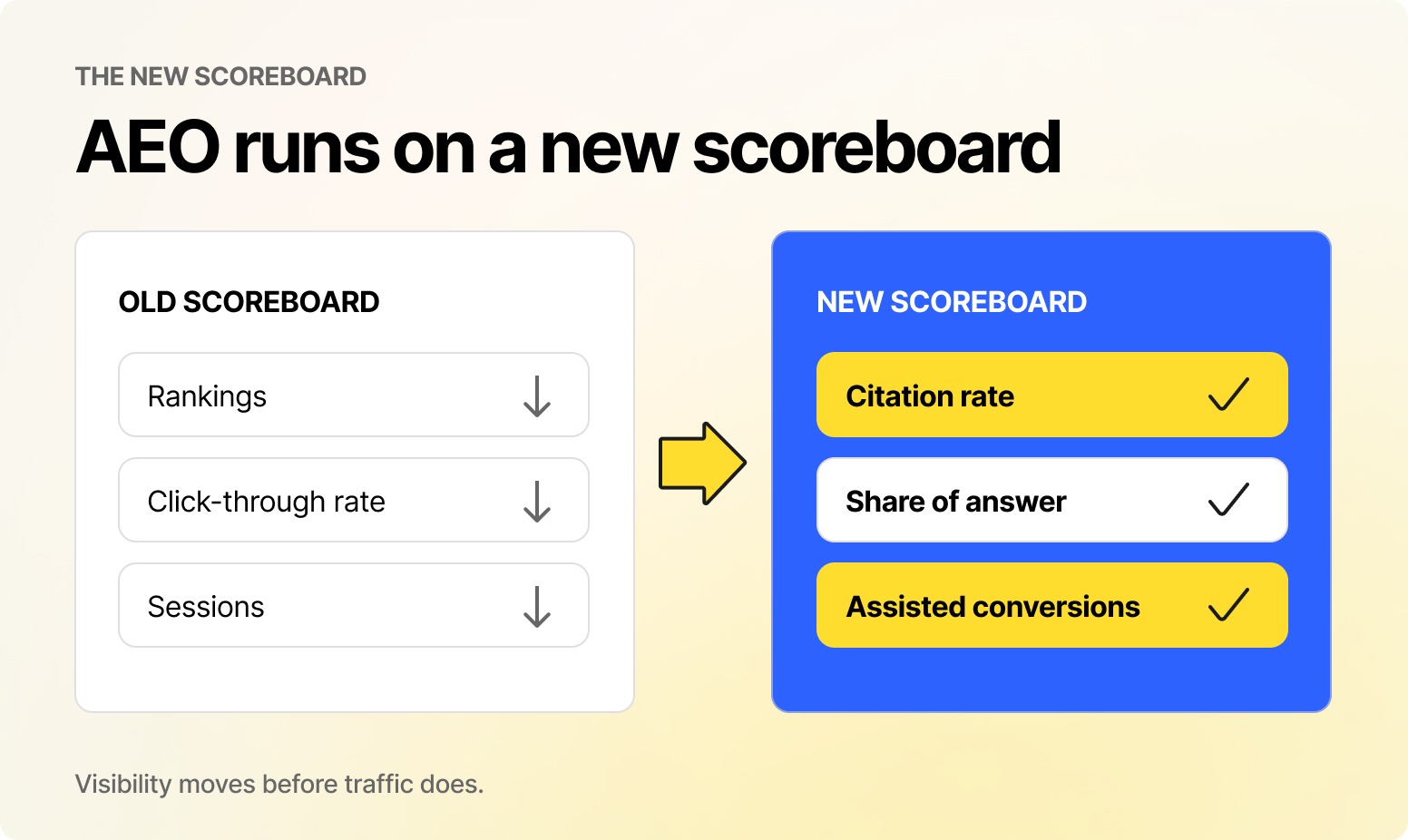
Wire AEO into a traffic dashboard, and you will lose before month two. AI referral traffic is still roughly 1% of total web visits. SparkToro’s 2024 Zero-Click Study found that for every 1,000 US Google searches, only about 360 clicks reach the open web at all. Report a % traffic number to a client that early, and they churn before the channel has a chance to compound.
The offsetting truth is that AI traffic converts well above organic. In Ahrefs’ data, AI-referred visitors made up about 0.5% of sessions yet drove 12.1% of signups. Treat early conversion figures like these as directional, since the datasets are still young, but the direction is consistent across sources.
So reset the scoreboard during onboarding, before the first invoice goes out. Track citation rate, share of answer (your client’s slice of brand mentions across a defined set of prompts), and assisted conversions.
Because visibility shifts before traffic does. If your reporting can’t surface that early movement, the client never sees the win that’s actually happening behind the scenes.
6. Stopping at on-page optimization and skipping the work that moves citations
Most AEO implementations stop too early.
They focus on on-page elements like structured data, content formatting, and answer-ready sections. While these still matter for clarity and machine readability, they are no longer the differentiator, and in some cases (like FAQ schema abuse), they’ve lost much of their original impact.
This is the commodity layer.
While the real leverage sits off-site.
Industry analyses put the share of AI citations coming from third-party sources at roughly 85%. Earning mentions across the independent sources answer engines trust, which is digital PR by another name, is where budgets and results actually grow.
This is the part of AEO optimization for clients that most agencies underprice or skip entirely, because it’s labor-heavy. It’s also the moat. While, anyone can clean up on-page content in a day.
Earning consistent citations across trusted external sources is what compounds and what competitors can’t replicate overnight.
7. Treating AEO as a one-time audit
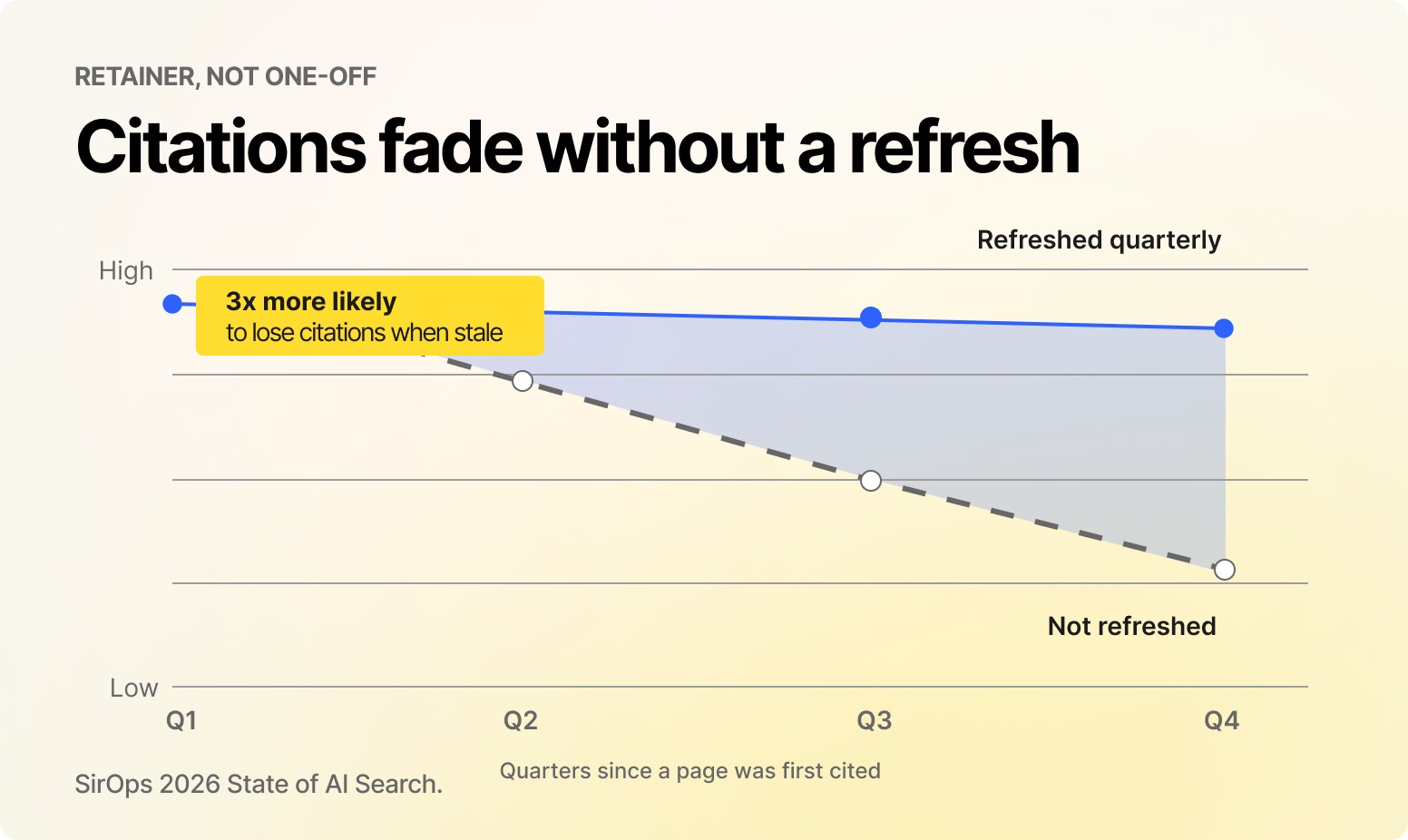
AEO is a weekly endeavour, not a project with a defined end date. AirOps’ 2026 State of AI Search report found that 83% of AI citations for commercial and evaluation queries come from pages updated within the last 12 months, and pages that aren’t refreshed quarterly are three times more likely to lose their citations than those that are refreshed quarterly. A page that gets cited this quarter goes silent next quarter if nobody touches it.
That single fact is the entire case for a retainer-based AEO service model over a one-and-done audit. When you map how agencies offer AEO profitably, the recurring refresh cadence is the engine. A sprint that decays in three to six months trains clients to see AEO as a cost. A maintained program trains them to see it as compounding equity.
8. Trying to build everything in-house too early
This slows down adoption more than anything else.
Most agencies assume they need internal AEO specialists, new processes from scratch, and full delivery ownership, but that’s rarely necessary at the start.
What agencies get wrong is that they tend to delay go-to-market while building capability.
What actually works is using AEO white-label services that allow agencies to enter the market faster, validate demand, and maintain delivery quality.
Then one may build internally once the volume justifies it.
The takeaway
So, none of these mistakes is about the tactics. They’re about the operating model wrapped around the tactics: how you frame it, price it, measure it, and sustain it.
If building that machine in-house feels like a lot, that’s the honest reality of a discipline barely over two years old. It’s also why white-label reseller services exist: you can sell the outcome under your brand while a partner manages the delivery cadence behind it.
Wondering why agencies lose clients? We recommend reading "Why great agencies still lose clients: Understanding the hidden delivery gap."


.png)