




Table of contents
Get in touch
Expect response in 4 hours.
.png)
IAC discontinued Ask.com on May 1, 2026, ending a nearly 30-year era.
As Ask.com is officially shutting down, the farewell message on the homepage reads,
“Every great search must come to an end.”
A polite send-off for a brand that hasn’t mattered commercially in over a decade.
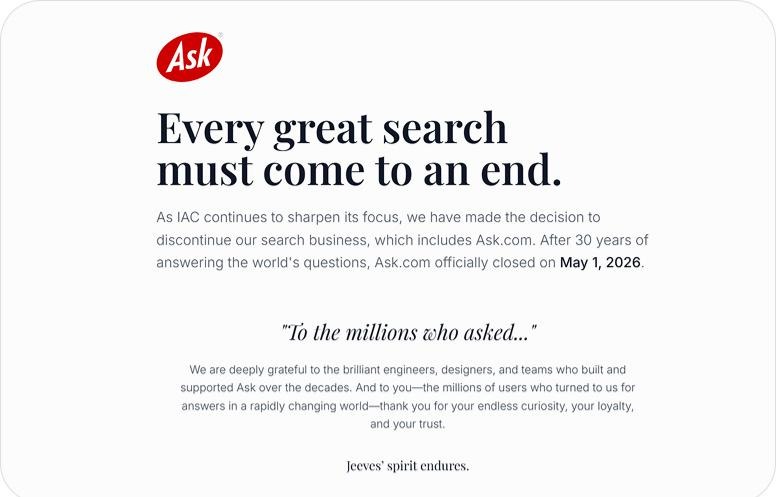
The timing feels ironic. Ask.com is shutting down at the exact moment the thing it pioneered - conversational, question-led search - has become the dominant model of AI SEO. That collision of too late and too early is worth examining seriously to understand what happened to Ask.com.
If you grew up with a smartphone in your hand, you might only know the name through memes or old movies.
But for business owners and brands, it’s a masterclass in how a company can correctly predict the future and still get left behind.
Most posts today are writing obituaries. We want to go deeper. The shutdown of the Ask.com search engine is a warning about the difference between having a vision and executing it.
The butler officially hangs up his coat

- Ask Jeeves launched in Berkeley in 1996, founded by Garrett Gruener and David Warthen.
- The product invited users to type questions in natural language. The butler, borrowed and licensed from P.G. Wodehouse’s novels, gave Ask Jeeves a face and a personality no other search engine had.
- The idea was that search should feel like talking to a smart assistant, not querying a database.
- The product couldn’t keep the promises made in the pitch. Natural language processing in the late 90s could not reliably parse the questions users typed.

- Of course, Google didn’t solve natural language processing either. Google won by deliberately sidestepping it. PageRank was a mechanical, humble solution - rank pages by how many other authoritative pages link to them. No need to parse the context or intent of a query.
- As outlined in the original Stanford research paper by Larry Page and Sergey Brin, Google succeeded by ranking pages based on authority and links rather than guessing the "intent" of a query.
- Google answered the question of what the web trusts rather than what the user means, and that turned out to be enough. Users tried both engines, traffic shifted fast, and Ask.com search engine fell behind.

- That mechanical simplicity turned out to be a massive strategic advantage. Instead of trying to interpret human language in the late 90s, Google focused on crawling, indexing, and ranking the web faster and more reliably than competitors.
- By the early 2000s, Google was already processing hundreds of millions of searches per day, while Ask Jeeves struggled with relevance, consistency and scale.
- IAC acquired Ask Jeeves in 2005 for $1.85 billion. A year later, the butler was retired and the company rebranded as Ask.com. It was a decision that would prove costly.
- By 2010, IAC chairman Barry Diller had publicly admitted the Ask.com search engine could not compete with Google. That same year, Ask shut down its own web crawler and laid off most of its engineering team.
- The site ran on third-party results and a Q&A community for sixteen more years before IAC formally closed it in May 2026.
- Once Ask.com stopped operating its own crawler, it stopped controlling its future as a search engine.
What happened to Ask Jeeves over those three decades came down to a few specific decisions, and a market that consolidated faster than the company could pivot.
Why did Ask.com fail when it had the right instinct?
Most retrospectives reduce the story to “Google’s results were better.” That’s true but lazy. Here is what actually went wrong:
1. Google answered faster and more accurately.
In 2002, you could type “why is my dog eating grass” into Google and get a useful answer almost instantly. Ask Jeeves returned irrelevant forums and asked you to rephrase. It couldn’t match the speed or precision of PageRank’s link-based relevance signals.
2. The Jeeves rebrand killed the only asset people remembered.
Users had strong feelings about the butler. IAC dropped Jeeves in 2006 to look more professional and compete on product terms. The brand became generic. And competing on pure product performance against Google was not a winnable position. The one thing Ask owned, it voluntarily surrendered.
3. Google became the default.
Google spent billions of dollars to be the default search engine across major distribution channels on earth. Browsers, operating systems, and eventually phones shipped with Google as the default search box.
Ask.com had a toolbar play and a Wikipedia distribution deal. It also damaged its own brand reputation in this period. Its toolbar installs were widely considered bundled adware, eroding the user trust it still had.
4. Ask stopped being a full web search engine.
By 2010, Ask was not really a search engine anymore. When IAC shut down the in-house crawler and started piping in third-party results, Ask became a dependent client of their direct competitors. There was no underlying product left to compete with.
Also worth noting: IAC was never primarily a search company - Ask was always one asset inside a diversified media portfolio. That context explains why IAC didn’t make the aggressive infrastructure investments that competing with Google would have required.
5. The Q&A pivot came too late.
The attempt to become a Q&A-focused site ran straight into stronger players. Yahoo Answers, Quora, and eventually Reddit were already ahead. The Ask Q&A community had some traction in its early years, but by the time Reddit became the dominant social Q&A platform, Ask had nowhere left to grow.
So why did Ask.com fail?
The vision of Ask.com was right. The infrastructure, distribution, brand decisions, and timing were not. The May 2026 closure is the official end date. But Ask.com was effectively finished as a competitive product by 2010. Everything after that was an attempt to find a smaller category to survive in.
Search no longer ends on your website
This is the real shift connecting Ask.com’s story to AI SEO and GEO:
- Traditional search engines helped users discover websites. AI search systems increasingly attempt to answer the question before the click happens.
- Google’s AI Overviews, ChatGPT, Perplexity, and Gemini are all competing to become the interface layer between users and information.
That changes the economics of visibility itself. Ranking first is no longer the only objective. Being extractable, quotable, and structurally useful to AI systems matters now too.
In the keyword-era internet, users evaluated links themselves. In AI-mediated search, the platform evaluates and synthesizes information on the user’s behalf.
That is why the Ask.com story feels relevant again. Ask Jeeves was trying to build a conversational answer layer decades before the compute power, advanced machine learning, and semantic understanding existed to support it.
The irony is that conversational search won. Ask.com simply did not survive long enough to participate in the version powered by modern AI.
What the current search environment actually demands
The Ask.com story is a business lesson, not an SEO roadmap. But the search environment it left behind has specific requirements that are worth being direct about. Five of them:
1. You are competing for multiple search surfaces, not one.
The traditional blue link on Google still matters. So does whether your content gets pulled into the AI Overview sitting above those links. Optimizing for only one of these is the same mistake Ask made when it focused on one product strategy while the market moved in multiple directions at once.
2. Generic content is on borrowed time.
“Top 10” guides and broad how-to posts are exactly what AI Overviews summarise and replace. If a five-second AI summary can answer the same question as your 1,500-word post, the user never clicks through.
Build content that contains things AI cannot easily generate: specific cases, real numbers, hands-on experience, proprietary data.
Ask Jeeves lost partly because it couldn’t offer something users couldn’t get better elsewhere. The same logic applies to your content now.
3. AI systems cite specifics and evidence, not generalities.
If you want your content cited in AI answers, publish real data, case studies, and firsthand experience. Generic content gets absorbed into the summary. Specific, sourced insight gets attributed.
4. Question-first formatting is not optional anymore.
Write headings as the questions people type. Put the direct answer in the first sentence below. Use the rest of the paragraph for context and proof. That structure is how AI Overviews extract from your page, and how readers scan it.
Ask Jeeves bet on question-led search in 1996. The format has finally won. Build your content accordingly.
5. Brand recall does not translate to AI citations.
Ask Jeeves remained one of the internet’s most recognizable search brands for years after it stopped being relevant. Recognition alone was not enough to survive the transition.
Modern discovery systems care less about legacy awareness and more about extractable expertise. Specific examples, original insights, first-hand experience, and well-structured answers are far more likely to surface in AI-generated responses than broad brand familiarity.
The only lesson worth taking from Jeeves
Ask.com was right about conversational search. It still lost.
Being early is not a strategy. Execution, distribution, and owning something defensible are. If your content strategy today depends on generic posts and keyword volume alone, you’re in the same position as Ask was in 2010, still running, already finished.
The brands that get cited in AI answers publish specific data, real experience, and structured answers. The ones that don’t get summarized out of existence.


.png)