




Table of contents
Get in touch
Expect response in 4 hours.

Most teams don’t fail at SEO because they did the wrong things; instead, they failed because they read the wrong signals at the wrong time.
If you’ve ever stared at a flat traffic graph and thought, “We’re burning budget”, this is for you.
Because here’s what we’ve learned after doing this at scale, SEO doesn’t feel like it’s working, right before it does.
The difference between teams that win and teams that churn isn’t patience.
It’s signal literacy.
Let’s fix that.
The shift you need to make (Before anything else)
Most founders and marketing managers come in with the following concerns;
~ How to tell if SEO is working?
~ How to check if SEO is working?
~ How long does SEO take to work?
Now all that is valid, albeit slightly misframed.
Simply because they are anchored in outcomes such as rankings, traffic, and revenue, which come later.
What you need in months 1-3 is proof of direction, not proof of results.
And direction shows up early, only if you know where to look.
The first 90 days: What actually happens (Not what you’re told!)
Now, let’s strip this down to reality.
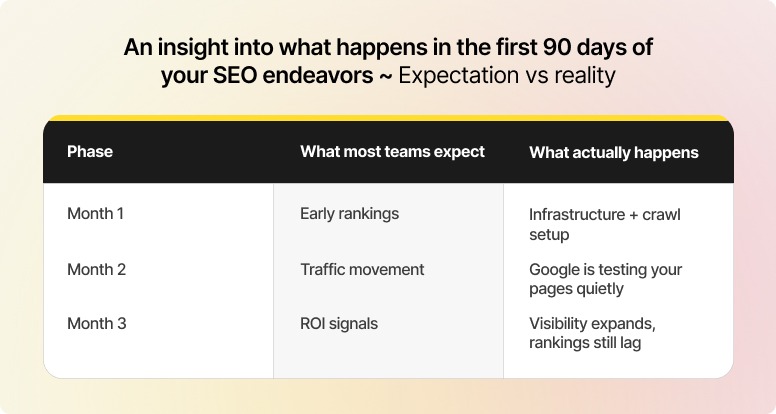
In the first 90 days, SEO isn’t “slow,” it’s quiet. A lot is happening, just not in the places most teams are looking (like traffic dashboards).
Here’s how it actually unfolds:
1. Discovery ~ Google finds you!
This starts once Google discovers your page; however, publishing alone doesn’t guarantee that.
Google only “starts” the process when it becomes aware of the URL, and that depends on how well your site is set up.
Discovery may feel instant when;
~ Your XML sitemap is submitted and updated
~ The page is internally linked from indexed pages
~ Your site is crawled frequently (high authority / fresh content)
~ You use URL inspection → “Request Indexing” in GSC
In these cases, Google may crawl within minutes to hours.
However, discovery can feel delayed if;
~ The page is orphaned (no internal links)
~ Crawl budget is limited
~ Sitemap isn’t updated or submitted
~ Site authority is low
In these cases, it may take days, weeks, and sometimes longer.
This stage is where many teams misread SEO performance. They might think that “We published 20 blogs last month,” but in reality, Google may have discovered only 5 of them!
So when nothing moves, they blame SEO, when the issue is discovery, not performance.
In simple terms, publishing is step zero and precursory to discovery, which is step one.
2. Indexation ~ Where you make or miss the cut
Now, a caveat here: crawled does not mean indexed.
At this stage, Google decides if this page is worth storing and showing in search results.
Pages get filtered out all the time due to thin or duplicate content, weak internal linking, and unclear intent match.
You need to watch out for;
~ Indexed pages increasing in Search Console
~ “Discovered, currently not indexed” or “Crawled, not indexed” statuses
So, if your pages aren’t getting indexed, rankings aren’t the issue; qualification is.
Sometimes, pages aren’t indexed even if the content is good, due to:
~ Crawl budget constraints (especially on large sites)
~ Site quality thresholds (overall domain trust)
~ Canonical conflicts
~ JavaScript rendering issues
~ Soft duplication (similar pages competing internally)
So it’s not just content, it’s system-level SEO health.
3. Testing ~ You show up, just not where you want to be!
This is where most teams start panicking.
Your pages begin appearing in search results, but in low positions (pages 3, 4, 5), with very few clicks across a wide range of queries.
This is where Google starts evaluating where your page fits in the search landscape.
You need to keep on the lookout for;
~ impressions starting to rise
~ new queries appearing in Search Console
~ average positions sitting in the 20–60 range
Traffic will still look flat, and that’s normal, because position drives clicks, and at positions 20–60, CTR is negligible.
What most teams don’t realize at this stage is that;
~ rankings are volatile
~ query matching is broad and messy
~ your page may rank for keywords you didn’t even target
This is acceptable because Google is mapping your content to intent clusters, not locking you into a final position yet.
Also, not every page goes through a clean “low ranking → high ranking” journey.
Some pages stay stuck (due to weak signals), might get indexed but never gain visibility, and they may need optimization to move out of this phase.
4. Validation ~ Your upside gets decided
Once your page starts appearing consistently, Google begins adjusting where it belongs.
Not through simple metrics, but through over time, such as;
~ how well your content matches intent
~ how it compares to competing pages
~ how users interact with search results at scale
This is what you should watch out for internally;
~ CTR trends in Search Console (as directional insight, not a lever)
~ engagement metrics like time on page (to diagnose content quality)
~ query-level performance shifts
In simple terms, if your content satisfies intent better than alternatives, it moves up. If it doesn’t, it stalls.
Google doesn’t rank you because of your engagement metrics, but poor engagement is often a symptom of why you won’t rank.
On that note, it is important to highlight that most teams tend to call it quits in the testing stage.
They see no traffic, no top rankings, “slow” performance, and assume SEO isn’t working.
In reality, they were one iteration away from movement.
The first 90 days aren’t about results; they’re about earning the right to rank.
~ Discovery gets you seen
~ Indexation gets you stored
~ Testing gets you evaluated
~ Validation gets you promoted
If you understand which stage you’re in, you stop guessing and start making the right moves at the right time.
The signals that tell you SEO is working (Before it looks like it is)
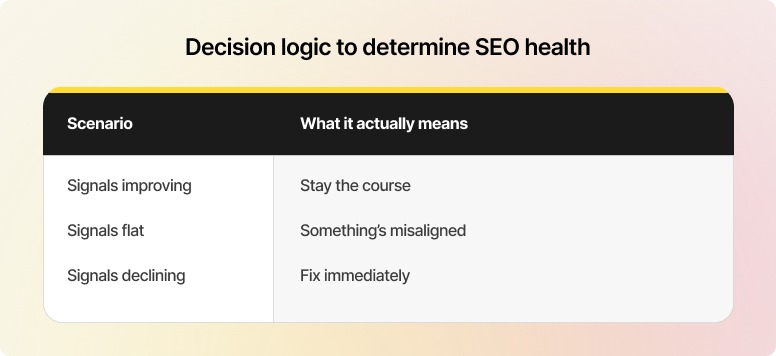
Now, these are not vanity metrics. These are the same signals that we use internally to decide whether to double down, hold steady, or fix immediately.
Let’s dive deeper into six of these early signals.
1. Crawlability ~ Is Google indexing your pages?
We don’t start by asking, “Are we ranking?” Instead, we start by asking, “Are we even being seen?”
Because until your pages are discovered, crawled, and indexed, you’re not competing, you’re pretty much invisible.
What most teams miss is this: publishing content does not mean Google has accepted it into its ecosystem.
There’s always a gap between when you publish and when Google decides your page is worth indexing.
That gap is where most SEO efforts silently fail.
Let’s now understand what healthy crawlability actually looks like.
Instead of a one-time check, you’re looking for momentum:
~ New pages getting indexed within a reasonable window (days to a couple of weeks, depending on site authority)
~ A steady upward trend in indexed pages
~ No persistent “Crawled, not indexed” patterns
Here’s what this signal really tells you. If indexing is happening consistently, Google is willing to store your content, which is the first gate cleared.
If it’s not, you don’t have a ranking problem; you probably have a qualification problem.
2. Impressions rising in GSC before the rankings move
Now this is where most SEO efforts get misjudged.
Teams look at traffic and see no movement, so they assume nothing is working.
But by the time you’re checking traffic, you’re already late to the signal.
The earliest reliable indicator sits one layer deeper, and that is impressions in Google Search Console.
Here’s what's actually happening under the hood.
When your content gets indexed, it doesn’t immediately “rank” in the traditional sense.
Instead, it starts getting eligible to appear across a broad set of queries.
That visibility shows up as impressions.
In practical terms, your pages begin to surface:
~ in lower positions (often beyond page 1)
~ across long-tail and loosely matched queries
~ with low CTR due to poor visibility and an unrefined intent match
This isn’t Google “testing” your content in a controlled way.
It’s Google’s systems mapping your page to queries, refining relevance, and adjusting positioning based on multiple signals like content quality, query match, and historical performance patterns.
Inside Google Search Console, you’ll typically see:
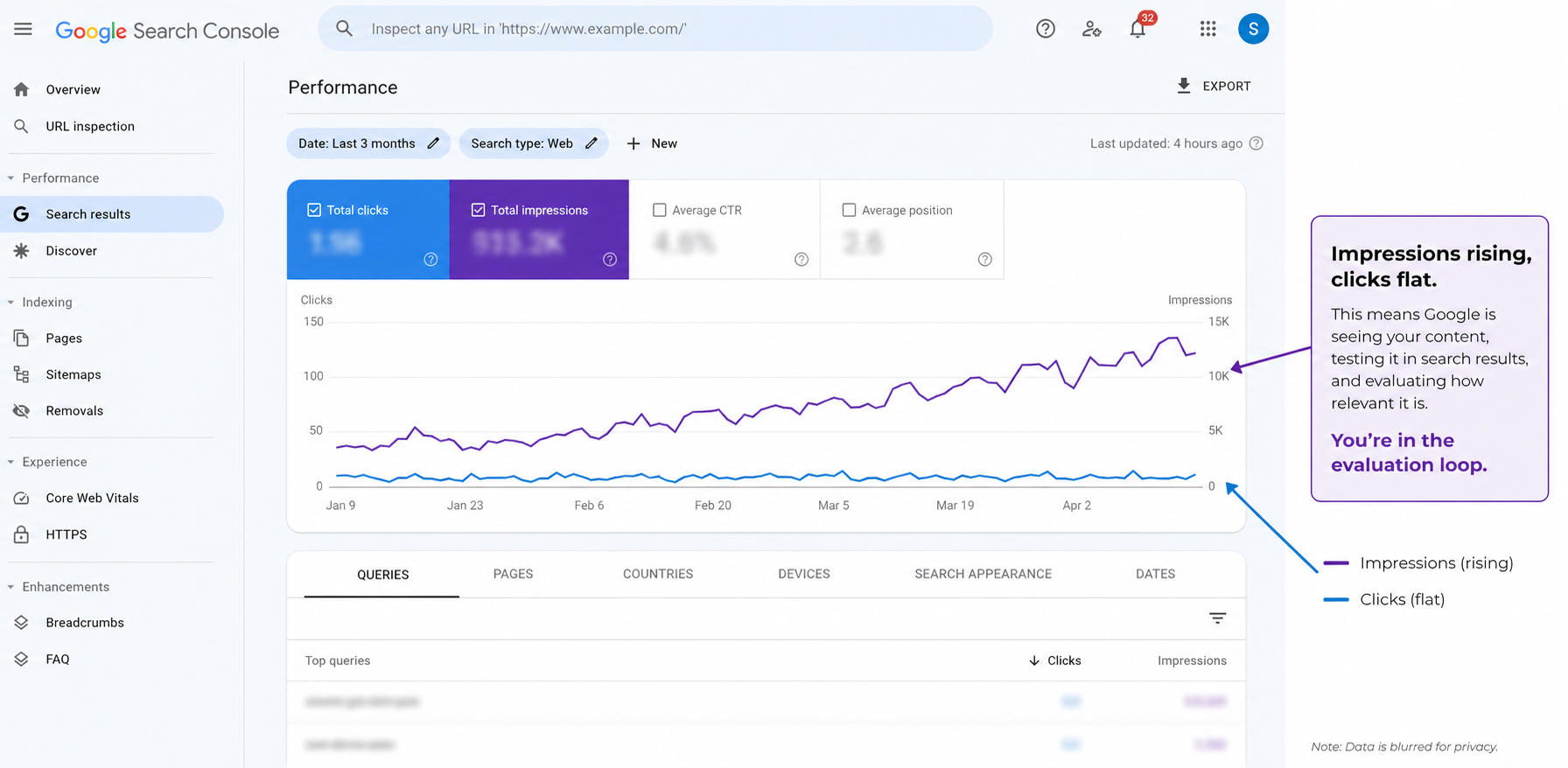
~ Impressions trending upward steadily
~ A growing number of queries triggering your pages
~ Average position remaining low or volatile
~ Clicks staying flat or near zero
That divergence, rising impressions with flat clicks, is not a problem.
It’s a sign that your content has entered the discovery layer of search.
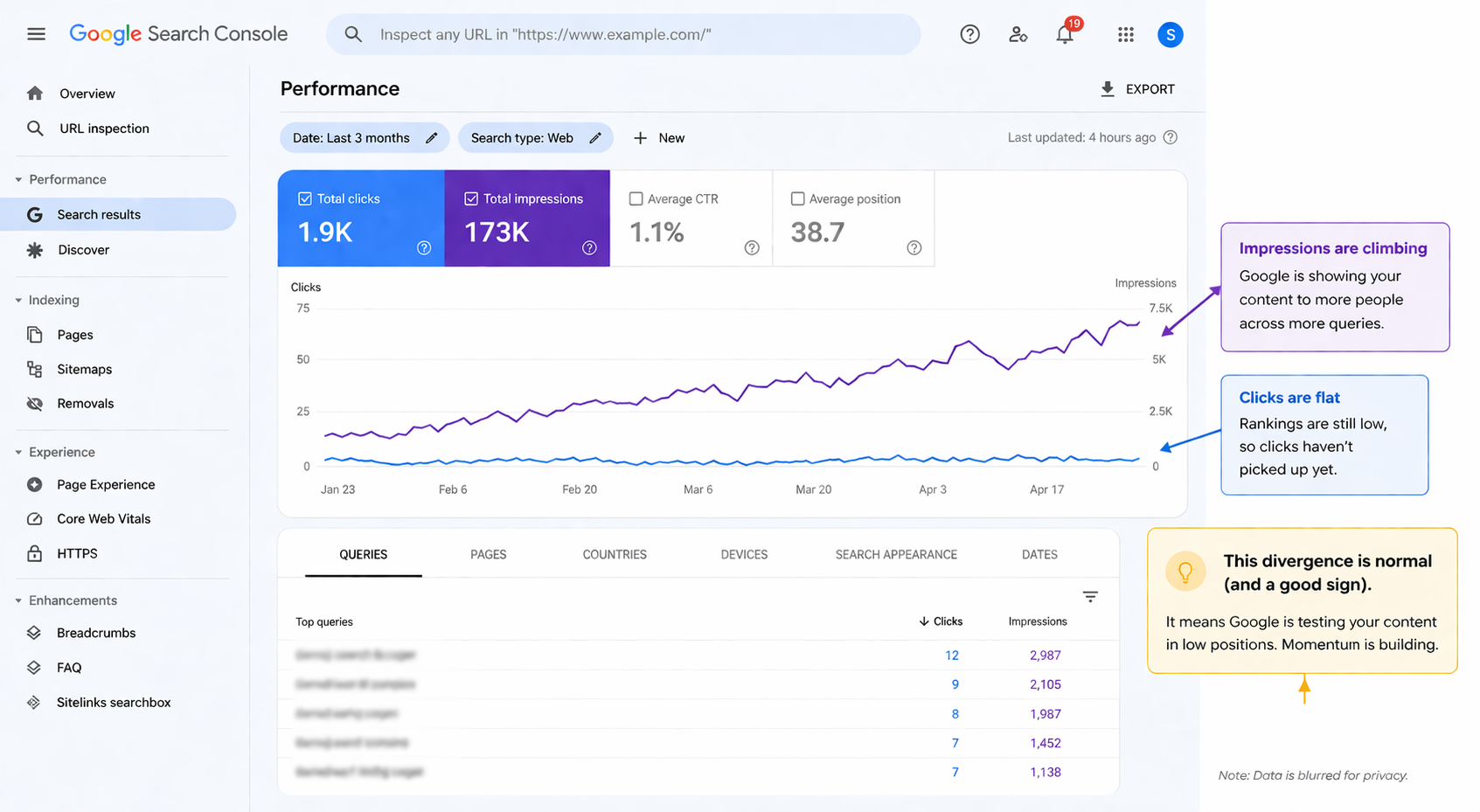
Let’s now delve deeper into understanding why clicks lag and why that’s normal.
So, clicks depend on visibility, and visibility depends on ranking position.
If your page is sitting in positions 20–60, it can generate thousands of impressions while still driving almost no clicks.
So flat traffic at this stage isn’t a performance issue; it’s a positioning issue.
Until your content moves closer to page 1, traffic will remain artificially suppressed.
Now, most teams optimize for traffic too early.
But the real question at this stage is, “Are we being shown at all?”
Because if impressions are rising:
~ Google has indexed and understood your content
~ your pages are eligible for relevant queries
~ and your keyword footprint is expanding
If impressions are not moving, then you likely have issues with indexation, internal linking, content relevance, or overall site authority.
This phase is your entry point into search visibility.
Everything that follows, rankings, clicks, conversions, depends on this layer working first.
Impressions are not a vanity metric here. They’re a leading indicator of relevance and discoverability.
That’s the actual sequence.
3. Branded search volume begins to increase
This one rarely shows up in standard reports.
But once you see it, you don’t ignore it again.
You’ll start noticing your brand name appearing in search queries and combinations like “[your brand] + service/category.”
Here’s what this actually indicates. This isn’t just visibility, it’s memory.
Your content is being discovered, associated with a category, and later searched for directly.
This matters because SEO isn’t just capturing existing demand; it’s shaping future demand.
And that shift happens earlier than most teams expect.
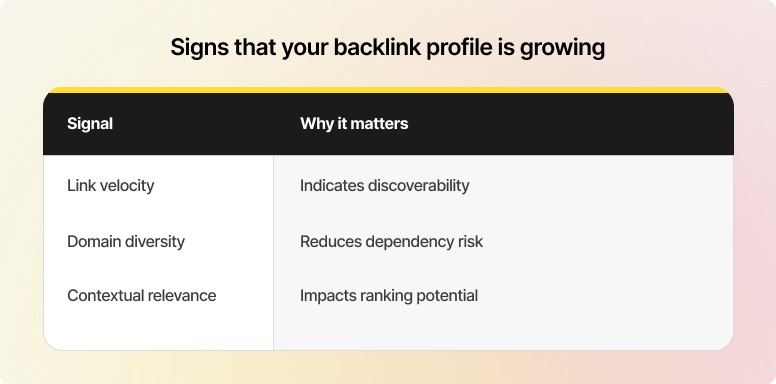
4. Your backlink graph moves before the authority does
Let’s get one thing straight; Domain Authority is not an early signal. It’s a delayed reflection.
What we actually watch is new referring domains, consistency of link acquisition, and contextual relevance.
An early-stage truth is that if your content is good, links start appearing, even before rankings.
Not viral spikes, albeit just steady, credible growth.
One should watch out for;
~ Are new referring domains appearing at all?
~ Is link growth consistent (not spiky)?
~ Are links contextually relevant to the content?
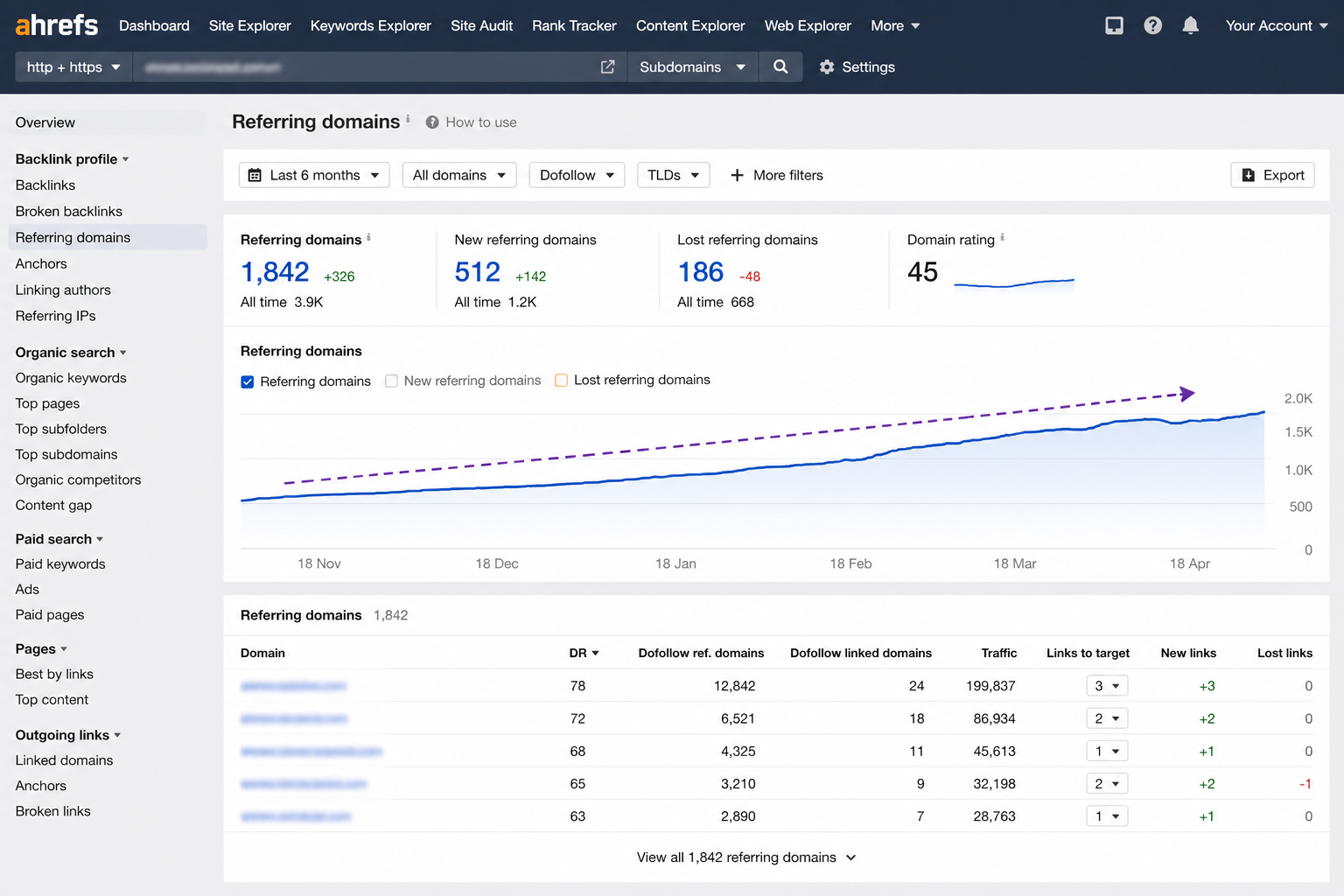
If links are starting to come in even slowly, your content is being discovered outside your own ecosystem.
That’s a completely different level of validation.
Here’s what matters;
So, if links aren’t showing up at all, something’s off.
While good content helps, links don’t appear automatically.
If there’s zero movement here, it’s often a distribution problem, not just a content problem.
5. Engagement improves before traffic scales
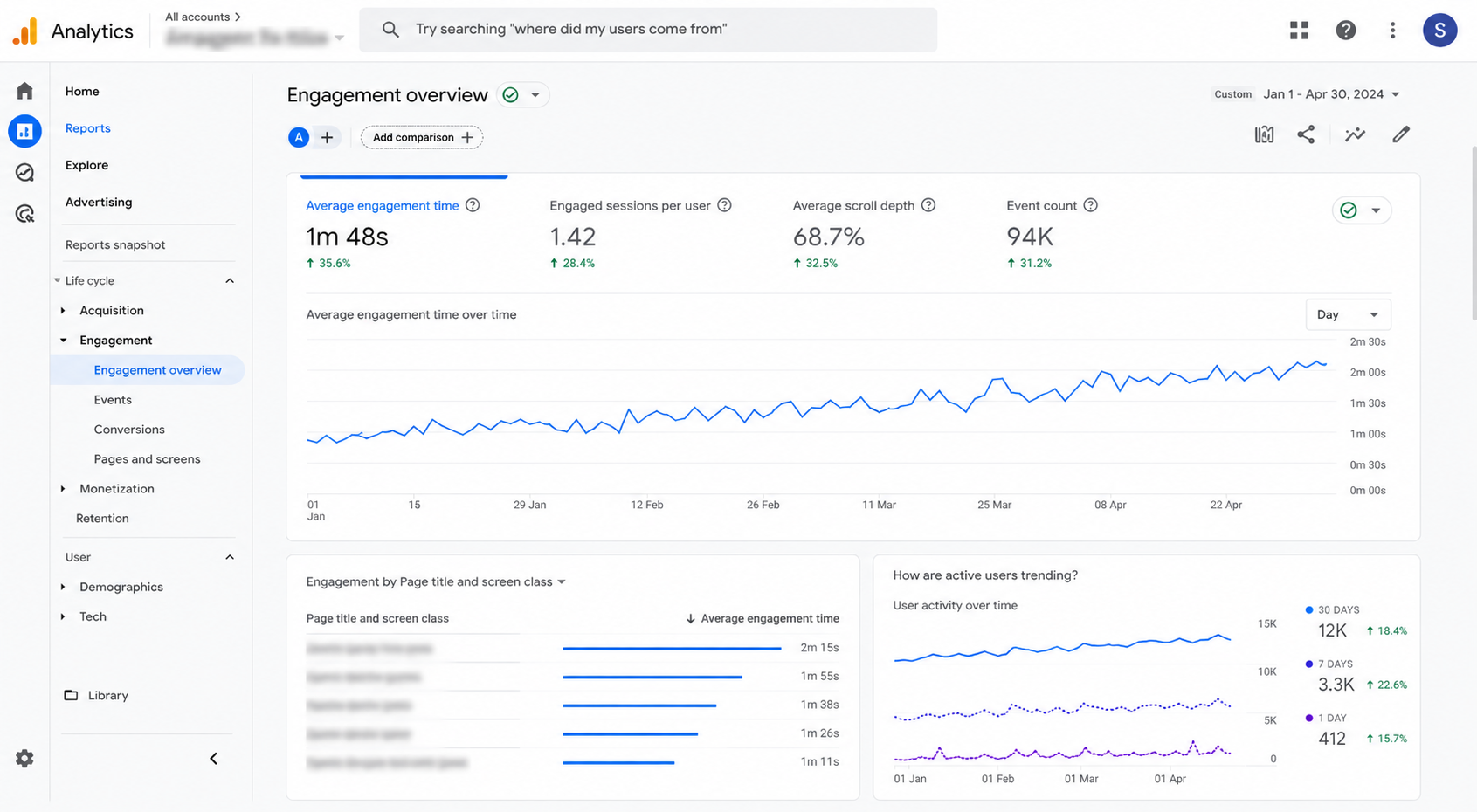
While most teams obsess over traffic, we care about what happens after the click.
Because Google does too.
Some early engagement signals to look out for are longer time on page, deeper scroll depth, and lower bounce rate on key pages.
This means that your content is landing, even if traffic is still small.
The hard truth is that if users don’t engage now, more traffic won’t fix it later.
6. Page 2 rankings are where SEO actually begins
Honestly, no one celebrates page 2 rankings, but in reality, they should.
Because this is where campaigns either break through or stall.
Here’s what you will start seeing;
~ keywords entering positions 8–20
~ long-tail queries gaining traction
~ increasing keyword footprint
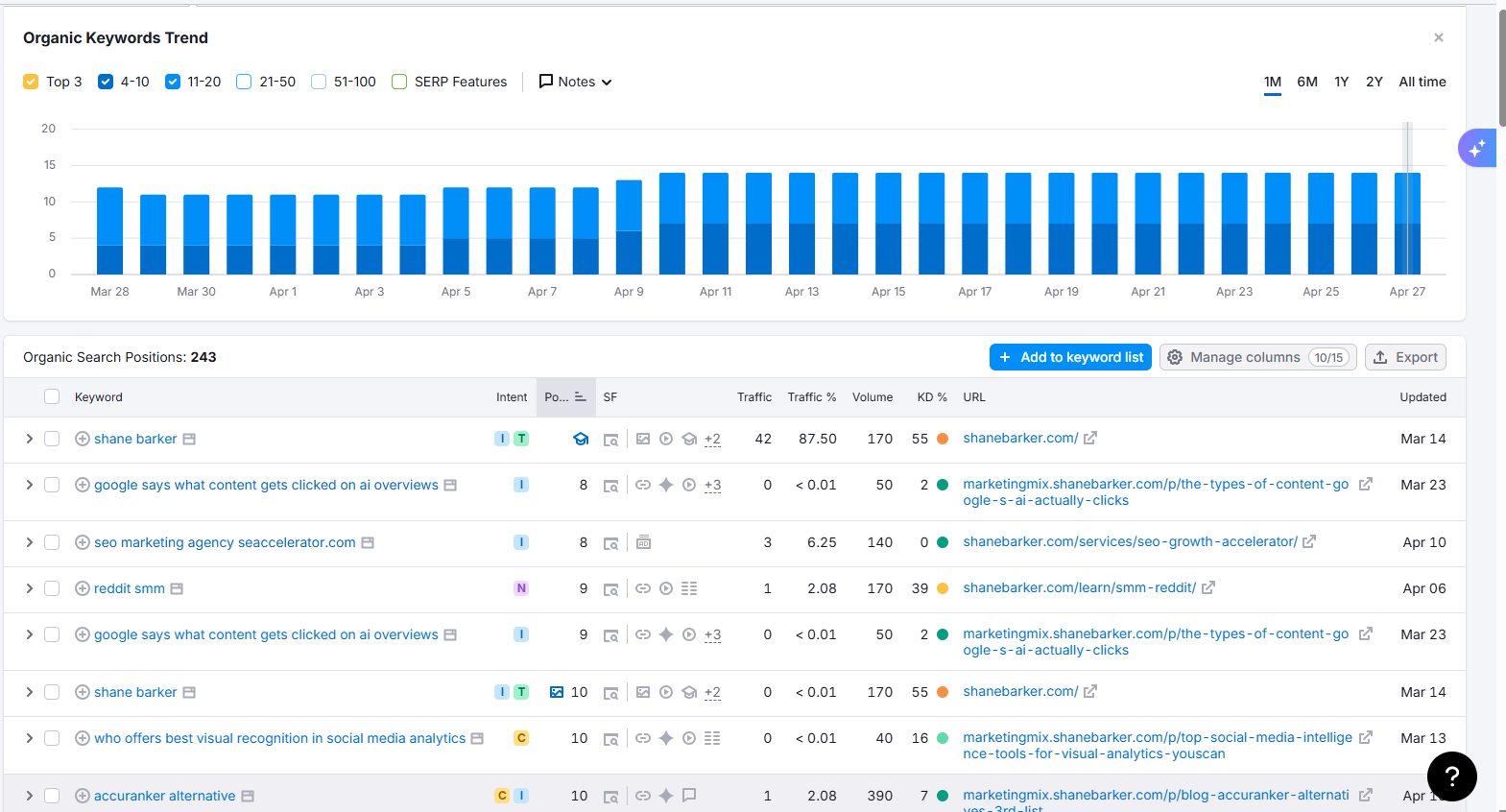
You are basically one optimization cycle away from ranking on page 1.
This is where smart teams act by refreshing content, tightening intent match, and strengthening internal links.
Most teams ignore this window, and that’s why they plateau.
What NOT to measure (If you care about reality!)
Let’s get down to discussing the SEO metrics that one must refrain from tracking early in the game.
1. Domain Authority
It’s slow, external, and irrelevant in early stages.
2. Page 1 rankings in 60 days
While this can be possible in edge cases, it can be dangerous as a benchmark.
3. Traffic spikes
Traffic is a lagging indicator, and one shouldn’t steer a campaign by relying on it.
4. Simply publishing content
Publishing is the first step in the journey; distribution, indexing, and validation determine the outcomes.
How to track SEO success without overcomplicating it
Honestly, you don’t need 50 dashboards; you just need one that tells you the truth.
Here’s a 90-day SEO health framework that you can print and tack on your team’s vision board!
1. Weekly signals (non-negotiable)
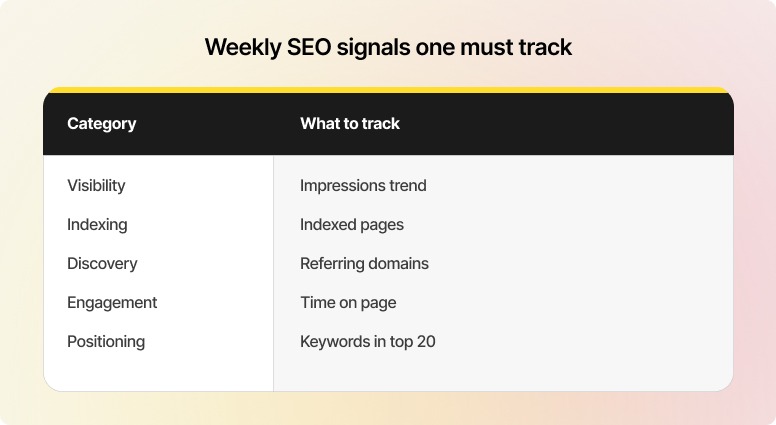
2. Monthly lens
By the month’s end, ask yourself the following questions;
~ Is visibility expanding?
~ Are more queries appearing?
~ Is engagement improving?
If the answer is a resounding yes, you’re on track.
Decoding the AI layer: Reading signals faster (Not replacing SEO)
Let’s address the shift most teams still underutilize.
AI doesn’t make SEO faster in execution.
On the contrary, it makes pattern recognition, prioritization, and interpretation exponentially sharper.
That distinction matters.
Because the bottleneck in modern SEO isn’t access to data, it’s making sense of it early enough to act.
1. AI-powered GSC analysis
At its simplest, this starts with a data export.
You pull your Search Console data and run structured prompts like, “Show queries with rising impressions but below-average CTR” or, “Identify queries where position improved but clicks didn’t follow.”
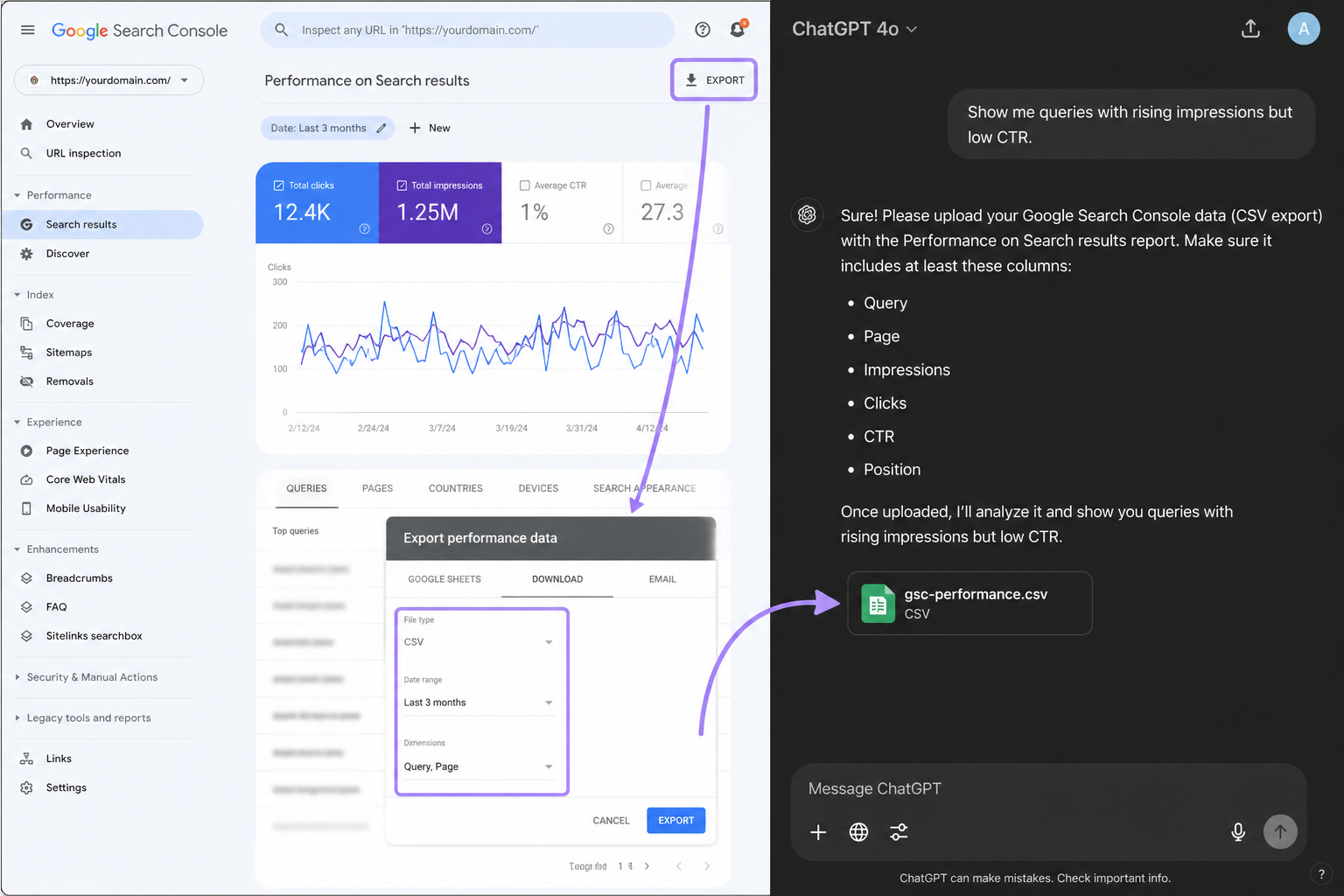
But the real value isn’t in the prompt.
It’s in what you’re able to see earlier than before.
Here’s what this unlocks for you;
~ Early opportunity clusters → queries gaining visibility before competition intensifies
~ Underperforming pages → where rankings exist, but click potential is underutilized
~ Hidden keyword trends → long-tail variations that don’t surface in standard views
These are not new signals.
What changes is your ability to connect them at scale, before they become obvious.
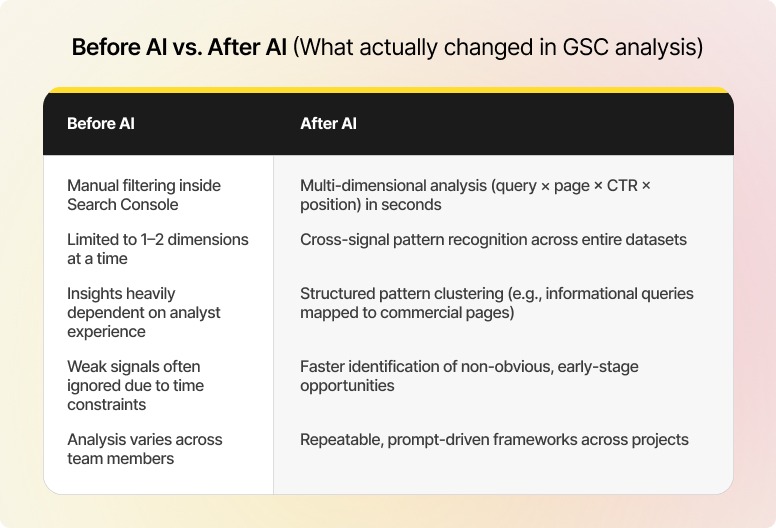
Let’s now take a look at how AI has optimized GSC analysis.
2. Automated early signal tracking
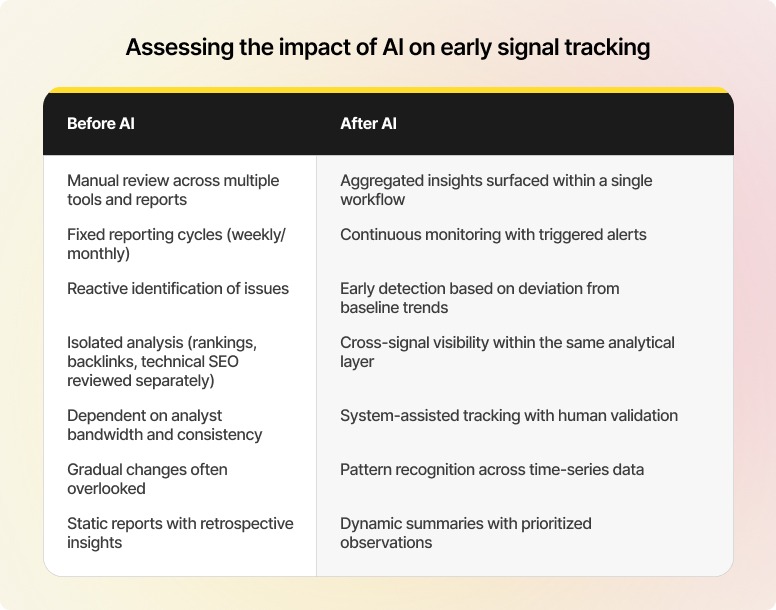
Tools like Semrush Copilot and Ahrefs AI do something that most teams don’t; they connect signals over time.
What you get is weekly SEO health summaries, anomaly detection, and trend clarity without manual digging.
Basically, you don’t need more data. You need better interpretation cadence.
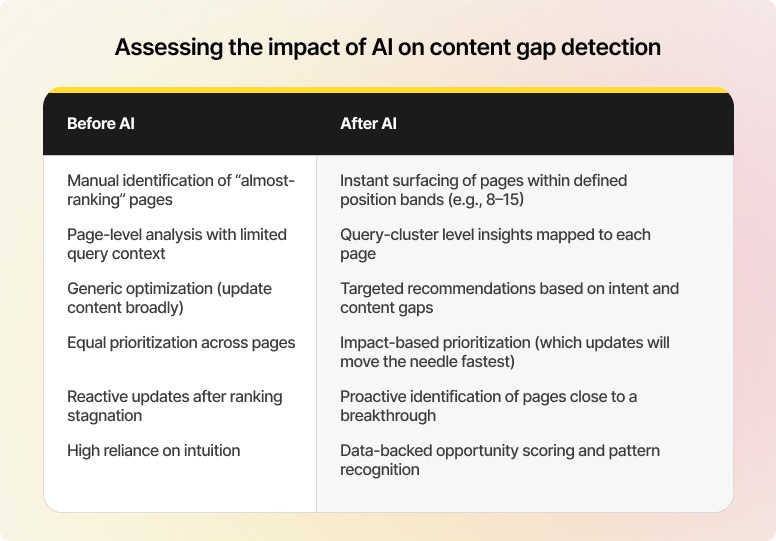
3. Content gap detection (Where growth actually happens)
The biggest wins rarely come from new content.
They come from almost-ranking content.
Pages ranking between positions 8 and 15 are sitting on the edge.
AI helps you identify these pages instantly, prioritize updates, and simulate optimization impact.
Small changes result in disproportionate gains.
We’ve seen 20–40% traffic lifts, without publishing a single new page.
When to be patient vs when to act
Now this is where experience shows.
One must stay patient when impressions are rising, keyword footprint is expanding, and engagement is improving.
Even if traffic is flat and rankings haven’t broken through.
However, you must intervene when;
~ pages aren’t getting indexed
~ impressions are stagnant
~ no new keywords are appearing
~ engagement is weak
A caveat here is that, if none of the early signals show up within 90 days:
It’s not a timing issue; it’s a strategy issue.
The only way to think about SEO ROI early on
To reiterate, in the first 90 days, you are not measuring revenue; instead, you are measuring trajectory.
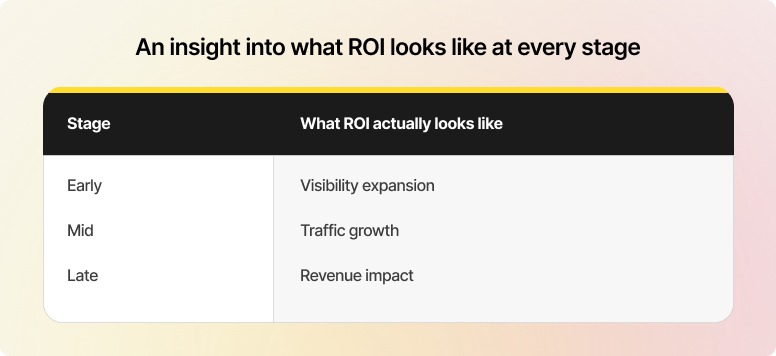
Simply put, no visibility equals no traffic, which ultimately translates into no revenue.
In summary
If you’ve read this far, the takeaway should be clear.
SEO doesn’t fail in the early stages. Interpretation does.
Most teams abandon SEO at the exact point where it starts sending the right signals, just not in the form they expect.
They look for traffic when they should be looking for a trajectory.
Over the next 90 days, stop asking, “Are we ranking yet?”, or “Where is the traffic?”
Instead start asking:
Are more pages getting indexed consistently?
Are impressions expanding across new queries?
Is our keyword footprint growing?
Are engagement signals improving on the pages that do get traffic?
Are we seeing movement toward page 2 (positions 8–20)?
Because if these signals are trending in the right direction, SEO is working, whether it looks like it or not.
If you’re still unsure where you stand
Don’t guess.

.png)
.png)