




Table of contents
Get in touch
Expect response in 4 hours.

Excerpt: Wondering if Shopify is to blame for your development bottlenecks? Here’s a ready reference of probable bottlenecks and their fixes!
As a project manager or delivery head, you are privy to a specific kind of unsettling silence that creeps into a Shopify project when things begin to go off track.
There are no alarm bells ringing or dramatic failures, just a Slack thread that goes quiet, a sprint that quietly rolls over, or a client who starts asking, “Hey, just checking, are we still on track?”
And you finally realize that this isn’t a technical problem anymore.
It’s a delivery problem.
Because across the industry, the pattern is consistent:
~ Research from the Project Management Institute shows that unclear requirements and scope creep are among the leading causes of project delays and failures.
~ And even small performance delays matter; studies show that as page load time increases from 1 to 3 seconds, bounce rates can rise by over 30%.
Here’s the uncomfortable truth: most agencies don’t say out loud, Shopify projects rarely get delayed because Shopify is difficult.
Instead, they get delayed because the way work moves inside the agency breaks down.
Not all at once. But in small, compounding ways, such as unclear briefs, messy handoffs, QA loops, and feedback spirals that stretch timelines without anyone noticing where things actually slipped.
If you’re an agency owner, delivery head, or project manager, this isn’t unfamiliar territory.
And this blog isn’t going to give you another generic list of Shopify development challenges.
Instead, we’re going to zoom in on exactly where Shopify projects get stuck in real agency workflows and, more importantly, how fixing those process gaps (not just adding more people) leads to faster, more predictable delivery.
While Shopify isn’t the bottleneck, it’s not blameless either!
While it’s tempting to point fingers at the platform, and yes, Shopify does have real constraints, such as theme architecture limitations, app dependency risks, and performance trade-offs when overextended.
But in most agency environments, those aren’t what derail timelines.
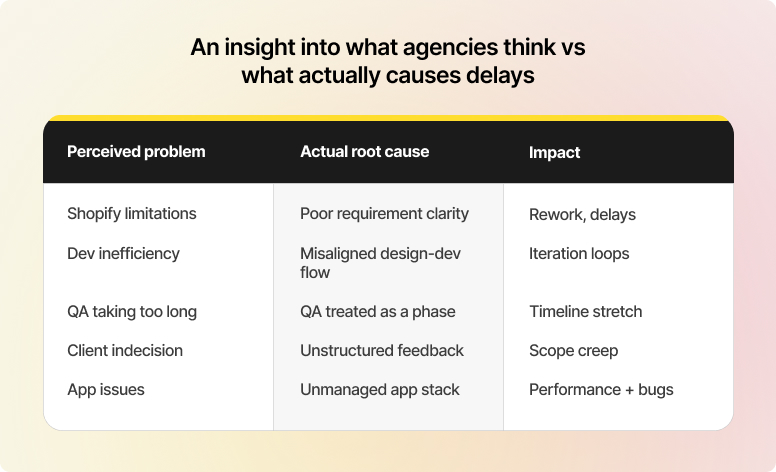
What actually causes Shopify development delays is a combination of the following factors;
~ Unclear or evolving requirements
~ Misalignment between design and development
~ Underestimated QA effort
~ Fragmented client feedback
~ Over-reliance on third-party apps
In other words, the platform introduces constraints, and the workflow turns those constraints into delays.
That distinction matters, because it tells you where to fix things.
Bottleneck 1 ~ The “looks good to me” brief
Now, let’s understand where things actually go wrong.
The project kicks off with what feels like a solid brief, there’s a Figma file, a few Loom walkthroughs, and some client notes.
Everyone nods, and work begins.
But here’s what’s amiss: edge cases, functional logic, clear acceptance criteria, and defined behavior for real-world scenarios.
And that’s where the first crack appears.
Here’s what this turns out to be later;
~ Developers make reasonable assumptions
~ QA tests based on interpretation
~ Client's review based on expectation
And suddenly, you’re not building, you’re reworking.
How to fix it
You need to move from “design handoff” to execution-ready documentation, and
~ Define behavior, not just layout
~ Document edge cases explicitly
~ Add acceptance criteria per component
~ Align on what “done” actually means
Looking for a simple test? Well, if QA has to ask questions, the brief isn’t complete.
Bottleneck 2 ~ The design that doesn’t survive development
The design might look perfect in Figma, but when development starts, reality pushes back.
Shopify theme constraints might kick in, app limitations could surface, or performance trade-offs might appear.
Wondering what happens next? Developers begin to approximate, designers push for fidelity, iterations increase, and timelines begin to stretch.
Now, this is one of the most common, but rarely acknowledged, Shopify store development issues.
Because the data tells a very different story.
~ Research from the Project Management Institute shows that 52% of projects experience scope creep or uncontrolled changes.
~ Even high-performing teams still see nearly 1 in 3 projects impacted.
And in less mature environments, that number rises significantly, along with wasted budget and delivery delays.
In other words, what agencies often label as “development issues” are, more often than not, process gaps surfacing late in the project lifecycle.
When you seek to identify the real problem, you realize that design and development are happening in sequence, not in alignment.
How to fix it
To solve for this bottleneck, you need to introduce a technical validation layer before development begins.
Run a Design Feasibility Review and involve developers before design sign-off.
Ensure that you flag;
~ What’s native vs app-dependent
~ What impacts performance
~ What requires custom logic
Also, build a Shopify-aware design system that is not just brand-driven, but platform-informed.
Bottleneck 3 ~ QA as a phase (Instead of a system)
The traditional flow looks like ~ Dev → QA → Fix → QA → Fix → QA, and just like that, timelines start stretching without visibility.w
This happens because QA is treated as something that happens after development.
But in Shopify projects, issues often surface only when real data is tested, apps interact, and edge cases are triggered.
This leads to long QA cycles, repeated bug loops, delayed UAT, and frustrated teams, which is a classic example of Shopify project delivery challenges.
How to fix it
Make it a point to;
~ Test features during development
~ Introduce developer self-QA
~ Use acceptance criteria as QA checklists
~ Validate edge cases early
Bottleneck 4 ~ The app stack that grows quietly out of control
Shopify’s app ecosystem is powerful; it’s also one of the most underestimated sources of Shopify development issues.
So, what starts as convenience turns into complexity, you initially install apps for reviews, upsells, subscriptions, and bundles.
Individually, they work; however, together they introduce script conflicts, performance overhead, UI inconsistencies, and integration dependencies.
However, what agencies often miss is that apps don’t just add features; they add risk surfaces.
How to fix it
Adopt a minimum viable app stack mindset and audit every app by seeking clear answers to;
~ Is it essential?
~ Can Shopify handle this natively now?
Replace heavy apps with lightweight custom logic (where it matters) and map dependencies across features.
And most importantly, test how apps behave together, not in isolation.
Bottleneck 5 ~ Feedback that breaks the flow
It’s important to know that client feedback is not the problem; however, unstructured feedback is.
Wondering what this looks like in reality?
Well, this is what it might look like;
~ Feedback comes via email, Slack, and calls
~ Multiple stakeholders weigh in
~ Inputs conflict
~ Changes come after approvals
And suddenly, timelines aren’t predictable anymore.
This is one of the biggest drivers of Shopify project delays.
Across agency discussions and community threads, a recurring pattern shows up: “Small changes from clients aren’t actually small in Shopify.” “Late feedback impacts multiple templates.” “We spend more time managing feedback than building.”
These aren’t edge cases; they’re operational realities.
How to fix it
We suggest creating structured feedback loops:
~ Centralize feedback in one system
~ Define review windows per phase
~ Limit decision-makers
~ Introduce change request protocols after sign-off
Set expectations early, as post-approval changes can affect scope, timeline, and cost.
Bottleneck 6 ~ The never-ending final 10%
Every agency knows this phase where the project is “almost done” and stays there.
This happens because the final stage is rarely defined properly.
It becomes a mix of minor bugs and content gaps, performance tweaks, and last-minute refinements.
This leads to unpredictable launch timelines, team fatigue, and client frustration.
How to fix it
We recommend turning the last 10% into structured milestones by;
~ Code freezing date
~ Compiling QA completion criteria
~ Content lock deadline
~ Pre-launch checklist
It’s also recommended to treat launch like a controlled event by;
~ Assigning ownership
~ Running go-live rehearsals
~ Preparing rollback plans
Bottleneck 7 ~ Migration fear (And why it’s valid)
When Shopify projects involve migration, the stakes go up significantly.
Clients aren’t worried about design; they’re worried about traffic drops, SEO loss, broken URLs, and checkout failures.
And to be fair, these risks are real.
Migrations go wrong not because of Shopify, but because of
~ Poor URL mapping
~ Missing redirects
~ Incomplete data migration
~ Insufficient testing
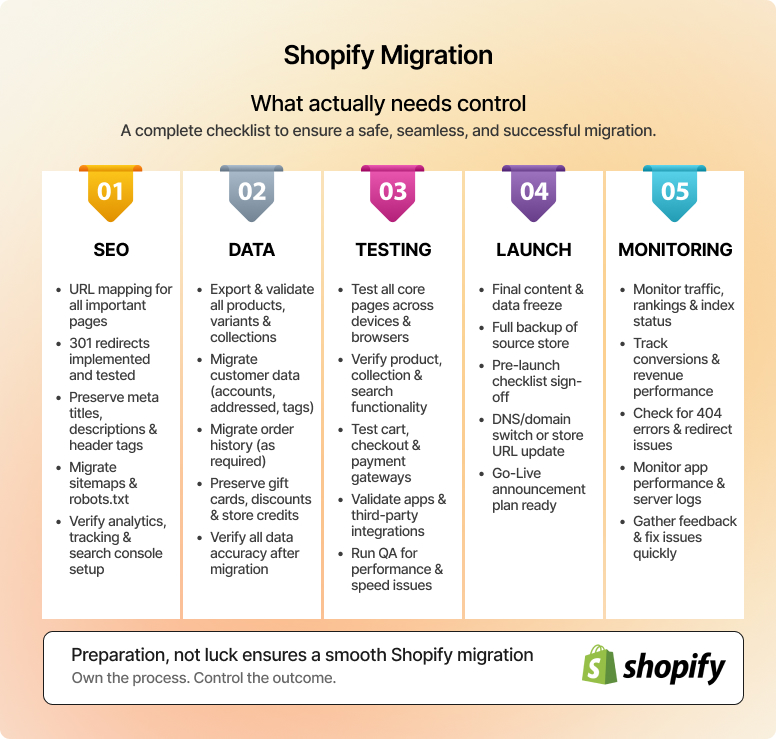
In order to fix it, build migration as a first-class workflow, not an afterthought:
1. SEO continuity
~ URL mapping
~ 301 redirects
~ Metadata migration
2. Data validation
~ Products
~ Customers
~ Orders
3. Pre-launch testing
~ Checkout flow
~ Payment gateways
~ Mobile UX
4. Controlled launch
~ Staging validation
~ Gradual rollout (if possible)
5. Post-launch monitoring
~ Traffic trends
~ Conversion rates
~ Errors
Migration success comes down to preparation, not luck.
Highlighting the pattern that most agencies miss!
If you zoom out, a pattern becomes obvious, that is a lack of talent or platform limitations does not cause most Shopify development bottlenecks. Instead, they’re caused by ambiguity, misalignment, poor flow, and lack of control in feedback and scope.
Technical issues do exist, especially around performance and apps.
But they become critical only when layered on top of broken workflows.
Decoding what high-performing agencies do differently
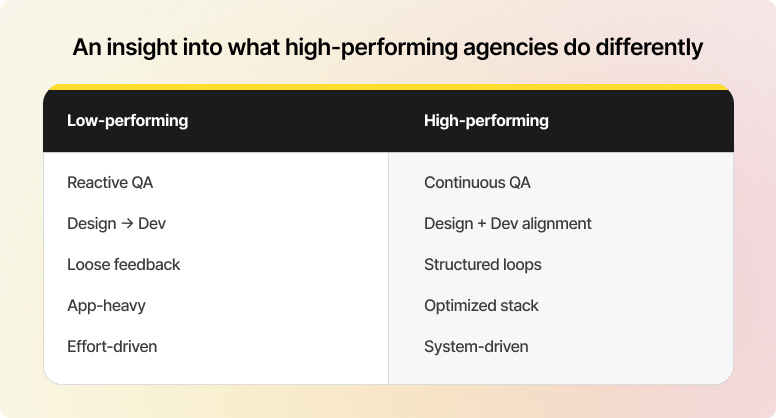
The agencies that consistently avoid Shopify project delivery challenges don’t just execute better; instead, they operate differently. This is what they do;
1. Design with development in mind
And not as a separate phase, but as a shared responsibility.
2. Treat documentation as a core deliverable
Something that is not optional, and not rushed.
3. Build structured feedback into the process
Not just around it.
4. Prioritize flow over speed
Because smoother execution always wins!
5. Systemize delivery from kickoff to launch
In summary
In the end, Shopify projects rarely fall apart in obvious ways.
They drift into oblivion, as a sprint rolls over, a dependency lingers, a Slack thread goes quiet, and somewhere in between, a client starts asking, “Are we still on track?”
What you’ve seen across these bottlenecks isn’t a collection of isolated issues.
It’s a pattern reflected in unclear inputs, fragmented ownership, delayed feedback loops, and reactive QA cycles.
Individually, they feel manageable, but together, they create the exact silence you felt at the start, where nothing is visibly broken, but everything is subtly off course.
And that’s the real takeaway!
Shopify delivery doesn’t break at the point of execution. It breaks in how the work flows between stages.
The agencies that scale this don’t move faster by chance; they move faster because they’ve designed for clarity at every handoff, from requirements to build to QA to launch.
If your projects feel slower than they should, harder than they need to be, or increasingly reactive, don’t start by asking, “Where did this go wrong?”
Instead, pause, reflect, and ask, “Where does clarity break in our process and how do we fix it before it compounds?”
Because once the flow is fixed, the silence disappears.
And in its place, you get something far more valuable; predictable delivery, confident clients, and a system your team can actually scale.

.png)
.png)