


Table of contents
Get in touch
Expect response in 4 hours.
%20Summit%2C%20May%2018%E2%80%9320%2C%202026_%20Three%20Days.%20One%20Reckoning.%20(1).png)
"It feels like this is a year when the status quo won't be enough." ~ Drew McLellan, CEO, Agency Management Institute, on why BABA 2026 existed in the first place.
He was right.
Three days in Denver, May 18-20, 2026. Twelve sessions. More than 350 agency leaders in the same room, wrestling with the same question. And once Drew framed the stakes, the line that framed the substance came from Marcus Sheridan in his opening keynote, "Agencies must go from being disposable to being indispensable."
That isn't motivational language. It's a description of the cliff edge the industry is standing on.
The summit didn't give us a new playbook. It pressure-tested the one we'd already started building.
Below you will find a detailed description of what we took from each day, and the collective position we've come home with.
DAY 1 Takeaway: Proof is the new pitch
Our position: the era of pitching opinions is over. Every claim we make has to ship with the evidence type that matches it, and if it doesn't, it doesn't ship.
Day 1 belonged to data, but not in the way agency people usually mean that word. The Mercer Island Group put structure to something most clients already feel, that is, agencies don't lack information; they lack alignment between claim and proof.
Market claims backed by reports the client already owns. Customer "truths" are built on internal interpretation, strategy justified by benchmarks, and the exact average you're supposed to outperform.
Their four claim types are market reality, customer truth, strategic recommendation, and projected outcome, each of which demands a different type of evidence.
Mismatched evidence is worse than no evidence. It tells the client we're hoping they won't check.
Three case studies on Day 1 made the same point in three different ways.
Chemistry validated two competing campaign directions with controlled audience testing before walking into the Hannaford room.
New Engen pulled live behavioural signals from Reddit to map real customer emotion for Fidium Fiber, not workshop outputs.
BarkleyOKRP reframed success entirely: "Work that earns cultural relevance isn't built for attention, it's built for adoption."
Basically, different doors, same standard.
Neil Smith of Mile Marker named the failure most agencies are still committing, "They get too far into the process before bringing it up, and they focus on marketing metrics. Impressions are great, driving sales is better."
Adam Ortman of Kinetic319 closed the loop, "Measurement is the currency for any agency. It turns our work into evidence, evidence into trust, and trust into retention."
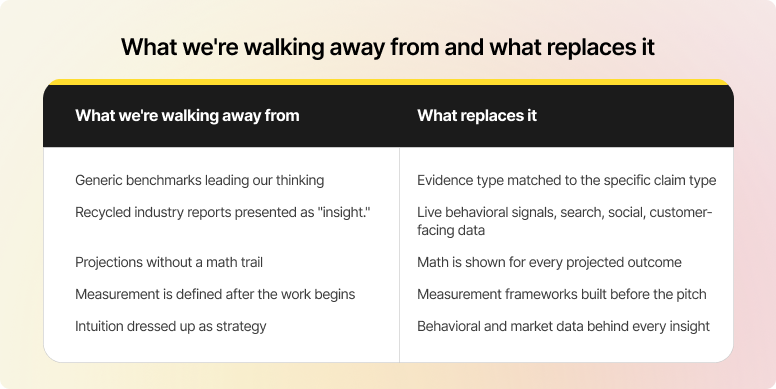
Simply said, if we can't show the work, we don't make the claim. That's it.
A roundup of the day’s takeaways in pixels!
DAY 2 Takeaway: The buyer has changed, the pitch hasn’t kept up
Our position: every Mavlers proposal must now earn its place in a conversation where marketing is not the only voice. Finance is in the room. Procurement is involved earlier. In-house teams are stronger. If the work we propose can be done internally, it will be, and we've stopped pitching for that work.
Robin Boehler of Mercer Island Group asked the room the question that defined the day, "The buyer has changed. Have you?" Most agencies, looking honestly, would have to answer no.
Her diagnostic for every agency in the room was unforgiving, "What do we do that a talented internal team genuinely cannot replicate? If you can't answer that in one sentence, that's your most important business problem. Not your pitch deck. Not your pricing. This."
And her warning about the new buying room cut even sharper, "If your proposals are full of reach, impressions, and engagement you are one budget cycle away from losing the account. Not because your work isn't good. Because your client can't defend you."
Marcus Sheridan stacked the structural pressure on top. The services he flagged as having no real future for agencies were "writing blog posts, managing social media, basic SEO, and running standard ad campaigns" because these are exactly the services AI compresses fastest.
His AEO reframe is the one we've adopted directly, "Stop talking about 'ranking' or 'page 1'. The question now is: Are we the answer? If not, what needs to change?"
The most useful counterweight to the doom narrative came from Brian Gerstner of White Label IQ, the summit's presenting sponsor, "Everyone was scared when AI arrived, but they are fighting the wrong fight. We all thought our clients were going to pull away from us, but instead they leaned in and asked us to be the experts they hired us to be."
That tracks with what Lori Highby showed in her LinkedIn session, authority no longer starts in the pitch room. LinkedIn is now the #2 most-cited domain across AI models, and the algorithm has shifted from connection-driven distribution (70% in 2024) to interest-graph distribution (50% in 2026).
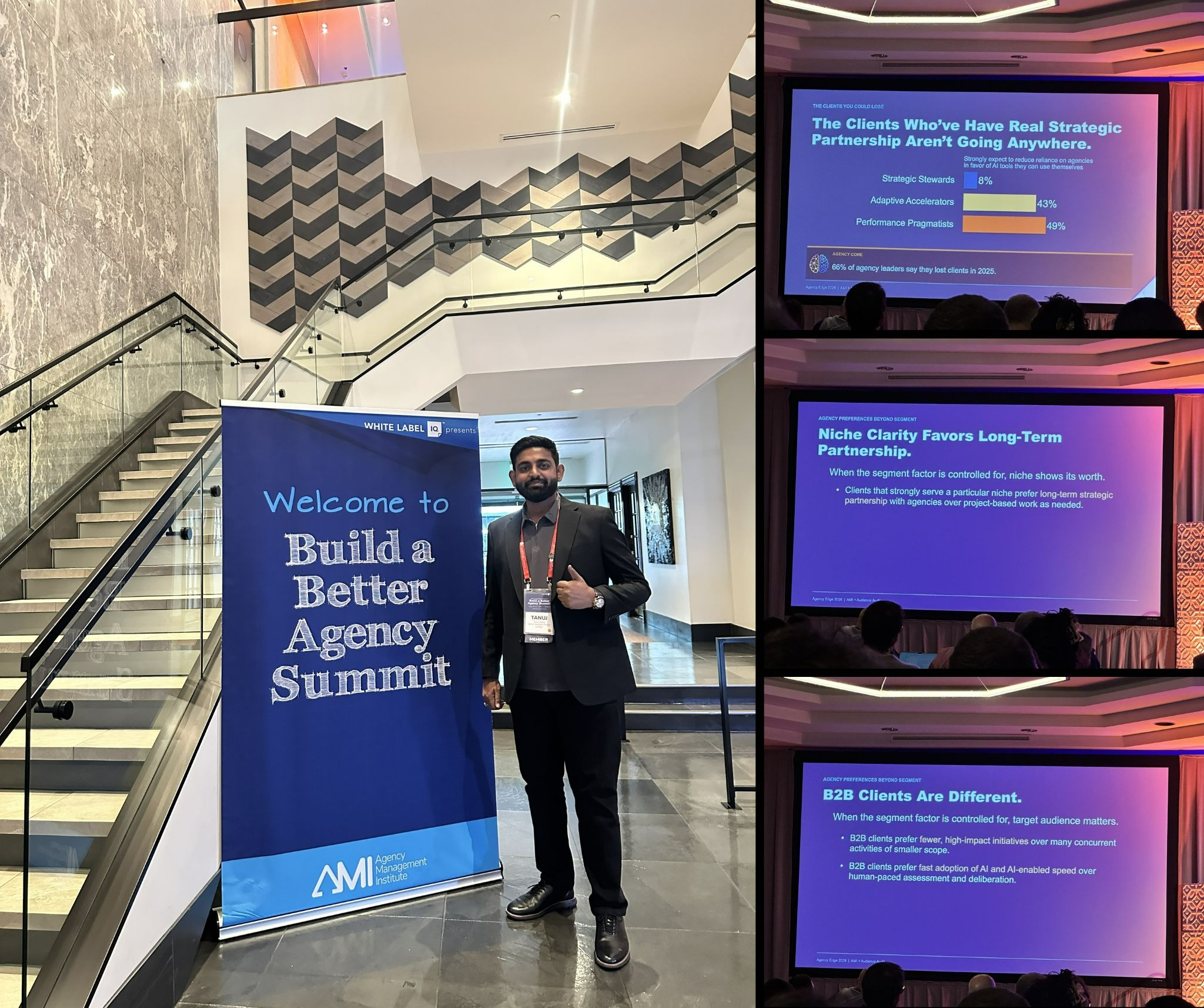
Niche clarity now travels further than network size. By the time a buyer is in a meeting with us, the evaluation is already over.
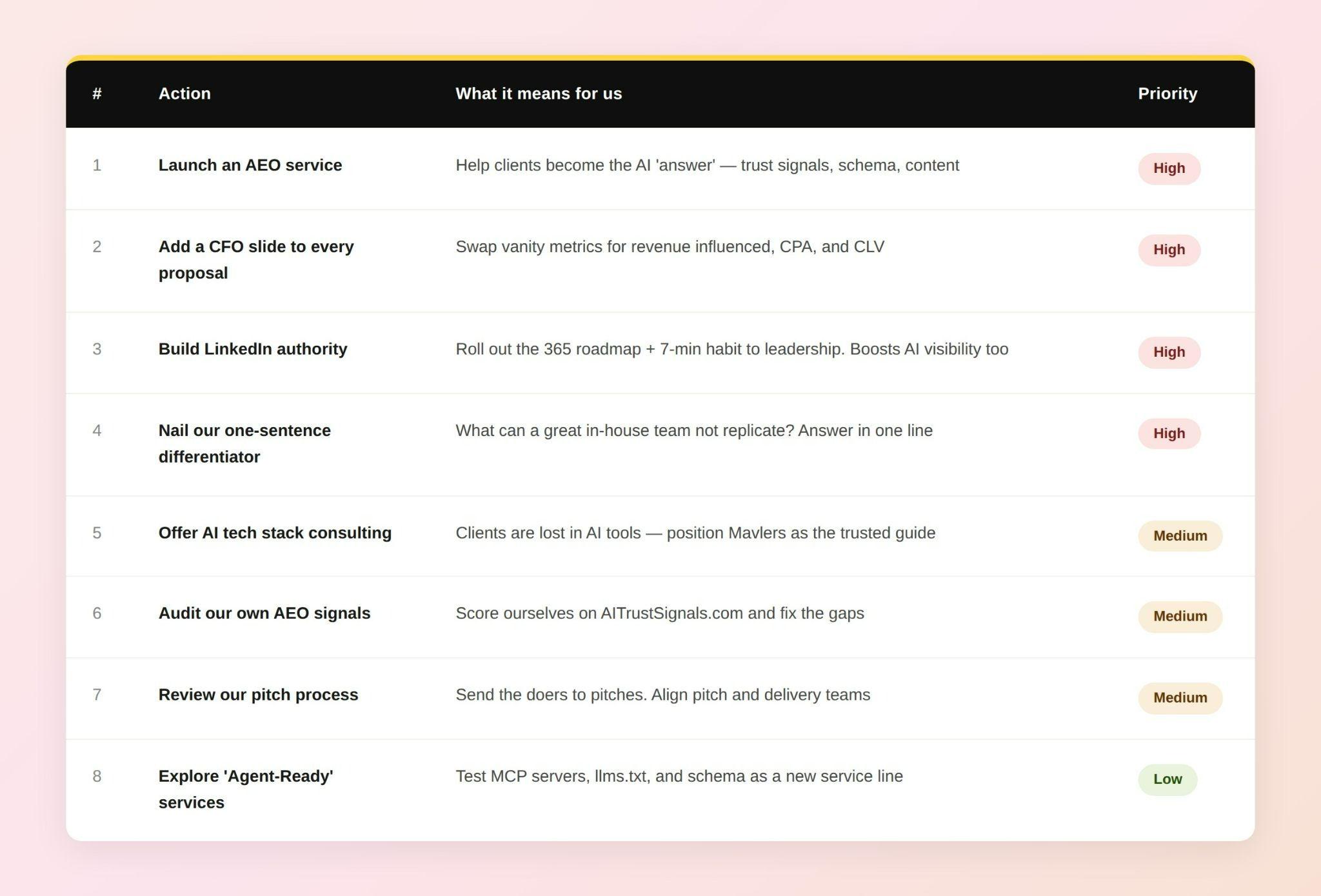
Based on the full Day 2 sessions, here are the highest-priority items for our team to discuss and act on:
Here’s what Day 2 of the summit looked like for us!
Day 3 Takeaway: The gap lies in execution, not knowledge!
Our position: the agencies that lose in the next 24 months won't lose on capability. They'll lose on follow-through. We're more interested in closing our own gaps than in benchmarking against the industry's.
Susan Baier and Brian Gerstner's "We Say / They Say" session held a mirror up and the numbers didn't blink.
Reading the AgencyCore data (what agencies believe) next to the Agency Edge data (what clients actually say) was the most uncomfortable hour of the summit:
~ 52% of agency leaders believe clients are questioning whether fees are worth it. → Only 29% of clients actually expect a fee reduction.
~ 95% of clients say a niche gives an agency a hiring advantage. → 46% of agencies have committed to one. Flat since 2022.
~ 82% of clients say AI transparency builds their trust. → 25% of agencies say they're fully transparent.
~ 57% of agency leaders can name the strategies that would solve their biggest problems. → Only 17% of clients say their agency is implementing them.
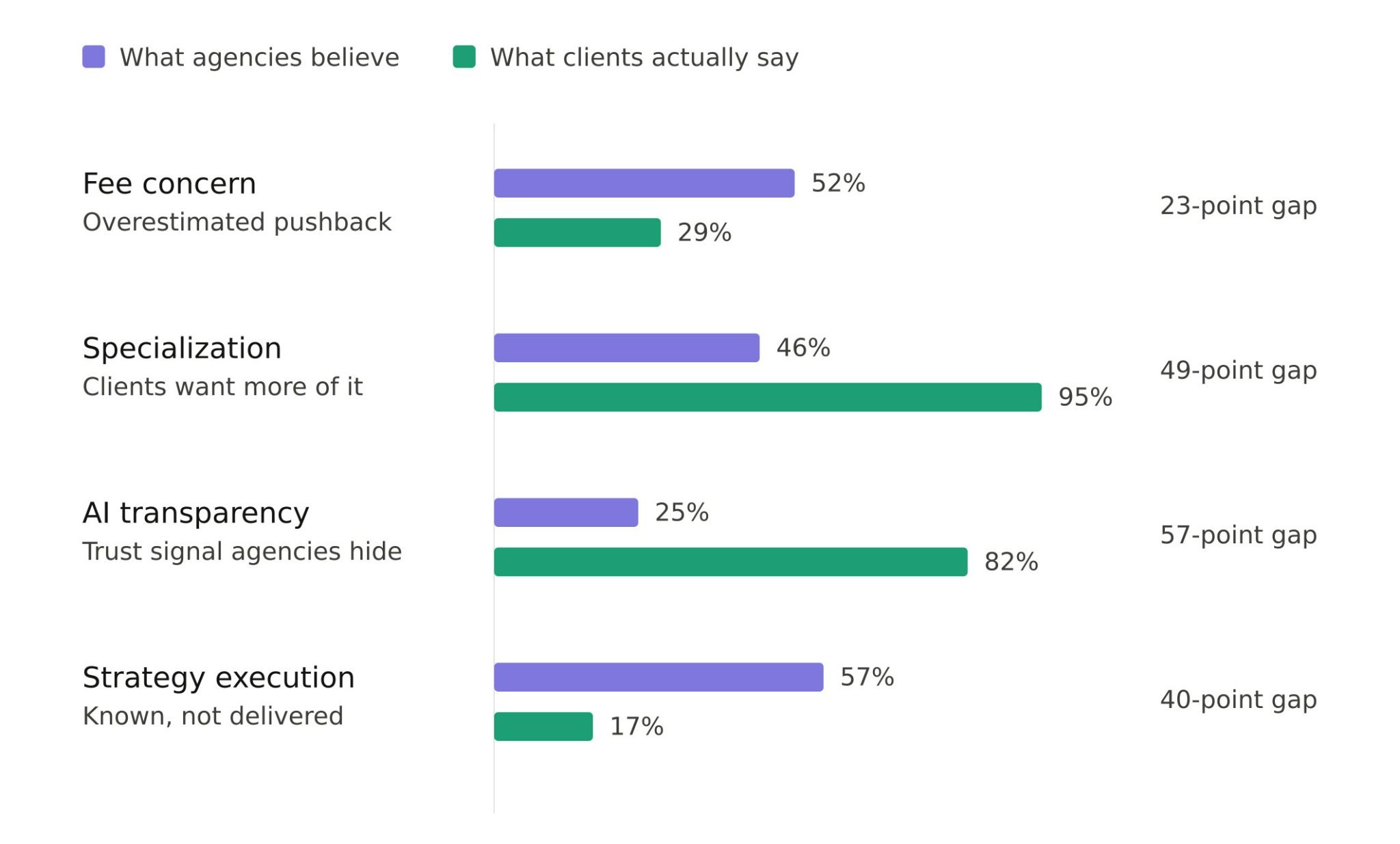
The pattern in every row is the same; agencies know the answer and aren't acting on it.
As Susan Baier summarised it at the summit, "All of the talks urged agencies to be strategic around AI. Also, be transparent in what you are doing."
The agencies treating AI transparency as a risk are reading the room exactly backwards.
Joe Pulizzi's session reinforced the same execution pattern, but for content.
His Content Inc. model is sequential and disciplined ~ find the sweet spot, define the tilt, commit to one platform for 12–18 months, build an owned audience, then diversify and monetize.
Most agencies invert it, they jump to monetization and skip audience-building.
His Trust Portfolio concept put the architecture in one line: the company is the platform, individuals are the distribution. And his directive was specific: "Launch three things in the next six months. Not thirty. Three."
Rishad Tobaccowala closed the summit with the reality check that pulled the whole three days together, "The future belongs to people and agencies who are interesting, not just competent. In a world where AI handles competence at scale, interesting is the new competitive moat."
What are we doing today that will make us more interesting and more trusted six months from now?
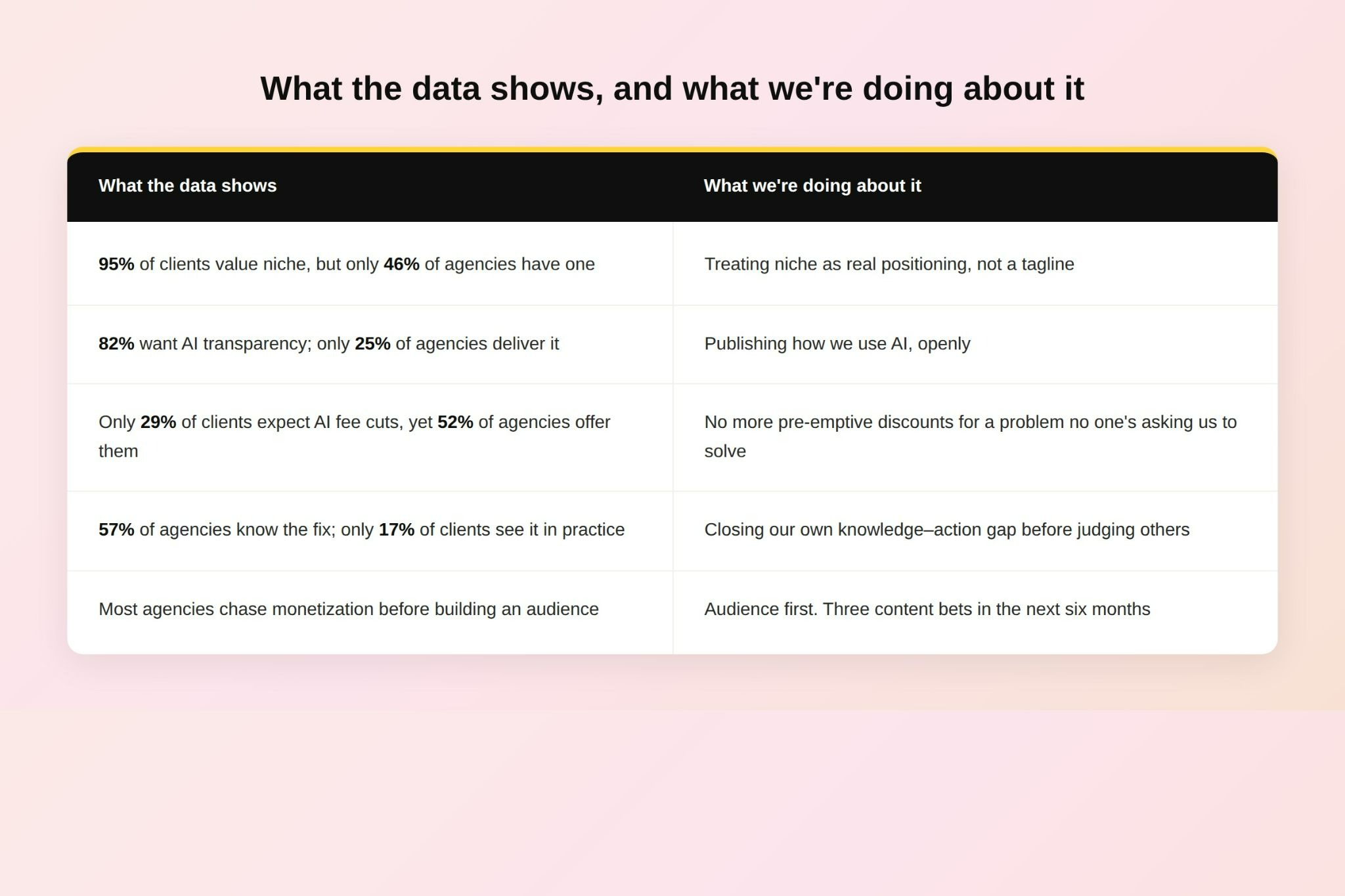
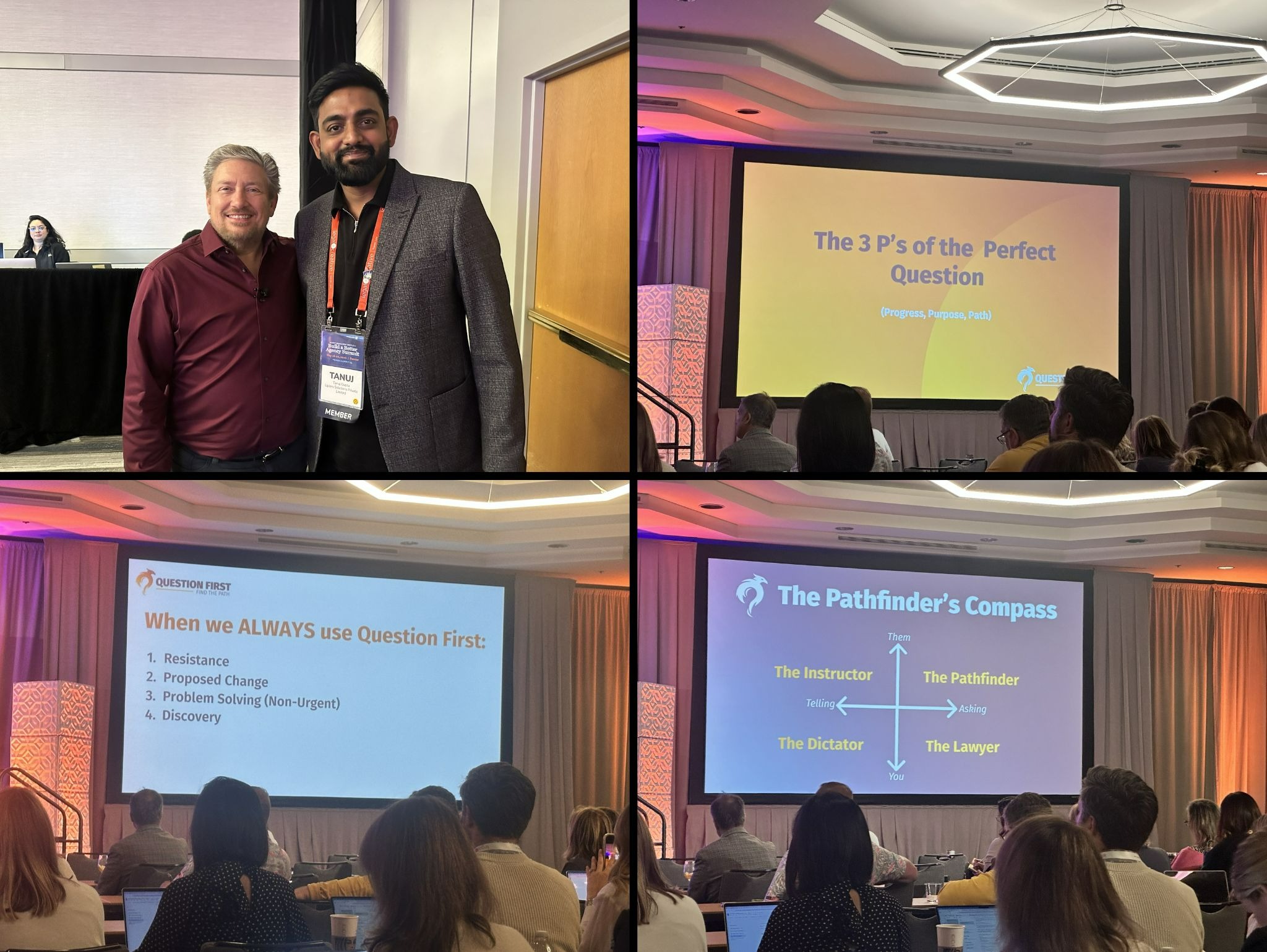
Here’s a sneak peek into Day 3 of the summit.
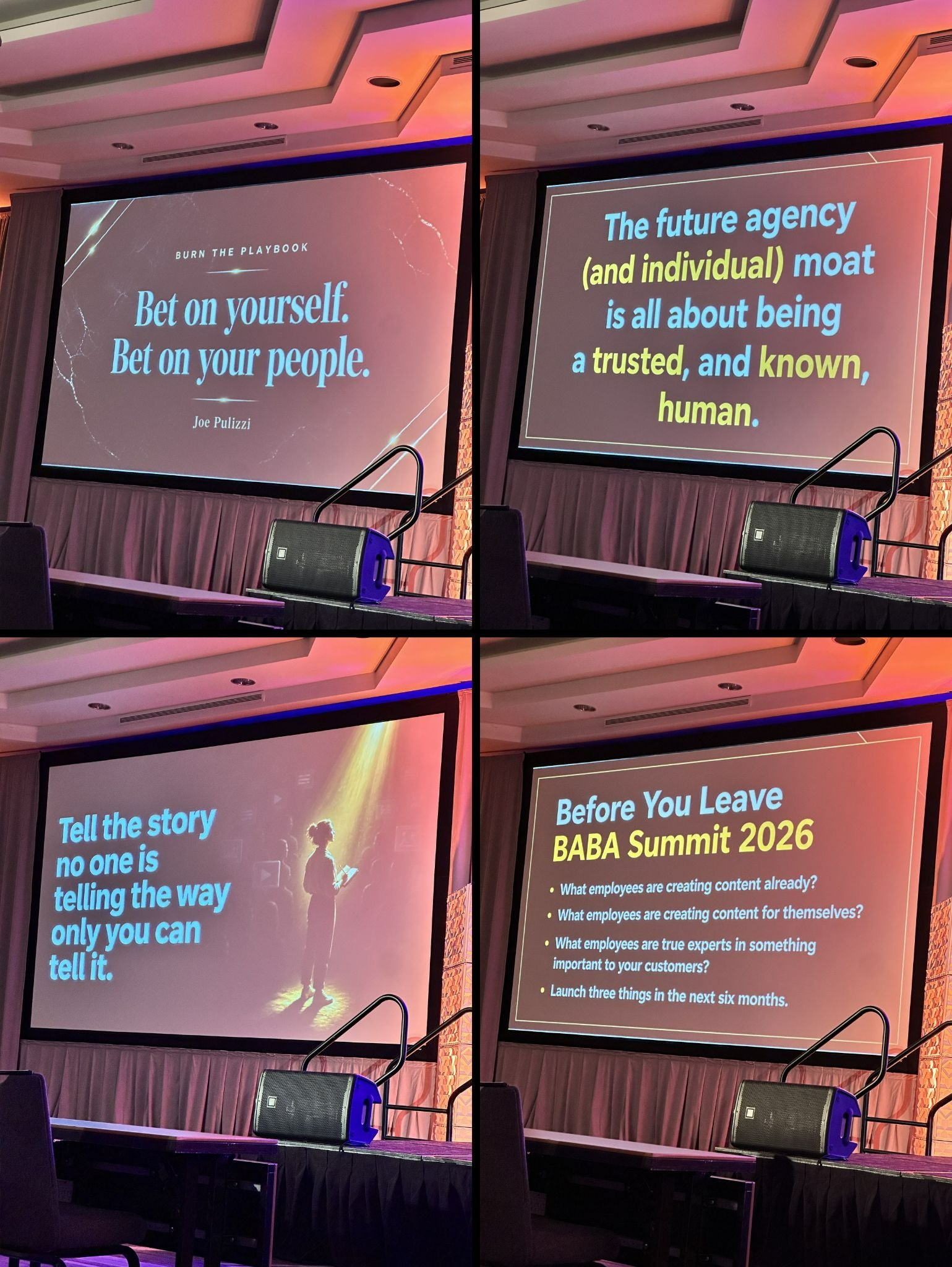
The collective takeaway: stop explaining, start showing.
Our position, post-summit: the gap between what an agency says and what its clients can actually point to is now the only competition that matters. Everything else such as AI, holding companies, in-housing, fee pressure, is downstream of that single fault line.
Every speaker pointed at the same fracture from a different door.
~ Sheridan: What you sell is getting commoditized, so go from disposable to indispensable.
~ Boehler: Every decision is being audited; pitch like a CFO is in the room, because one is.
~ Highby: Authority is earned before the pitch ever happens.
~ Baier and Gerstner: what you think you deliver isn't what clients are experiencing.
~ Pulizzi: no audience, no leverage.
~ Tobaccowala: What you know expires faster than you think.
Libby Olson of GROWL Agency framed it as the question every leader in the room had to sit with: "Will I keep choosing to be relevant? The act of freezing in place is what makes us irrelevant."
Tom Wadelton of Anders Virtual CFO put the timing on it: "Agencies will have to intentionally change their businesses more in the next three years than they ever have."
And as stated in the beginning, Drew McLellan, the host of the room, said it most plainly in his framing for why this summit existed in 2026 at all, "It feels like this is a year when the status quo won't be enough."
He was right at the start. He's still right now.
The rules, as we now read them, are:
If it can be done in-house, it will be.
If it sounds like opinion, it gets priced like one.
If AI is invisible in our work, trust is invisible too.
If our expertise isn't published, it's irrelevant.
If our strategy isn't executed, it's fiction.
If the pitch team disappears after the win, that's the memory the client keeps.
No ambiguity. No grace period.
Based on the full three days, the highest-priority actions for Mavlers are:
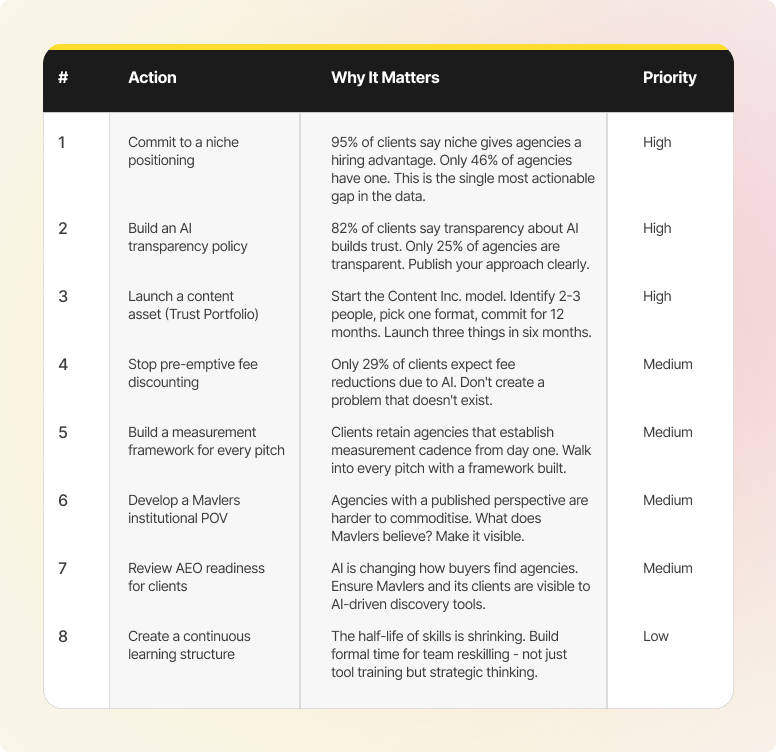
The summit wasn't a conference about the future. It was a reality check on the present.
The agencies that adjust will define the next era of this business. The ones still explaining themselves will keep losing to the ones demonstrating themselves.
We've made our choice.


.png)