


Table of contents
Get in touch
Expect response in 4 hours.
%20%20(1).png)
If you own an agency, we hate to be the ones to break this to you, but hear us out. Most agencies aren't businesses; they're dependencies wearing a logo.
Take a quick second and sit with one question.
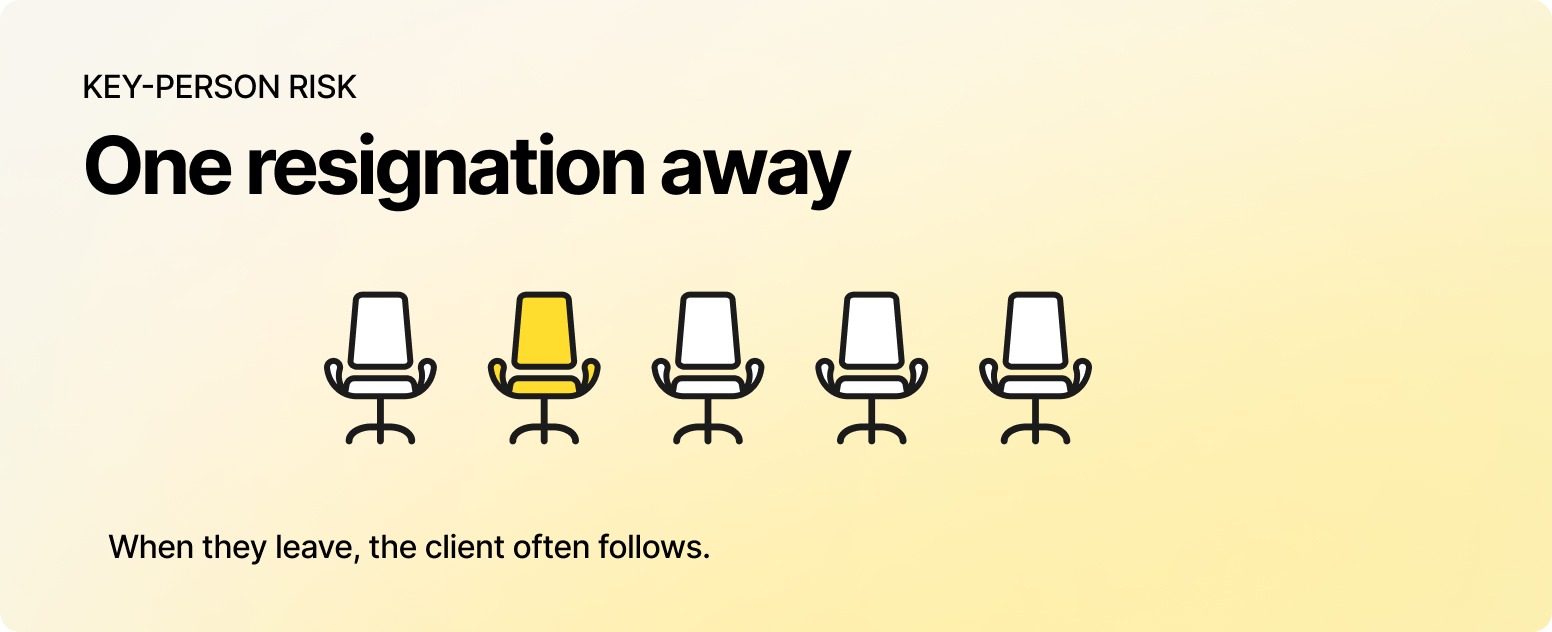
If your three strongest delivery people resigned on the same Monday, how much revenue walks out the door with them by the end of the quarter?
Not the salaries you would stop paying, but the retainers that quietly go cold because the only person who knew the account, held the logins, and took the client's direct calls is gone.
Most owners can feel the answer before they can calculate it. That flicker of unease is the most accurate piece of business intelligence you own, and almost nobody acts on it.
We have rebuilt delivery for agencies on both sides of that Monday, the ones planning for it and the ones cleaning up after it. The pattern holds every time.
The agencies that survive a key departure are not the ones with the best people. They are the ones who made sure no single person could take a client with them. That is what agency key-person risk really means, and the usual fixes do not address it.
The conversation that agency leaders don’t have but should
We will now delve deeper into the conversation that agency leaders often tend to avoid.
The honest answer reveals something that no pitch deck, award submission, case study, or revenue milestone can paper over: the thing they've spent years building is far more fragile than it looks from the outside.
We've watched agencies that billed $3M a year collapse in six months because two people left. A recession was not to blame, not a market shift, not a client scandal, but two people who got off the train, and the clients didn't follow the agency. They followed the people. Or they simply left because the delivery capability that had justified the retainer walked out the door, and nobody could replace it fast enough to stop the bleeding.
The agency leaders in both cases had the same story to share later:
- They knew it was a risk to begin with
- They'd been meaning to document processes and cross-train the team
- They kept deferring it because everything was running fine (why fix what ain’t broken?)
The economics make this sharper than it appears. Bain & Company research led by Fred Reichheld found that raising retention by five percentage points lifts profit by 25 to 95 percent, because acquisition costs are front-loaded and most clients only turn truly profitable in the later stages of the relationship.
There is a cascade effect that owners consistently underestimate.
When a key person leaves, you do not lose one account; you expose every account that person touched. The difference between losing clients when employees leave as an isolated event and losing them as a chain reaction is the difference between a hard quarter and a broken year.
The prize for getting this right is not abstract. The average agency-client relationship runs about 3.2 years, yet the strongest relationships last an average of 22 years, according to R3 research. That spread shows up in the financials. The 2025 Agency Growth Benchmark from Predictable Profits found that eight-figure agencies have a 92 percent annual retention rate, compared with 78 percent for seven-figure firms. The gap is rarely talent; it is structure.
Why your best clients are the first to go
This is where most agencies misread the room; they worry about difficult clients leaving when, honestly, they shouldn’t.
Difficult clients stay simply because they have fewer options.
Your best clients, the ones driving your margins, are the ones most at risk when agency operational efficiency slips.
Wondering why? Well, that’s because they have:
- Multiple agencies that are pitching them every quarter
- Internal pressure to optimize vendor performance
- Zero tolerance for inconsistency
And most importantly, they stayed because delivery was strong, not because your agency name was irreplaceable.
The moment delivery becomes uncertain, there’s nothing left to anchor them. At this point, the following read may interest you: "Why great agencies still lose clients: Understanding the hidden delivery gap."
That’s how losing clients when employees leave actually plays out.
Not as a dramatic exit, but as a quiet replacement.
The dependency you haven’t admitted to yet
There’s another layer most leaders avoid looking at.
And no, we are not talking about who might leave, but what you’re already overpromising.
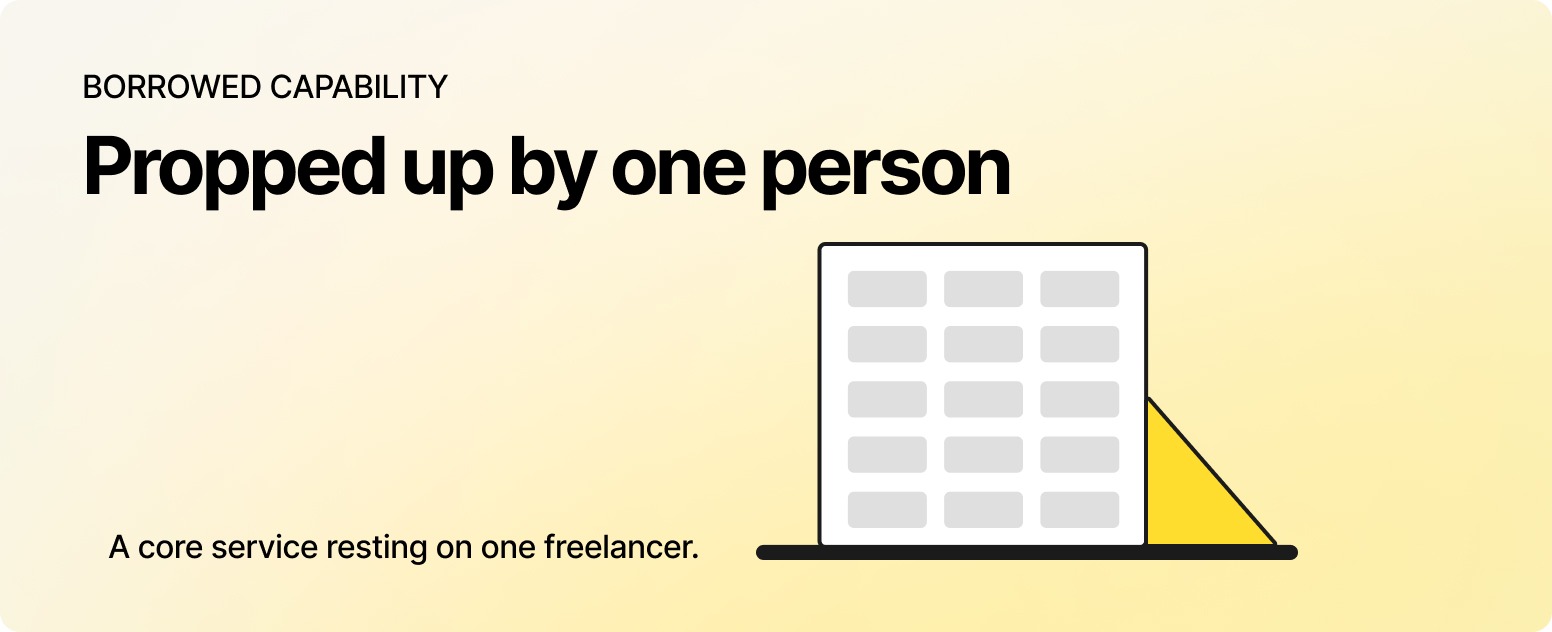
Every agency has at least one service that depends on a single freelancer, a niche contractor, or an external “expert” you bring in when needed.
And yet, that service is positioned as a core offering.
This is not scalable agency operations; instead, this is borrowed capability.
And it works, until it doesn’t.
Because the client believes they’re buying your agency’s depth, but in reality, they’re buying someone else’s availability.
That gap, ladies & gentlemen, is where trust breaks.
Why hiring your way out does not work
At this point, most agencies default to the obvious solution, which is “We need more people.”
The truth is you don’t.
Instead, you need more depth per capability, not more headcount.
Because here’s the math nobody wants to run. To eliminate agency dependency on individuals, you’d need:
- Redundant specialists across every core service
- Overlapping knowledge across accounts
- Bench strength that absorbs unexpected exits
That structure is expensive and in many cases, unsustainably so. Interestingly, the cost of replacing an individual employee can range from one-half to two times the employee's annual salary.
This is why most agencies remain fragile: not because they don’t understand the risk, but because traditional fixes erode their margins.
What high-resilience agencies do differently
The agencies that don’t feel this pressure operate differently at a structural level.
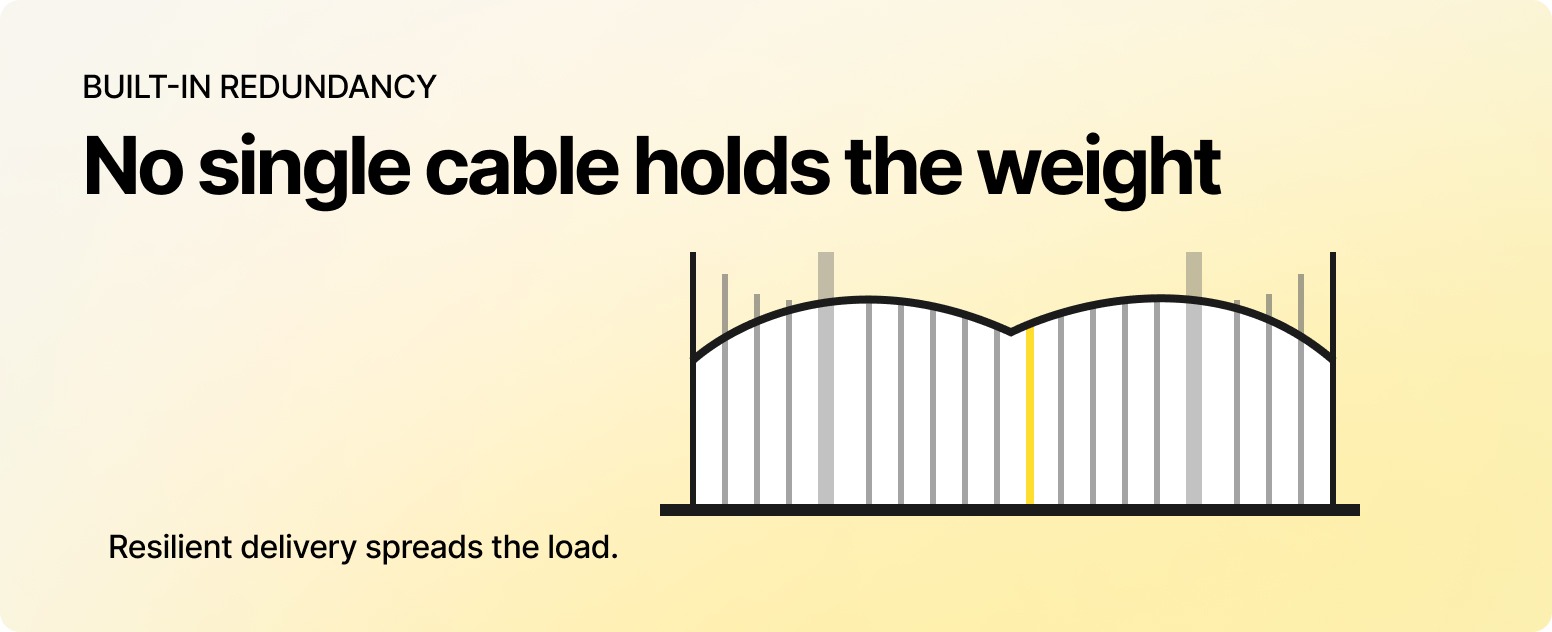
They don’t rely on hero employees; instead, they design for replacement, and that shows up in three ways:
1. Capability that exists beyond individuals
No single person owns a function end to end.
Workflows are distributed, knowledge is shared, and execution is modular.
2. Redundancy is built-in, not reactive
They don’t “cross-train later,” instead, they build overlap from day one.
3. Delivery is infrastructure, not personality
Clients don’t rely on specific people; they rely on consistent output.
This is what real agency resource management looks like when done properly.
The tried & tested scalable way to remove key person risk
Investing in white-label infrastructure is the only honest answer to this problem that does not require you to either overhire or overexpose.
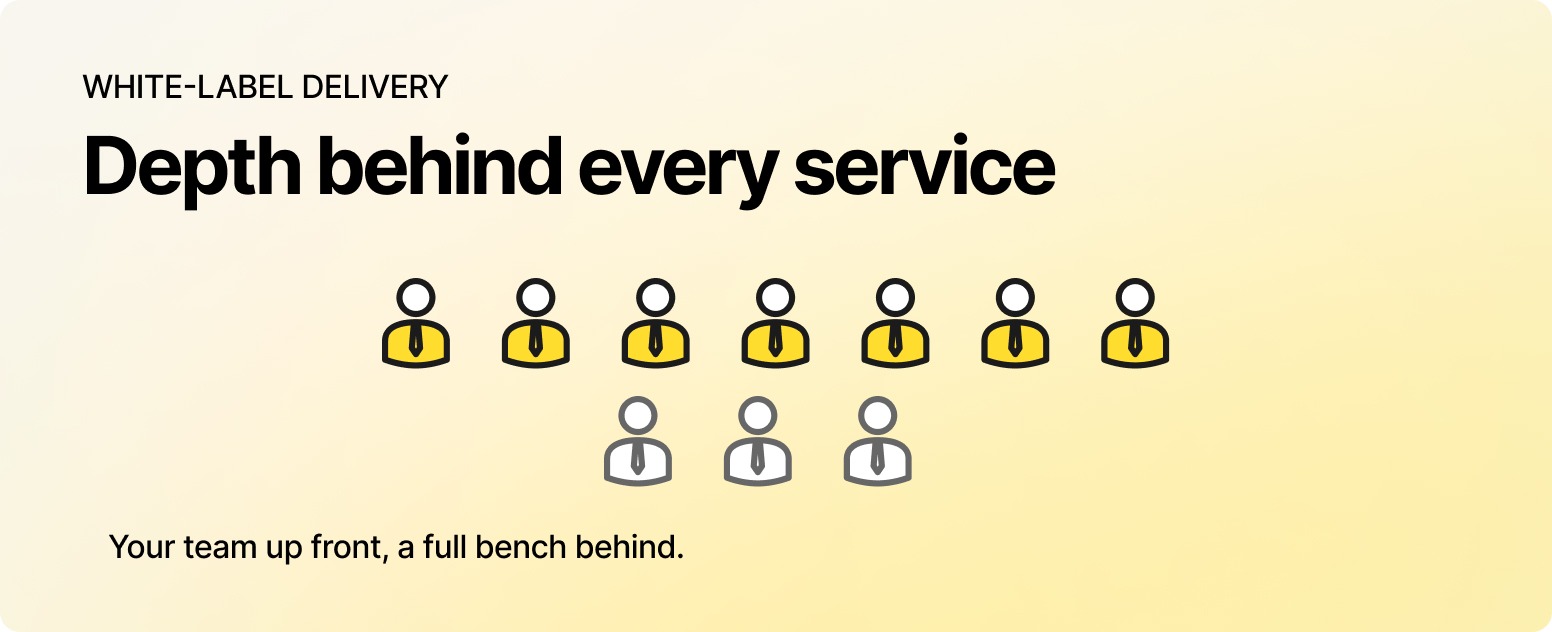
When your delivery backbone includes a white-label partner with genuine depth across disciplines:
- The single point of failure stops being a person on your team
- Redundancy is built into the model, not bolted on after a crisis
- Specialist expertise exists independently of any individual relationship
The shift most agencies resist
The need for control is the real reason this doesn’t get implemented earlier.
Agency leaders equate internal teams with control and external support with risk.
But in reality, the opposite is often true.
A single employee holding critical knowledge is not control; it’s exposure.
While a distributed, well-structured delivery system is not risk, it’s resilience.
Also, organizations that build redundancy into their execution layers recover significantly faster from disruption than those that rely on individual expertise.
Agencies just haven’t caught up to that thinking, yet.
The audit you shouldn’t delay

If you take nothing else from this, take this: run the audit.
Not later, or when things slow down, do that now.
Go client by client and answer the following honestly:
- Which accounts depend on one person more than your agency?
- Which services would break if a single contributor became unavailable?
- Which clients have relationships that bypass your structure entirely?
- Which retainers feel stable but are actually fragile underneath?
And then answer the question that most leaders avoid: How long have you known this and done nothing about it?
The final line most agencies cross too late
Every agency believes they’ll fix this “before it becomes a problem.”
Most don’t, because while things are working, fragility is invisible.
Until one day, it isn’t.
And by then, the cost isn’t theoretical.
It starts reflecting in clients, revenue, and reputation.
The fragility is already there.
The only question is whether you choose to see it now or wait until it introduces itself.

.png)

.png)