Let’s make your brand our next big brag.
If your budget is bleeding, your conversions are ghosting you, or your CPA is stubbornly high, you don't need a miracle. You just need a structural fix. Let’s go find it.


Organisation
Industry
Location
Founded
Starting CPA
Target CPA
Products / Services Used
Doctors' Health Fund has protected Australia's medical community since 1977. It offers hospital and extras cover built around the AMA List of Medical Services and Fees, with unrestricted choice of doctors and the country's best gap cover for hospital stays.
The product was strong. The brand had loyal members. What DHF needed was a paid search campaign that could convert at scale. One that brought in quality leads and phone calls without haemorrhaging budget on the wrong audiences.

Increase in total conversions
Improvement in CPA
More phone calls
Final CPA achieved (target: ~$8)
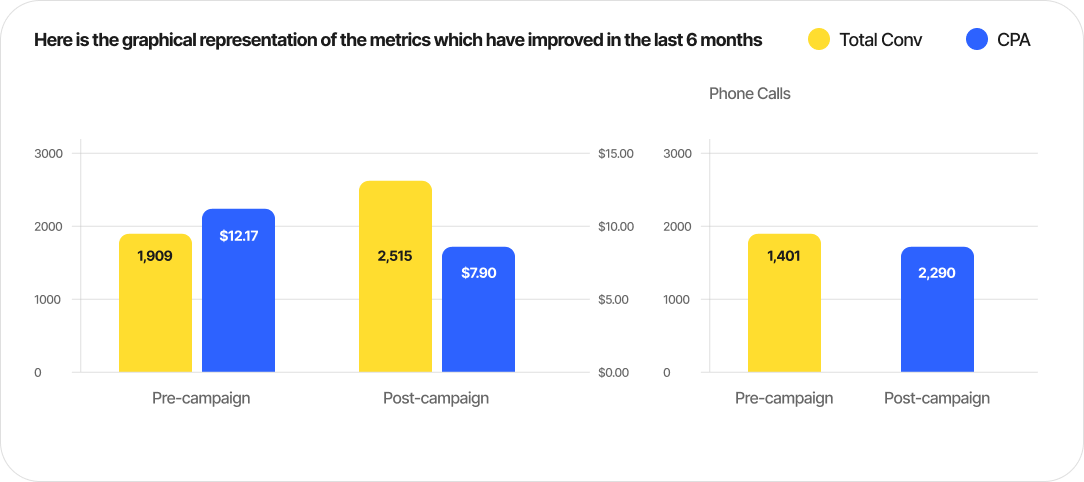
Application submissions, contact forms, and quote requests were trickling in, not flowing. Total conversions across the first six months was 1,909, with CPA running well above the $8 target at $12.17.
Ad groups were carrying 15+ keywords each. It was dragging down Quality Scores and pushing CPC up. Bloated match types meant the budget was being absorbed by searches that had nothing to do with health insurance.
No audience targeting was set on the display campaign. Ads were surfacing to completely open audiences. They were spending a budget to reach people with zero purchase intent, and generating zero conversions to show for it.
Phone calls are a high-intent signal in the insurance sector. With only 1,401 calls in the baseline period, there was no dedicated strategy to capture this audience. It left a significant revenue channel unused.
Smart bidding needs sufficient historical data to function well. Automated tools aren’t mind readers. If you don't feed them the right data through manual testing first, they will optimize for the wrong goals. That exactly was the case here.
Keyword research defined a complete restructure. Tighter ad groups, cleaner theming, and campaigns based on the symptoms, treatment, and awareness journeys relevant to DHF's audience. Fewer, more relevant keywords per group meant higher Quality Scores and lower CPCs.
Specific brand campaigns were tested with call-only ad formats. For an insurance brand, the phone is often where the purchase decision happens. Routing high-intent brand searchers directly to a call proved immediately effective in lifting call conversion volume.
A detailed search term analysis surfaced the keywords attracting off-topic traffic. Generic terms were paused, negative keyword lists were built out, and match types were corrected. This recovered budget that was previously going nowhere.
Brand and AMA campaigns started on Manual CPC. It gave full control while the account built its data foundation. Once enough conversion history existed, the switch to Maximize Conversions was made. Automated bidding works when it has data to learn from; this sequencing is what made it effective.
GDN display campaigns were created with defined audience segments. High-bid keywords, those competing above $2 in the Google Grant account, were moved to the Paid account. Here they could compete for prime placement, expanding visibility for the terms that matter most.
Past visitors who hadn't converted were pulled back into the funnel via a dedicated display remarketing campaign. Template banner ads kept DHF visible to warm audiences.
We launched campaigns on Microsoft Ads with precise UTM tracking to see exactly what drives conversions. It paid off: Bing introduced us to an older, professional crowd that felt like a natural extension of the DHF community.
Campaign-level performance was reviewed weekly and monthly. It helped us optimize everything from keywords and locations to devices and timing. Clean conversion data meant we stopped guessing and started making precise, profitable adjustments.


Australian Medical Community Insurer

Successful migration of 9,000+ pages across 12+ languages, with no critical downtime.

Multi-channel strategy driving 50%+ monthly registration growth.

Ogilvy needed to scale SEO delivery across multiple markets without expanding headcount. Mavlers stepped in as their invisible production partner.
We'll get back to you within 4 business hours.

