




paid media

How Mavlers rebuilt Cloth & Co.'s paid media and lifted revenue 140% in 90 days

Project Overview

Organisation

Cloth & Co.

Industry

Sustainable fashion / Retail

Location

Australia

Founded

2014

Category

Women's natural-fibre apparel

Engagement window

90-day rebuild

Products / Services Used

Google Ads
Meta Ads
Performance Max
Feed Optimization
eCommerce Fashion

Cloth & Co. is an Australian ethical fashion brand, founded in 2014. The clothes are made from natural fibres. Production supports artisan communities. The brand has stayed deliberately premium since launch. Which gave it a clear voice, but also a specific audience to find.

Cloth & Co. already had a great product line. But their paid media setup was holding them back from growing. Mavlers came in to fix the invisible digital infrastructure that was stalling their sales.

Performance Insights

Key results for the client

140%

Revenue growth (Apr–Jun)

71.6%

Lift in ROAS

$5K+

Weekly sales, hit consistently

8x+

ROAS on returning-user campaigns

Client objectives

The challenges Cloth & Co. faced

1.
Ads were rendering against the wrong competitors

Even with niche targeting in place, campaigns kept showing up beside mainstream fast fashion. That’s the exact category Cloth & Co. had spent years differentiating away from.

2.
Low visibility on the searches that mattered most

Sustainable, ethical, natural fibre. These were the terms Cloth & Co. should have owned in SERPs. The brand wasn't surfacing.

3.
An account structure inherited from default settings

The product feed had been set up through Shopify's Google & YouTube apps and left there. Account architecture across both platforms was overlapping, conflicting, and never deliberately designed.

4.
Meta performance was inconsistent

Some weeks worked. Most didn't. There was no pattern stable enough to optimize against.

5.
Off-brand creative

AI-generated Meta assets clashed with the considered, premium feel of the brand. Performance and identity were pulling against each other.

6.
ROAS broke under scale

Campaigns that worked at low spend collapsed when budgets went up. Without fixing the underlying structure, more money meant worse returns.

Mavlers Strategy

How we rebuilt the backend, starting with the product feed

The diagnosis was uncomfortable in a useful way:

The strategy was fine. The execution underneath was a mess: chaotic feeds, default account setups, and audiences competing against each other.

So the work happened in order. Foundations first, then architecture, then campaigns and creative on top.

1.
Rebuilt the product feed in DataFeedWatch

Variants were consolidated into clean parent listings, which killed off the duplicate-listing problem. Out-of-stock items were filtered out dynamically. Names and categories were standardized. And the AI-generated copy was rewritten to include the conversion-deriving specifics: fabric, fit, intended occasion.

2.
Restructured Performance Max around intent, not site taxonomy

The default groupings followed how the website was organized. We regrouped products by what a shopper was trying to do, discover, compare, buy, and then matched bidding strategies to the funnel stage.

3.
Separated new and returning users into different campaigns

New users saw broader, brand-led ads. Returning users saw conversion-focused ones. This single decision was the one that drove 8x+ ROAS on the returning-user side, because the message matched the signal.

4.
Re-engineered the Meta campaign mix

Static, video, and dynamic catalog campaigns ran in parallel. Ad groups and asset groups were organized carefully enough that Cloth & Co. wasn't competing against itself for the same audience.

5.
Treated creative refresh as an operating rhythm

10+ creatives per ad group, rotated continuously. Ad fatigue was prevented structurally, not noticed after the fact.

6.
Made the handoff between platforms the point

Meta carried the awareness load. Both platforms shared the consideration stage. Google Shopping closed the high-intent searches. The hand-offs between them were where the funnel either worked or didn't, and most of the optimization work happened there.

Results

What Cloth & Co. achieved

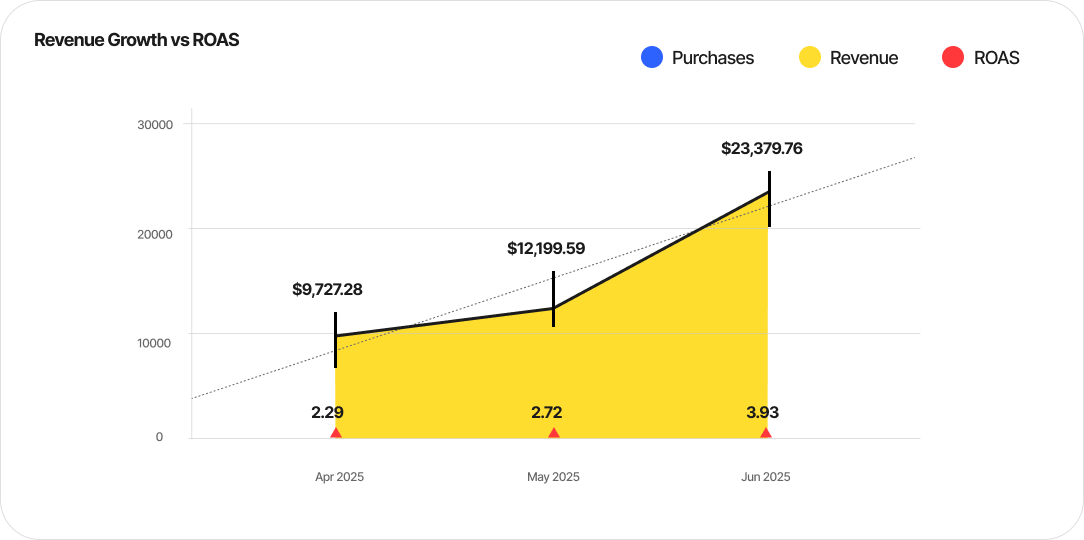
Three months, with most of the lift concentrated between May and June, once the foundational fixes had time to compound into the optimization signal.

The detail worth flagging

The detail worth flaggingJune wasn't just the strongest of the three months. It was the strongest month Cloth & Co. had posted in a year. In June, every dollar of ad spend was returning roughly $4 in revenue. The $5,000 weekly sales target stopped being a goal and became the baseline.

3.14%

Highest CTR

66.03

Most purchases

$23,379.76

Highest Revenue

3.93

Best ROAS

Monthly performance metrics

Characteristic APR 2025 MAY 2025 JUN 2025 Δ (Apr→Jun)
Purchases 43 42 66 ↑ 53%
Revenue $9,727.28 $12,199.59 $23,379.76 ↑ 140%
ROAS 2.29 2.72 3.93 ↑ 71.6%
CTR 2.33% 2.06% 3.14% ↑ 35%
Clicks 3,272 4,399 4,465 ↑ 36%

This is fantastic. Thank you for your dedication to getting our SEM working so well. Hopefully, we can scale this successfully even through our slower months. We're thrilled to be making such positive steps forward.

Daisy Burgess
Daisy Burgess

Co-founder, Head of Operations

Related Case Studies

Results that speak
for them selves.

Migrating 9,000+ pages across 12 languages

Successful migration of 9,000+ pages across 12+ languages, with no critical downtime.

80% CPR reduction and 3x ROI over 6 years

Multi-channel strategy driving 50%+ monthly registration growth.

35% cost reduction while scaling SEO delivery globally

Ogilvy needed to scale SEO delivery across multiple markets without expanding headcount. Mavlers stepped in as their invisible production partner.