Dedicated Team

How a B2B travel platform turned siloed systems into one Salesforce ecosystem

Project Overview

Organisation

Enterprise B2B Travel Marketplace

Industry

B2B Travel Technology

Location

Performance-driven distribution, outcome-based partner engagement

Operates across

International markets

Serves

Accommodation partners and advertisers

Products / Services Used

  • Dedicated Team
  • Salesforce Marketing Cloud
  • Salesforce CRM Integration
  • Marketing Automation
  • GA4 Reporting Pipeline

The client runs a massive B2B travel marketplace, connecting hotels and advertisers worldwide. It’s a business where everything hinges on performance. 

But distribution, data transparency, and outcome-based partner engagement only function if your CRM, marketing tech, and sales reports aren't aligned with each other. Theirs weren't. 

They had Salesforce CRM and Marketing Cloud plugged in, but the two systems were running in completely different directions. The business was growing fast, but the infrastructure holding it up was about to snap.

Performance Insights

Key results for the client

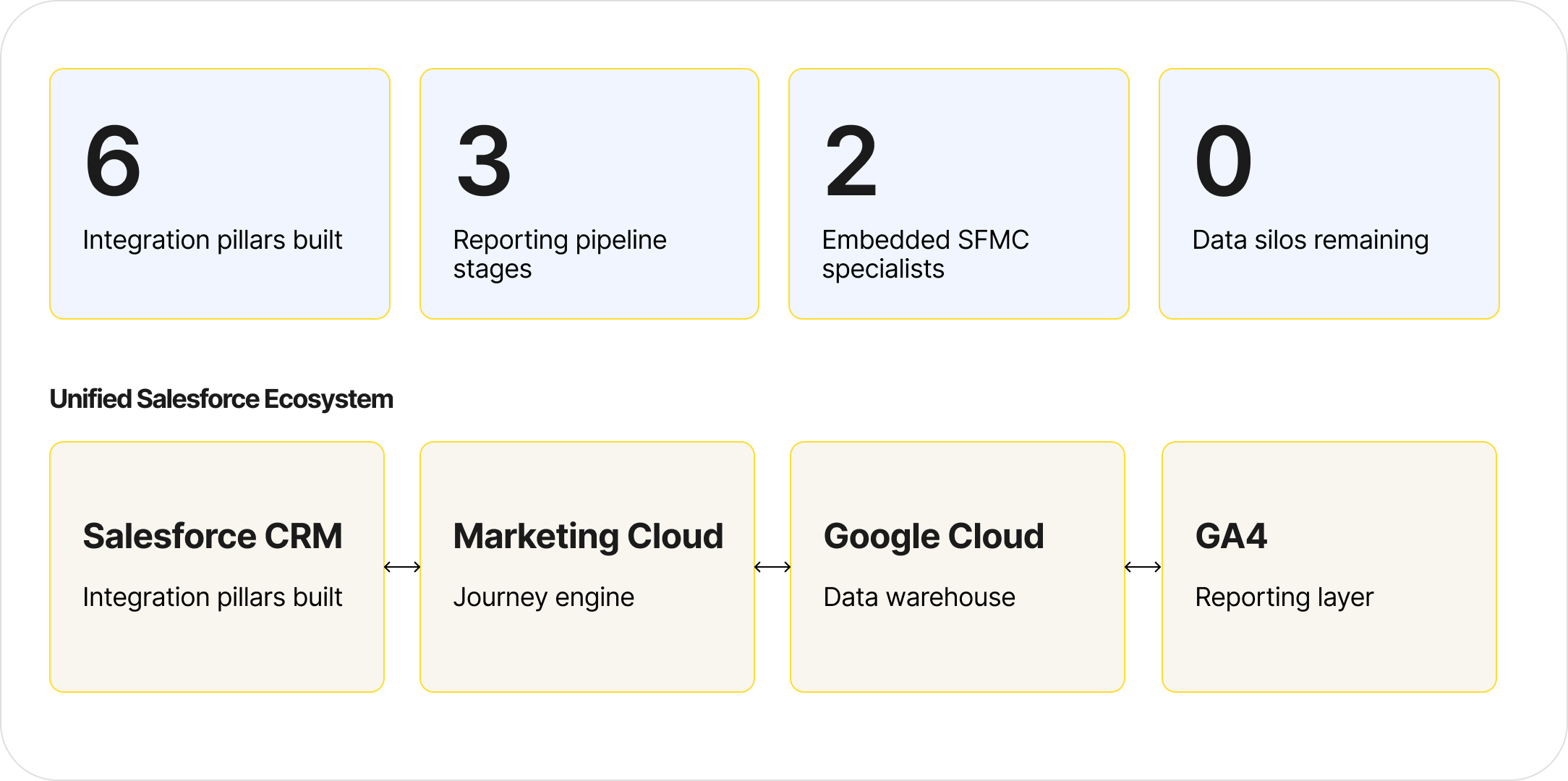
6

Integration pillars built end-to-end

3-stage

Reporting pipeline: SFMC → Google Cloud → GA4

2

Embedded SFMC specialists

0

Data silos remaining

Client objectives

The challenges the client faced

1.
Salesforce CRM and SFMC running as silos

Both systems were implemented but never architected to operate as a unified ecosystem. CRM partner data wasn't activated inside SFMC journeys. Marketing automation had no real-time lifecycle signals to act on. Sales teams couldn't see marketing engagement at all. The blind spots were piling up, even though the business runs on partner performance.

2.
 CRM complexity making integration genuinely risky

The Salesforce instance carried multiple standard and custom objects, layered account–contact–partner relationships, and custom hierarchies built around the marketplace model.  Without a deliberate sync strategy, integrating that into SFMC would have meant incorrect data syncing, duplication, and downstream reporting failures. At enterprise scale, architectural accuracy was non-negotiable.

3.
Journeys running without lifecycle intelligence

The marketing team couldn't see partner lifecycle stages, sales-driven status updates, or contextual account attributes. They had to fly blind. They couldn't segment effectively, so their messaging was generic. Instead of responding to what a partner actually needed in the moment, the system just shoved them through a rigid, pre-set sequence of emails.

4.
Sales teams blind to marketing engagement

Engagement data sat locked inside SFMC. Sales reps had little visibility into which partners were engaging. They couldn't identify high-intent prospects, or use marketing signals to prioritize outreach. In a competitive B2B distribution environment, that's missed timing on every cycle.

5.
Reporting trapped inside platform dashboards

Without integration into broader analytics, the team couldn't assess partner intent, prioritize follow-ups, or measure marketing's actual influence on pipeline. Reporting answered the wrong questions.

Mavlers Strategy

How we delivered an enterprise CRM–SFMC integration

1.
CRM discovery and integration blueprint

We tore open the CRM to audit everything: object structures, custom relationships, hierarchies, data ownership, and lifecycle definitions. From that analysis came a tailored integration architecture built for data integrity, scale, and long-term flexibility.   Best of all, the same architect who designed the system stayed to build it. No handoff meant we could validate and refine decisions on the fly, instead of arguing over them later.

2.
SFMC contact model realignment

The SFMC contact model was re-architected to align with the CRM structure. Which CRM objects to sync, how to handle relational data, and what sequencing preserved hierarchy integrity. The Campaign Manager & Developer made sure architectural decisions translated cleanly into actual journey execution, not just documentation.

3.
CRM data activated inside B2B journeys

We rebuilt every email journey around real-time partner actions and sales updates. Out went generic, automated blasts; in came sharp, targeted messaging. Instead of forcing partners through a rigid, pre-set sequence, the system started responding to where they stood in the relationship.

4.
Closed marketing–sales feedback loop

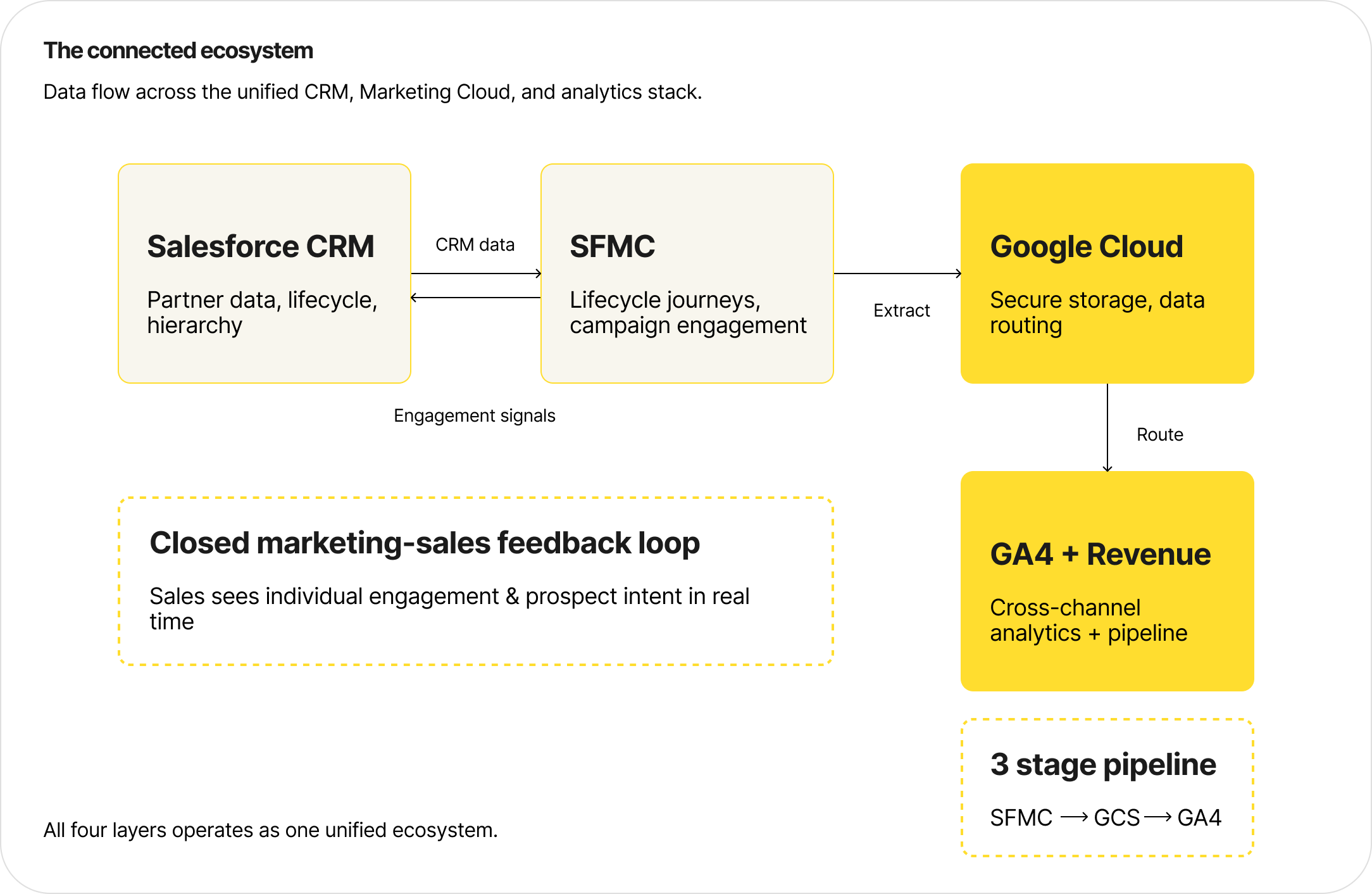
Engagement data from Marketing Cloud was synced back into Salesforce CRM at the contact and lead level. Sales reps could now see individual email engagement, read prospect intent from marketing interactions, and prioritise outreach based on real signals.

5.
Custom reporting pipeline: SFMC → Google Cloud → GA4

A custom pipeline was built to pipe SFMC data straight into Google Cloud Storage and out to GA4. This finally put marketing, digital analytics, and revenue metrics in one room. It gave the team a level of cross-channel visibility. Far beyond what a standard connector-based setup would have delivered.

6.
Enterprise-grade testing and validation

End-to-end validation, data accuracy testing, load reliability checks, and future-scale readiness - all run before anything went live.

Results

What the client achieved

CRM data activated

In real time inside SFMC journeys.

Lifecycle-driven B2B communications

Treat partners based on reality, not a predetermined workflow map.

Full sales visibility into marketing engagement

Individual email engagement, intent signals, and follow-up prioritization inside the CRM.

Closed loop between marketing activity and pipeline performance

Campaigns can finally be measured against revenue rather than just opens and clicks.

Cross-channel reporting across SFMC, Google Cloud, and GA4

Marketing impact analyzed alongside revenue and digital performance in one view.

An architecture built to scale

Without compromising data integrity as the business grows.

Continuous optimization

Through the embedded SFMC team.

Sandra Field

Related Case Studies

Results that speak
for them selves.

Migrating 9,000+ pages across 12 languages

Successful migration of 9,000+ pages across 12+ languages, with no critical downtime.

80% CPR reduction and 3x ROI over 6 years

Multi-channel strategy driving 50%+ monthly registration growth.

35% cost reduction while scaling SEO delivery globally

Ogilvy needed to scale SEO delivery across multiple markets without expanding headcount. Mavlers stepped in as their invisible production partner.