Whitelabel

How Mavlers cut CPA by 42% on 30% less spend for a Phillipines' bank

Project Overview

Organization

A major BFSI brand in the Philippines

Industry

BFSI (Banking, Financial Services & Insurance)

Location

Philippines

Engagement Model

Full-time dedicated team

Products / Services Used

  • Paid Search
  • Paid Social
  • Performance Max Advantage+
  • Creative Strategy

Our client, a titan of the Philippine banking industry, offers a wide range of financial products - credit cards, retail banking, loans, and wealth management solutions. They hold a significant share of the country's consumer credit market.

The bank's acquisition program had a clear objective: increase credit card growth without increasing marketing investment. But faced a common performance plateau: a pipeline full of leads that failed to meet strict eligibility benchmarks.

‍

The client wanted approved credit card applicants - people who would actually clear the bank's strict eligibility criteria.

‍

We stepped in to re-engineer their entire paid media architecture. By shifting the "North Star" metric from simple form-fills to bank-approved customers, we proved that it is possible to achieve double-digit growth in quality while reducing total capital outlay.

Performance Insights

Key results for the client

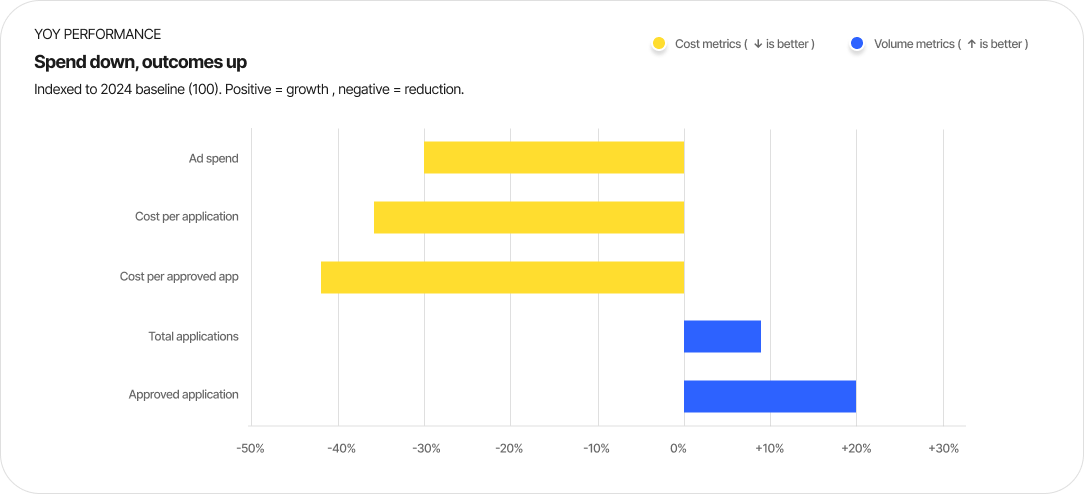
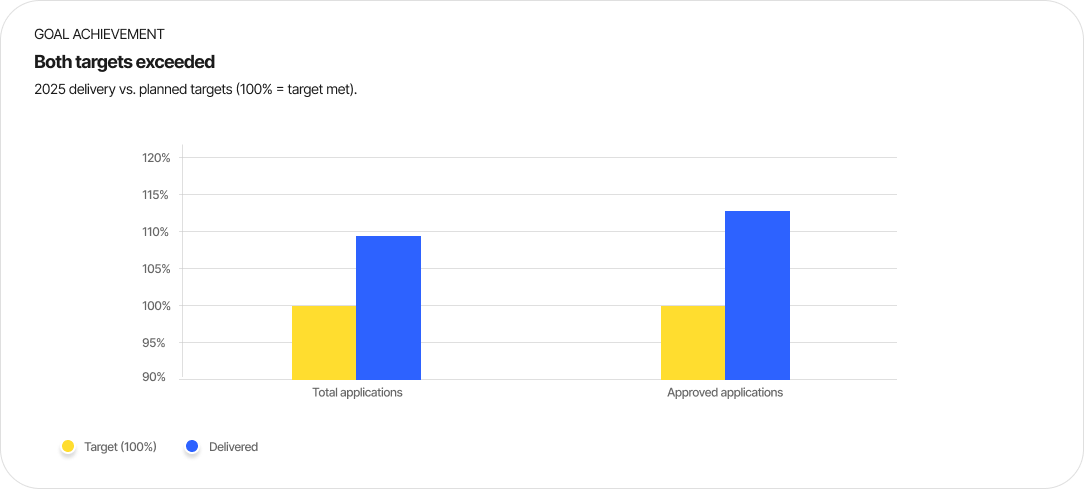
30% YoY ↓

Total ad spend

9% YoY ↑

Total applications

36% YoY ↓

Cost per application

Client Objectives

The challenges the client faced

1.
The quantity-quality paradox

The existing campaigns were optimized for volume. While leads were high, the "approval yield" was low. The marketing engine was finding people eager for credit, but not necessarily those meeting the bank’s risk criteria.

2.
Uncapped acquisition costs

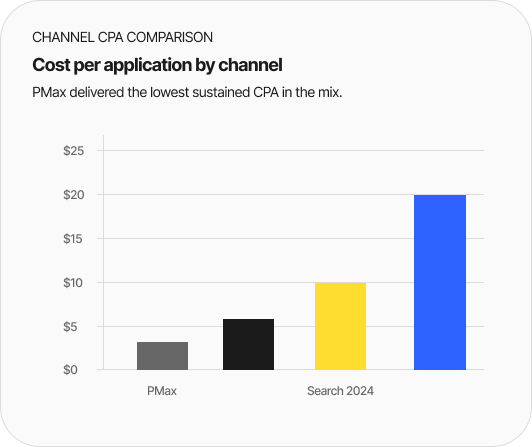
Cost Per Application (CPA) was inconsistent across channels. Without a clear "efficiency ceiling," the bank was overpaying for clicks in competitive auctions without a guaranteed return on investment.

3.
Low approval rates

Application volume looked acceptable on the surface. Downstream, the conversion-to-approval rate told a different story - spend was concentrating on applicants the bank's credit assessment process was rejecting.

4.
Misaligned media and approval outcomes

The platform algorithms (Google and Meta) were receiving "success signals" every time a form was submitted, but were blind to the downstream approval. This caused the AI to find more of the "wrong" type of applicants.

5.
Budgetary rigor

The brief required a paradoxical outcome: scale the number of approved customers while simultaneously decreasing the total marketing spend. There was zero room for experimental waste with unproven channels.

‍

Mavlers Strategy

How we rebuilt every campaign around one downstream metric

1.
Strategic pivot to downstream optimization

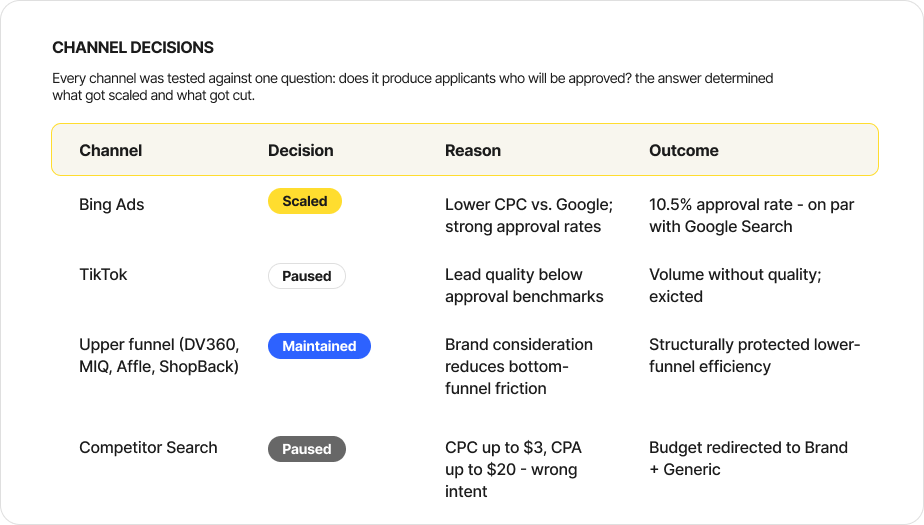
We stopped optimizing for the "Click" and started optimizing for the "Approval." By integrating internal bank data into our bidding strategies, we forced the algorithms to seek out high-propensity users rather than high-volume lead generators.

2.
Re-architecting search for high-intent yield

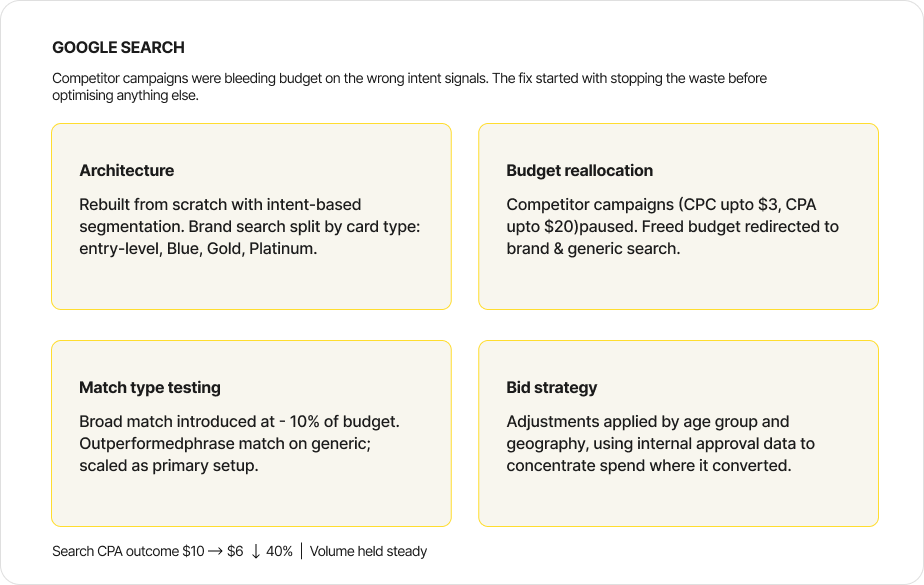
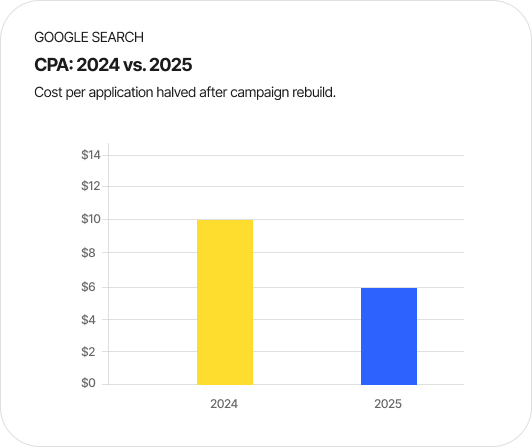
We paused expensive competitor campaigns (where CPAs reached $20) and redirected the budget into granular Brand-tier campaigns. By segmenting by card type (Blue, Gold, Platinum), we gained surgical control over budget allocation.Β 

Search architecture was rebuilt to reduce keyword overlap, improve relevance, and provide greater control across credit card categories.Β 

The team also refined ad messaging, extensions, and audience bid adjustments to better pre-qualify prospective applicants before they entered the application process.

3.
Audience modeling based on success data

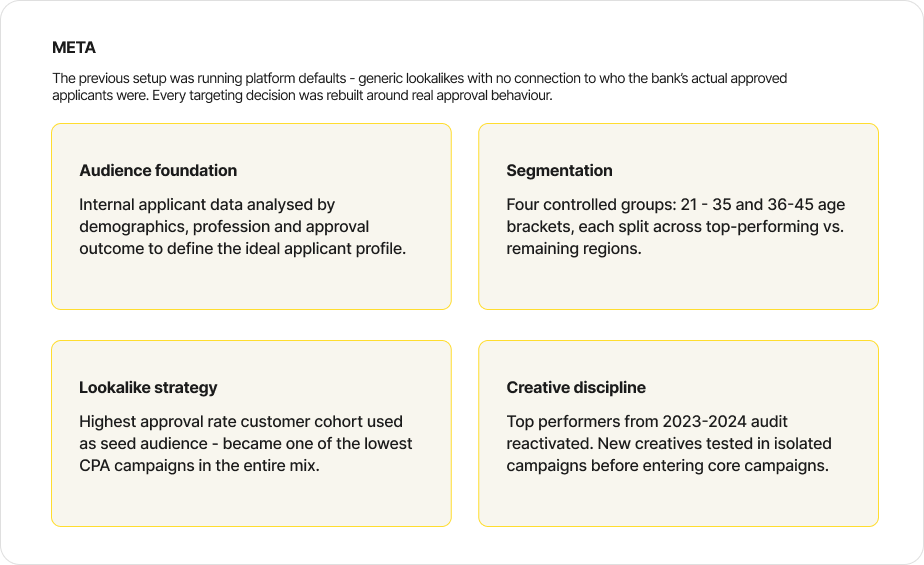
Internal approval trends were analysed to identify demographic, geographic, and behavioural characteristics associated with stronger approval performance.Β 

Rather than relying on platform interest tags, we built Meta Lookalike audiences based on "Approved Applicants" only. We specifically isolated the "Carded Non-Depositor" segment, which historically showed the highest approval propensity.

4.
Aggressive creative pre-qualification

We overhauled the creative assets to act as a filter. By clearly stating value propositions and eligibility cues in the copy, we discouraged unqualified clicks, improving the quality of traffic before the user even landed on the site.

5.
Strengthened automation with higher-quality signals

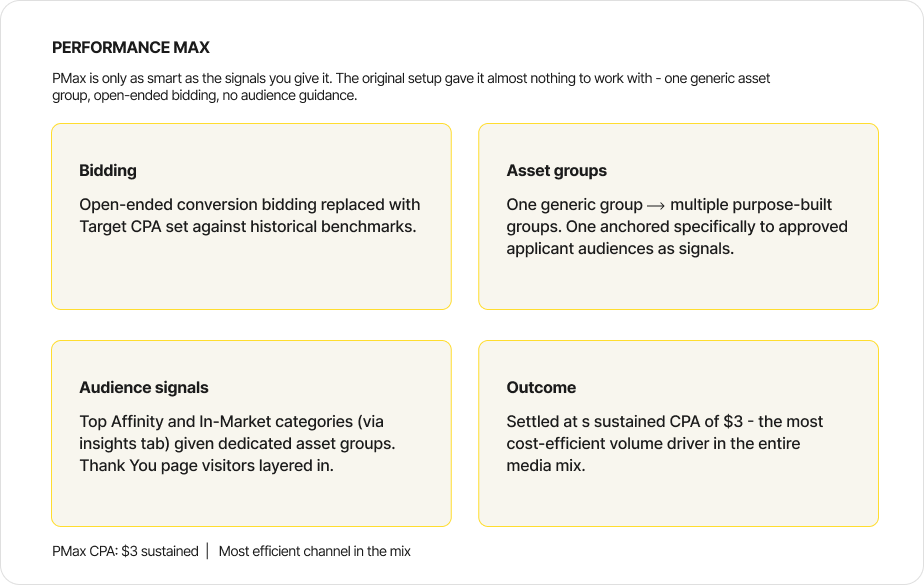
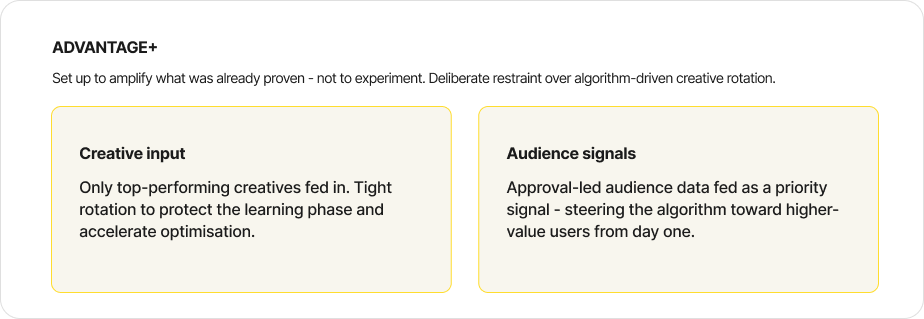
Performance Max and Advantage+ campaigns were rebuilt using structured audience signals, refined asset groups, and historical performance benchmarks.

6.
Meritocratic channel governance

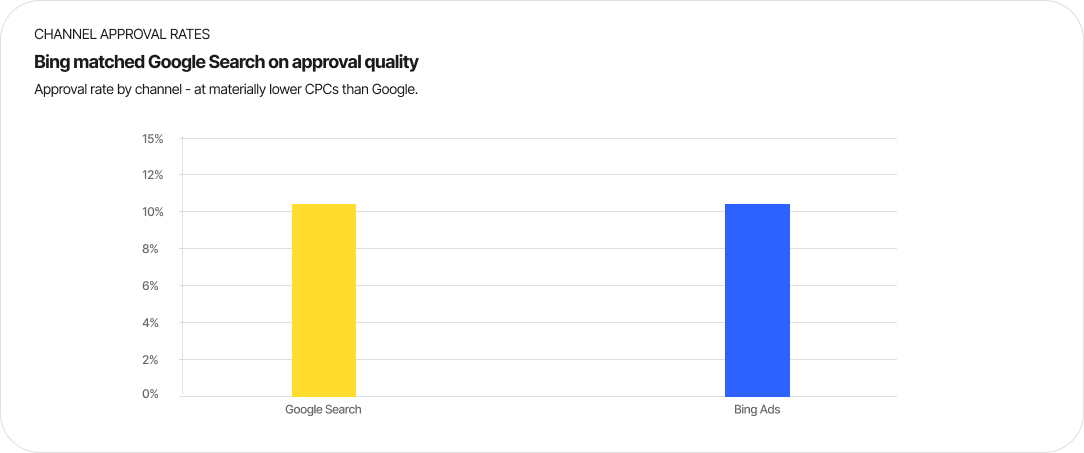
We applied a "test and cut" discipline. TikTok was introduced, evaluated against the approval benchmark, and promptly exited when lead quality lagged. Conversely, Bing Ads was scaled when it delivered a 10.5% approval rate, matching Google’s efficiency at a lower cost.

‍

‍

‍

‍

‍

‍

Team Structure Deployed
↓ 30%

Total Ad Spend

↑ 9%

Total applications

↓ 36%

Cost per application

↑ 20%

Approved applications

Results

What the client achieved

‍

‍

‍

Sandra Field

Related Case Studies

Results that speak
for them selves.

Migrating 9,000+ pages across 12 languages

Successful migration of 9,000+ pages across 12+ languages, with no critical downtime.

80% CPR reduction and 3x ROI over 6 years

Multi-channel strategy driving 50%+ monthly registration growth.

35% cost reduction while scaling SEO delivery globally

Ogilvy needed to scale SEO delivery across multiple markets without expanding headcount. Mavlers stepped in as their invisible production partner.