




AI EMAIL TRIAGE

How Mavlers cut manual email review by 90% from 3,000+ daily emails to ~300 action-ready rows

Project Overview

Organization

Mavlers Agency

Technology Stack

n8n Β· Google Apps Script Β· OpenAI GPT-5 Nano & Mini Β· Google Sheets

Timeline

2025–2026

Products / Services Used

  • AI Email Classification
  • Workflow Automation
  • Escalation Detection
  • Sentiment Analysis
  • SLA Monitoring
  • Google Sheets Dashboard

Mavlers monitors all client interactions to identify escalatable matters before they damage relationships. In early 2025, that meant multiple team members manually scrolling through thousands of emails daily, including notifications, transcript messages, no-reply system emails, calendar invites, newsletters, and internal communications, just to find the real client interactions buried in the noise. The Gmail Escalation Detector replaced that entire manual process with an intelligent, automated triage system.

Performance Insights

Key results for the client

90%

Reduction in manual review effort

10Γ—

Fewer items to review daily

24/7

Consistent automated monitoring

Client Objectives

The challenges we set out to solve

1.
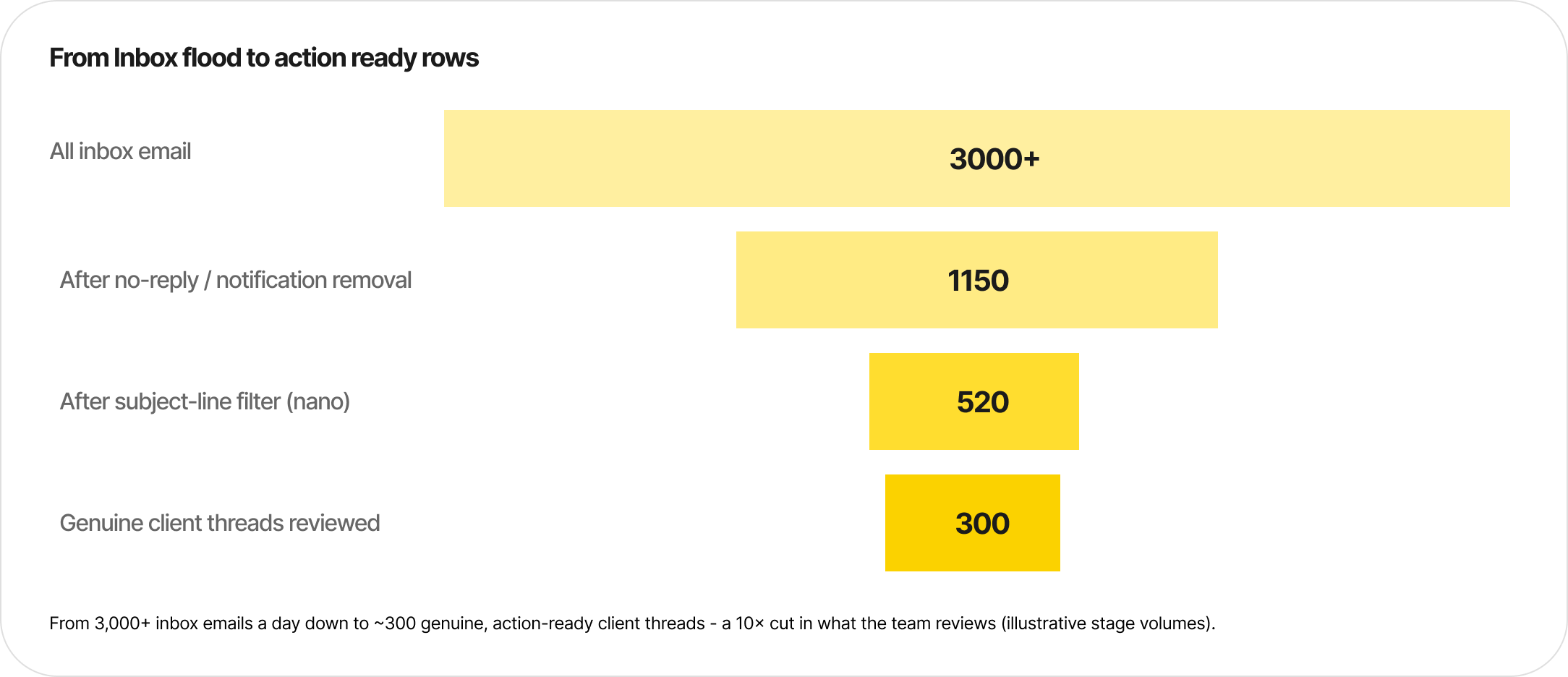
3,000+ emails per day flooding the inbox

The daily volume included automated notifications, multiple transcript messages per interaction, no-reply system emails, alert emails, internal team communications, and calendar invitations, all mixed together.

2.
Real client issues buried in noise

Actual client interactions requiring attention were hidden among thousands of irrelevant messages, making manual identification exhausting and unreliable.

3.
Multiple team members lost hours to manual scrolling

Several people were needed daily just to scroll through the Gmail web UI, manually calculating and identifying client interactions.

Mavlers Strategy

How we built an intelligent email escalation detector

1.
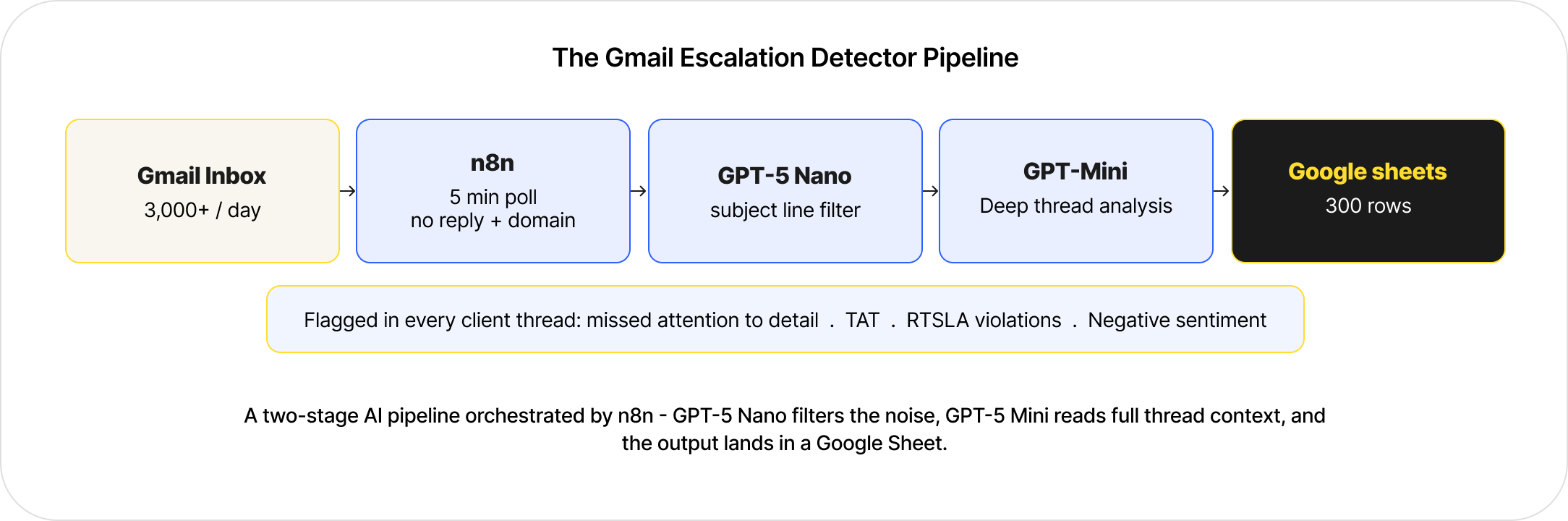
Designed a two-stage AI pipeline

GPT-5 Nano first filters subject lines to remove invitations, newsletters, and ads; GPT-5 Mini then performs deep analysis of the full thread context.

2.
Thread-based context processing

The system fetches the last 6 emails per thread to ensure the AI sees full conversational context before classifying any issue.

3.
Automated client matching and noise removal

n8n polls Gmail every 5 minutes, removes no-reply senders, cross-checks domains against the client database, and passes only genuine client threads to the AI layer.

4.
AI checks for multiple risk signals

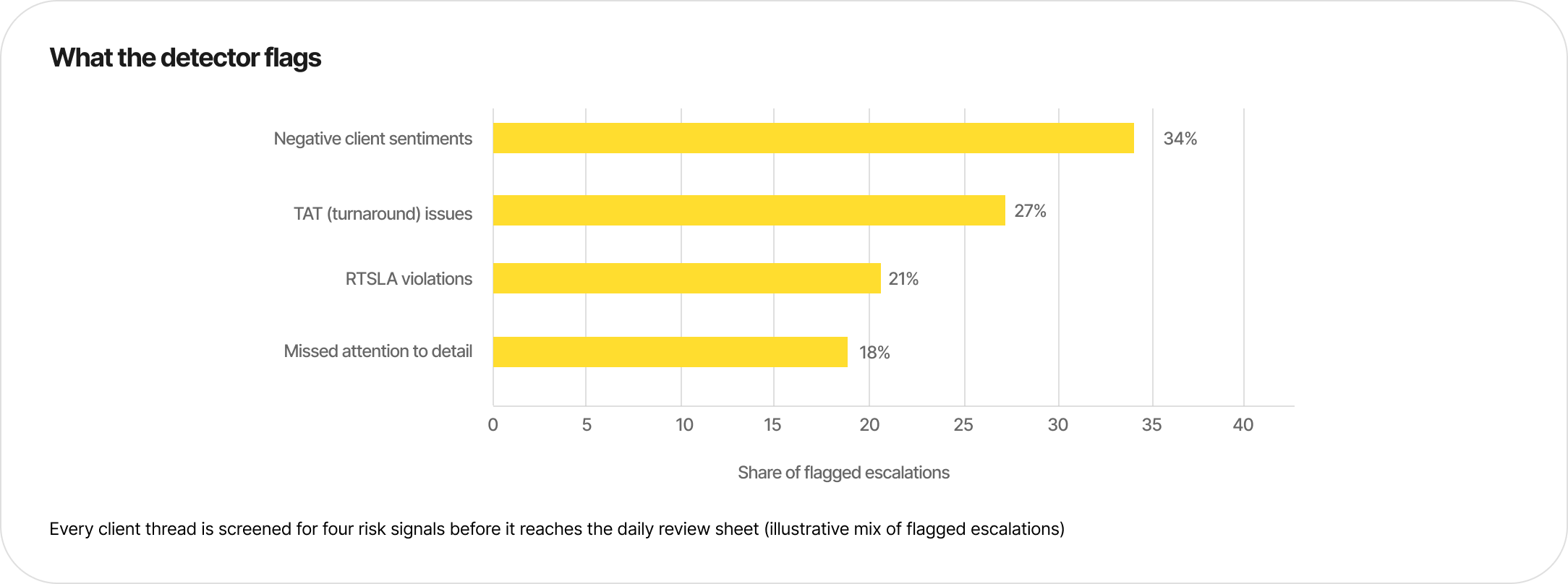
The system flags missed attention-to-detail, TAT issues, RTSLA violations, and negative client sentiment in every thread it processes.

5.
Action-ready Google Sheets output

The final dashboard shows Escalation Status (True/False), Issue Category, AI Reasoning, Thread Link, Client Details, and Timestamp, giving the team a single pane of glass for daily review.

Results

What the Gmail Escalation Detector achieved

The team went from drowning in 3,000+ emails to reviewing roughly 300 pre-classified, AI-analyzed, action-ready rows in a Google Sheet. Manual effort dropped by 90%; monitoring now runs 24/7 without human fatigue; classification follows a standardized protocol; and escalation response time has improved dramatically. The team now spends its time acting on escalations rather than searching for them.

‍

‍

‍

Optimization

How we optimized credit investment

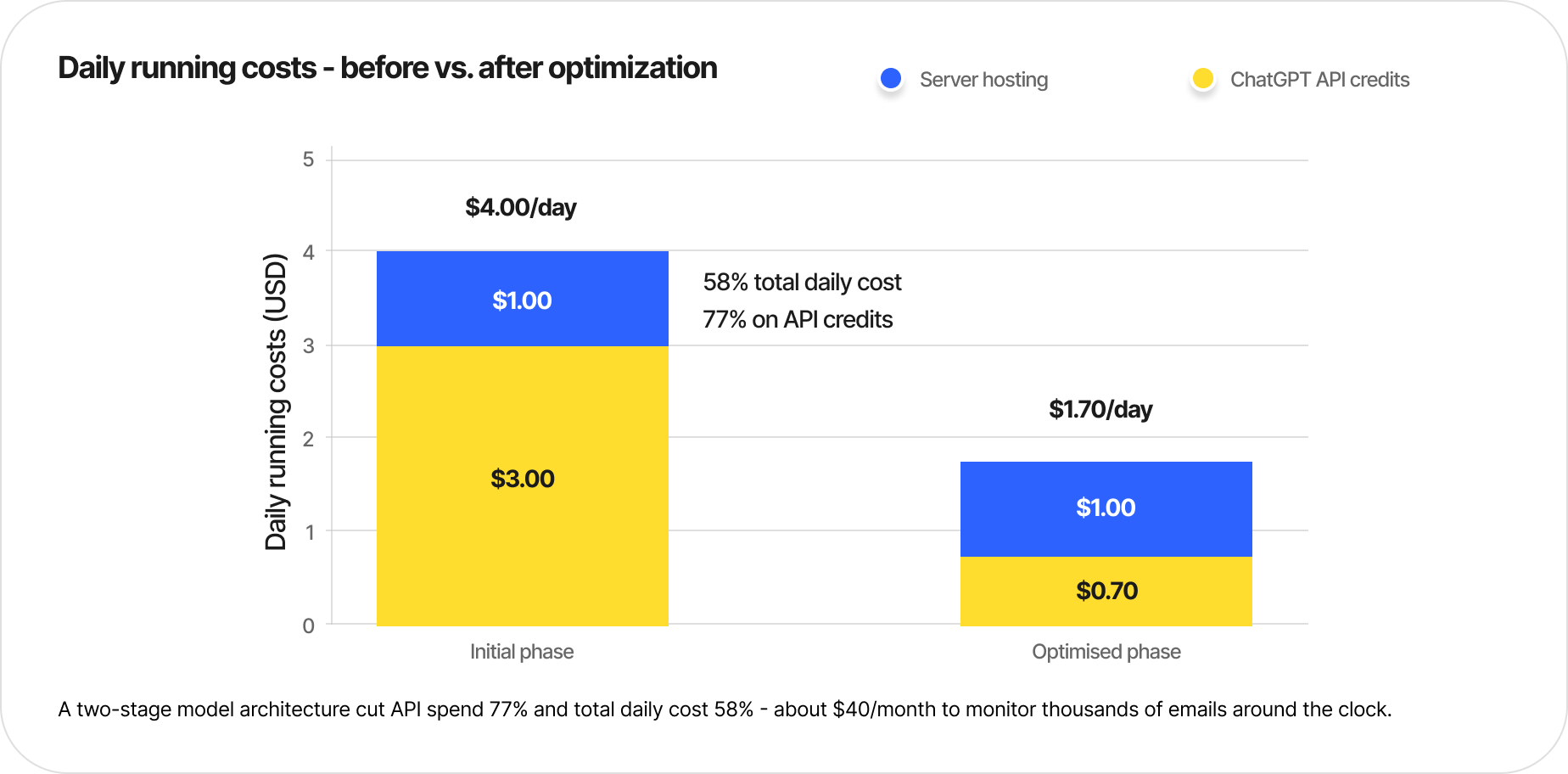
Beyond building the system, the team kept iterating on cost efficiency - cutting daily API spend by 77% with no loss in detection quality.

$4.00

/ day
Initial total cost ($3.00 API + $1.00 server)

$1.70

/ day
Current total cost ($0.70 API + $1.00 server)

77%

less
ChatGPT API credits

$40

/ month Current running cost

1.
Initial phase - $4.00/day

Every email ran through a single, larger model, driving higher token use; $3.00/day in API credits plus $1.00/day for server hosting.

2.
Optimised phase - $1.70/day

A two-stage architecture put GPT-5 Nano on the high-volume subject-line filtering (cheap and fast) and reserved GPT-5 Mini only for threads that pass the filter and need deep analysis, cutting API spend from $3.00 to $0.70/day (a 77% saving) while server cost stayed at $1.00/day.

3.
Result - 58% lower daily cost

The combined daily cost dropped from $4.00 to $1.70 which is roughly $40/month to monitor thousands of client emails around the clock, with zero loss in detection quality.

Sandra Field

Related Case Studies

Results that speak
for them selves.

Migrating 9,000+ pages across 12 languages

Successful migration of 9,000+ pages across 12+ languages, with no critical downtime.

80% CPR reduction and 3x ROI over 6 years

Multi-channel strategy driving 50%+ monthly registration growth.

35% cost reduction while scaling SEO delivery globally

Ogilvy needed to scale SEO delivery across multiple markets without expanding headcount. Mavlers stepped in as their invisible production partner.