SEO

How Mavlers makes brands visible in AI search

Project Overview

Organisation

Function

Generative Engine Optimization (GEO) — AI Visibility & Outreach

Use Case

Identify, qualify, and pitch listicles where a brand is absent from AI-generated recommendations

Pipeline

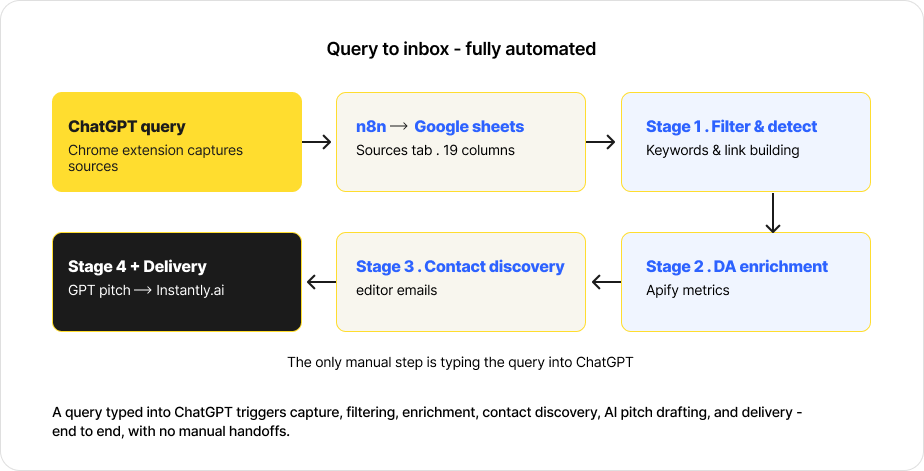
Chrome Extension → n8n → Google Sheets → 4-stage Apps Script → Instantly.ai

Products / Services Used

  • Custom Chrome Extension
  • n8n Workflow Automation
  • Google Sheets
  • Google Apps Script
  • Apify (Domain Authority & Backlinks)
  • OpenAI GPT-4o-mini (Pitch Drafting)
  • nstantly.ai (Cold Email Delivery & Sequencing)

When a buyer asks ChatGPT, “Who’s the best PPC agency for ecommerce?” or Perplexity, “top white-label SEO providers,” the answer isn’t random. AI models pull from specific blogs, listicles, and roundup articles. If your brand isn’t in those sources, you don’t exist in the AI-generated buyer journey, and your competitors do.

Most companies have no idea which sources AI models cite for their industry, whether they’re listed in them, or how to close the gap. This project changes that. In two weeks, Mavlers built a fully automated pipeline that captures AI-cited sources, identifies where a brand is missing, qualifies targets by authority, drafts personalized pitches, and delivers them, turning AI visibility from a blind spot into a managed GTM channel.

Performance Insights

Key results for the client

2 weeks

From concept to fully operational pipeline

Hrs → Mins

Research-to-outreach cycle time

100%

Personalized AI-drafted pitches per target

End-to-End

Query to inbox delivery, fully automated
Client objectives

The AI visibility blind spot

1.
AI search is the new first touch

Buyers are asking ChatGPT and Perplexity instead of Googling. If a brand isn’t cited in the sources these models pull from, it’s invisible at the top of the funnel.

2.
No way to audit AI-cited sources at scale

Manually querying AI models, reading every cited article, and checking for brand mentions across hundreds of keywords was impractical.

3.
Signal buried in noise

AI responses cite a mix of blogs, directories, social profiles, and app stores. Separating editorial listicles worth pitching from everything else required intelligent filtering.

4.
Discovery and outreach were disconnected

Finding a gap was one problem; qualifying the target, finding the right contact, drafting a pitch, and sending it was a separate manual process every time.

5.
No repeatable playbook

Every new service vertical or campaign meant starting from scratch. The GTM team needed a system, not a one-off exercise.

Mavlers Strategy

How the pipeline works

1.
Data capture (Chrome extension → n8n → Google Sheets)

A team member types a service query into ChatGPT; a custom Chrome extension captures every cited source (URL, title, snippet, domain, date) and fires it to an n8n webhook, which flattens it into a structured one-row-per-source format (19 columns) written straight to a Google Sheets “Sources” tab with no manual entry.

2.
Stage 1 — Listicle filtering & brand-mention detection

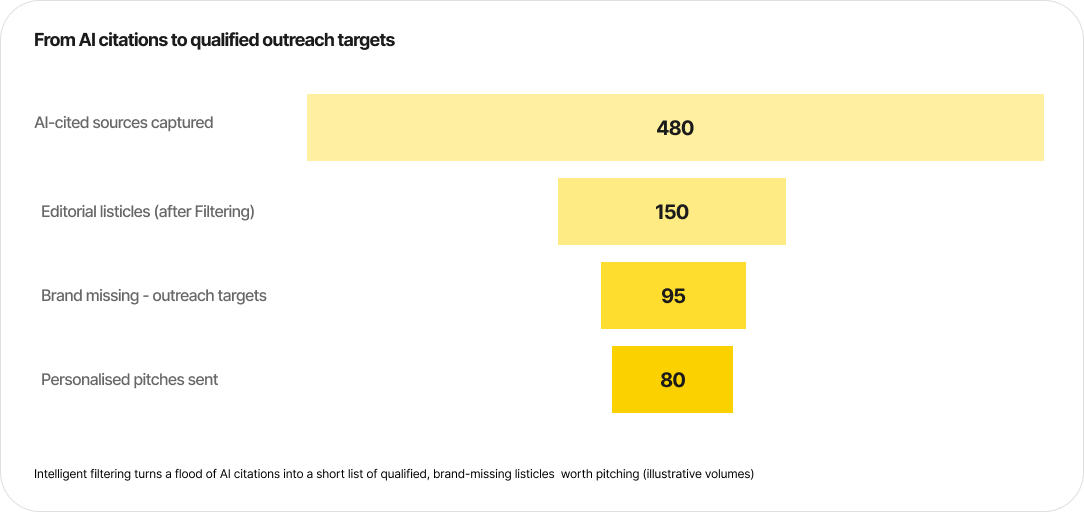
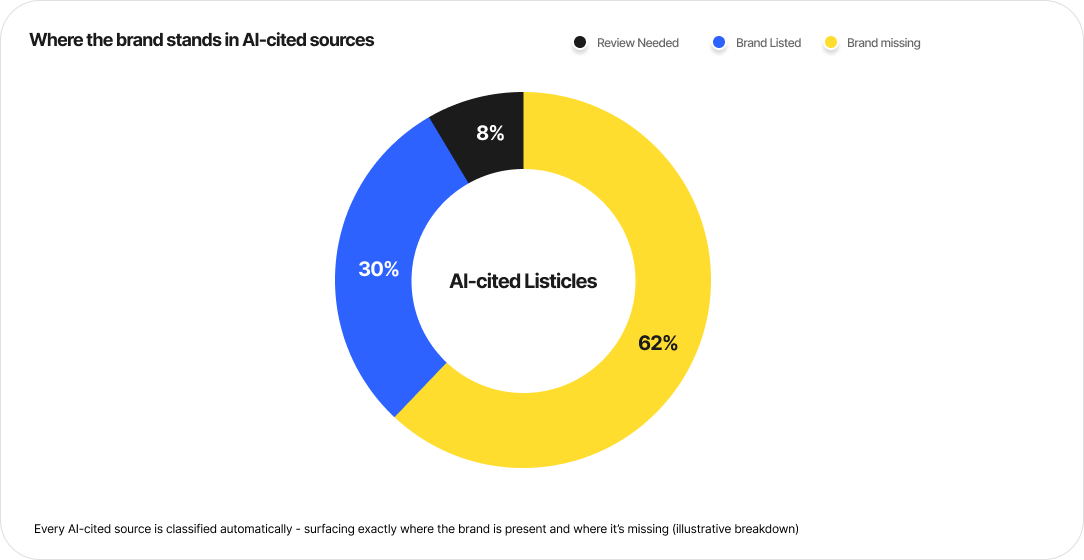
Scans every URL against editorial patterns (/blog/, /article/, /guide/, best-, top-N, roundup), excludes noise (social platforms, directories, Wikipedia, app stores), deduplicates by canonical URL, then fetches each qualifying page and checks for a brand mention, classifying results into Outreach Output (not mentioned), Brand Listed, Review Needed, and Removed URLs.

3.
Stage 2 — Domain authority enrichment

Enriches every outreach target with DA and backlink metrics via Apify, so the team can pitch the high-authority listicles that most influence AI models first.

4.
Stage 3 — Contact discovery

Scrapes editor and content-team emails from each target domain, building a ready-to-use contact list without manual lookups.

5.
Stage 4 — AI-powered pitch drafting

GPT-4o-mini writes a unique pitch per target using the article’s topic as context, with randomized opening and closing styles and a forbidden-phrase list to block generic AI-sounding copy; each run creates a timestamped sheet with cross-run deduplication, so no target is pitched twice.

5.
Stage 4 — AI-powered pitch drafting

GPT-4o-mini writes a unique pitch per target using the article’s topic as context, with randomized opening and closing styles and a forbidden-phrase list to block generic AI-sounding copy; each run creates a timestamped sheet with cross-run deduplication, so no target is pitched twice.

6.
Delivery (n8n → Instantly.ai)

Pitch sheets feed into Instantly.ai, which handles warmup, sender rotation, scheduling, and follow-up sequencing. The only manual step is typing the initial query into ChatGPT.

Results

What this means for GTM teams

1.
AI visibility becomes a managed channel

Know exactly which listicles AI models cite, where your brand is present, and where it’s missing, across every service line.

2.
Outreach runs at pipeline speed

What used to take days of manual research, qualification, and drafting now runs in minutes, from query to ready-to-send campaign.

3.
Every pitch is genuinely personalised

AI-drafted emails reference the specific article, its topic, and why the brand belongs, not generic “please add us” templates.

4.
The system scales to any vertical

New keyword sets, service lines, or markets, the same pipeline works without rebuilding.

We went from not knowing where we were missing in AI search to having a system that finds the gaps, qualifies the targets, writes the pitches, and sends them. This is what AI-powered GTM should look like.

Sandra Field
GTM Team

Mavlers

Related Case Studies

Results that speak
for them selves.

Migrating 9,000+ pages across 12 languages

Successful migration of 9,000+ pages across 12+ languages, with no critical downtime.

80% CPR reduction and 3x ROI over 6 years

Multi-channel strategy driving 50%+ monthly registration growth.

35% cost reduction while scaling SEO delivery globally

Ogilvy needed to scale SEO delivery across multiple markets without expanding headcount. Mavlers stepped in as their invisible production partner.