Mavlers Build Stories

How Mavlers turned competitor emails into winning campaigns

Project Overview

Organization

Mavlers Agency

Use Case

Monitor competitor email strategies, generate data-driven campaign suggestions, and deploy approved emails to the ESP - on autopilot

Pipeline

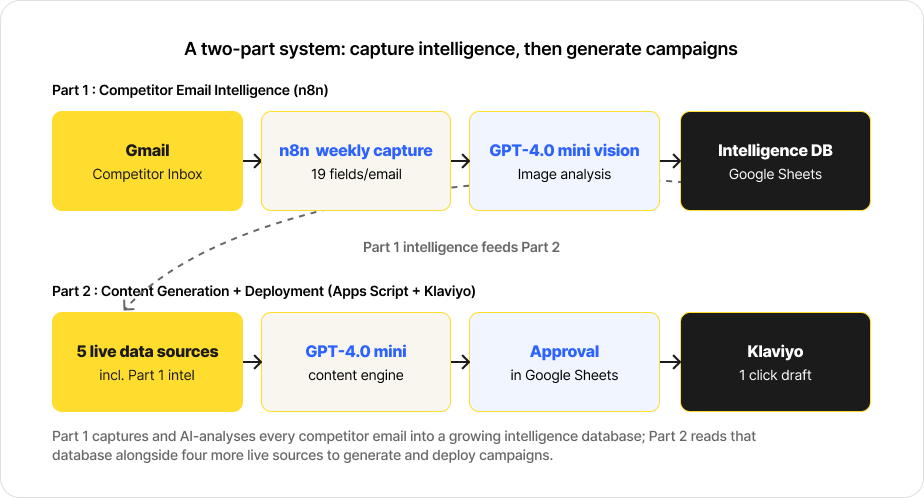
n8n (competitor capture) β†’ Google Sheets β†’ Apps Script + GPT-4o-mini (content engine) β†’ Klaviyo (deployment)

Function

AI-Powered Competitor Email Intelligence + Automated Campaign Generation

Build Time

2 weeks

Products / Services Used

  • n8n Workflow Automation
  • Gmail API
  • Google Sheets
  • Google Apps Script
  • Klaviyo (ESP)
  • Shopify (Product Catalog)
  • OpenAI GPT-4o-mini (Vision + Text)

Every week, competitors land in your customers’ inboxes with offers, product launches, and seasonal campaigns. Most marketing teams have no systematic way to track what competitors are sending, extract actionable intelligence from it, and turn those insights into better campaigns of their own, let alone do it fast enough to stay ahead.

‍

This project solves that end-to-end. In two weeks, we built a two-part system: an automated competitor email intelligence pipeline that captures, parses, and AI-analyses every competitor email, including image-level visual analysis, and a content generation engine that reads competitor data alongside product catalogs, calendar events, past campaign performance, and manager priorities to generate ready-to-send email campaigns with a single approval click.

Performance Insights

Key results for the client

2 weeks

From concept to fully operational system

1-click

Approval to live Klaviyo campaign

100%

AI-drafted, competitor-informed email copy

Weekly

Automated competitor intelligence cycle

Client Objectives

The email marketing blind spot

1.
Competitor emails disappeared into inboxes

Newsletters were read once (if at all) and forgotten, with no structured capture of subject lines, offers, product positioning, or visual strategy.

2.
No way to extract intelligence from images

Email marketing is visual-first, product photography, layout, color palette, and styling all signal strategy, yet no one was systematically analyzing competitor visuals.

3.
Campaign creation was slow and disconnected from data

Writing copy, choosing products, deciding offers, and building campaigns in the ESP were separate manual steps, with no connection to competitor intelligence or past performance.

4.
Calendar events and manager priorities lived in silos

Upcoming events, seasonal pushes, and ad hoc directives were scattered across calendars, Slack, and spreadsheets, never feeding into a unified content engine.

5.
No feedback loop

Rejected or revised content meant starting from scratch; there was no way to iterate on AI-generated copy from team feedback without losing context.

Mavlers Strategy

How the system works

‍

Part 1 - Competitor Email Intelligence Pipeline (n8n)

1.
Automated email capture

Runs weekly on a schedule with no manual triggering, reads competitor emails from a dedicated Gmail inbox (last 20 days), and extracts 19 structured fields per email, subject, sender, date, send time, event proximity, products, prices, offers, CTAs, headlines, image URLs, visible text, and more.

2.
AI-powered image analysis

Downloads every image, filters out tracking pixels and icons, selects the top 5 by quality, and runs GPT-4o-mini Vision on each for product type, color palette, style, and a quality score, then merges the results back with the email metadata.

3.
Structured intelligence output

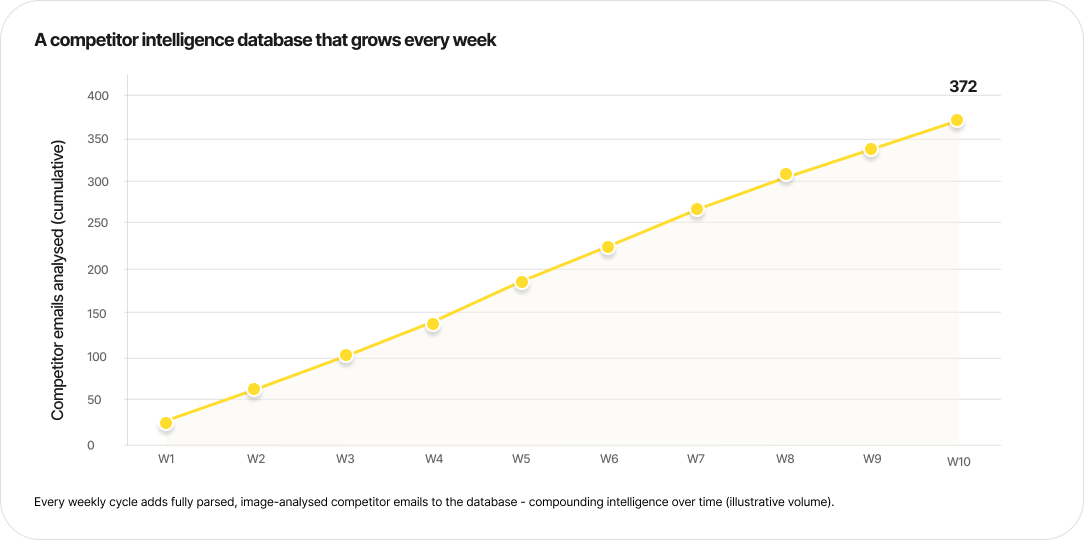
GPT-4o-mini classifies each email into 12 standardized columns (competitor, subject line, event, theme, offer type, offer details, products featured, CTA, key messaging, and links) and appends to Google Sheets, building a competitor intelligence database that grows week over week.


Part 2 - AI Content Generation + Campaign Deployment (Apps Script + Klaviyo)

1.
Multi-source data ingestion

Reads from 5 live sources: Shopify catalog, Klaviyo history (open/click rates and revenue), calendar events, and manager notes. Part 1 intelligence sheet scores products against each event by keyword, season, and category, and ranks competitor emails by relevance.

2.
AI-powered suggestion engine

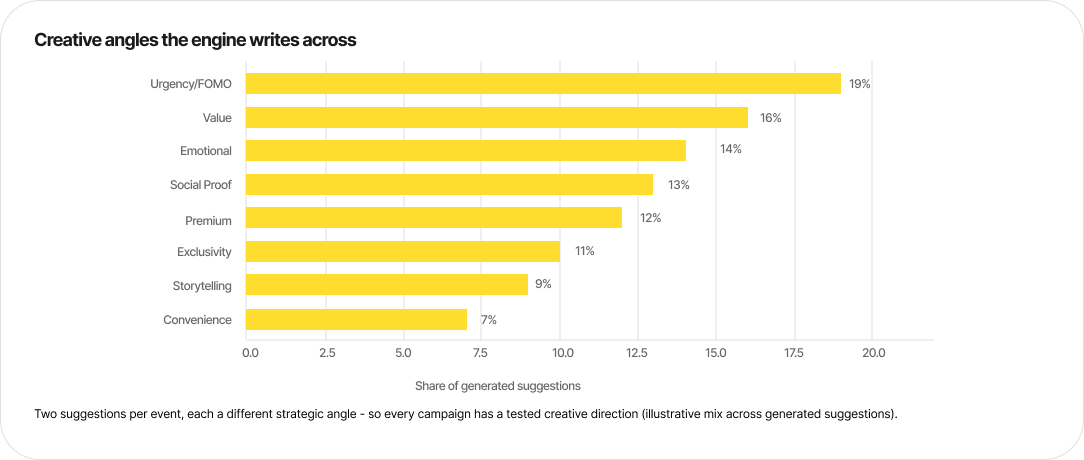
Generates 2 suggestions per event, each with a different strategic angle (Urgency/FOMO, Emotional, Value, Premium, Social Proof, Exclusivity, Convenience, Storytelling), complete with subject line, preview text, hero and body copy, design directions, catalog-validated products, offer, CTA, rationale, and cited sources, in the brand’s voice, with no hallucinated products or URLs.

3.
Approval workflow + Klaviyo deployment

The team reviews suggestions in Google Sheets via status dropdowns: Approved creates a Klaviyo draft (full HTML, product images, correct sender/list) in one click; Rejected regenerates fresh content with a new angle; Needs Revision revises from feedback; and approval locks the row to prevent duplicate sends.

Results

What this means for marketing teams

1.
Competitor intelligence runs on autopilot

Every competitor email is captured, parsed, image-analyzed, and categorized into a structured database, with no manual reading or note-taking.

2.
Campaigns are informed by real data, not guesswork

Every suggestion is built on competitor insights, product catalog, past campaign performance, calendar events, and manager priorities, all connected.

3.
From idea to deployable campaign in minutes

What used to take days of copywriting, product selection, and ESP setup now happens with a single approval click.

4.
The feedback loop is built in

Reject, revise, or approve, the system iterates with AI from team feedback instead of starting from scratch.

‍

‍

Sandra Field

Related Case Studies

Results that speak
for them selves.

Migrating 9,000+ pages across 12 languages

Successful migration of 9,000+ pages across 12+ languages, with no critical downtime.

80% CPR reduction and 3x ROI over 6 years

Multi-channel strategy driving 50%+ monthly registration growth.

35% cost reduction while scaling SEO delivery globally

Ogilvy needed to scale SEO delivery across multiple markets without expanding headcount. Mavlers stepped in as their invisible production partner.