

Let's make your SFMC our next stabilization story.
Whether the bottleneck is duplicate records, deliverability, or workflows held together by manual effort - an embedded SFMC team can take it off your plate without expanding headcount.


Organisation
Industry
Location
Retail partners
Mission
Products / Services Used
Acima is a leading lease-to-own solution provider. They help customers get products they need through flexible payment options. The business grew and expanded across thousands of U.S. retail partners which started straining its marketing operations.
Salesforce Marketing Cloud was creating duplicate records faster than teams could clean them up. Every 15–30 days, someone had to manually delete records just to keep things moving. This wiped out valuable engagement history along the way and risked the removal of legitimate customers.
At that point, another quick fix wasn’t going to cut it. The platform needed a structural rethink.

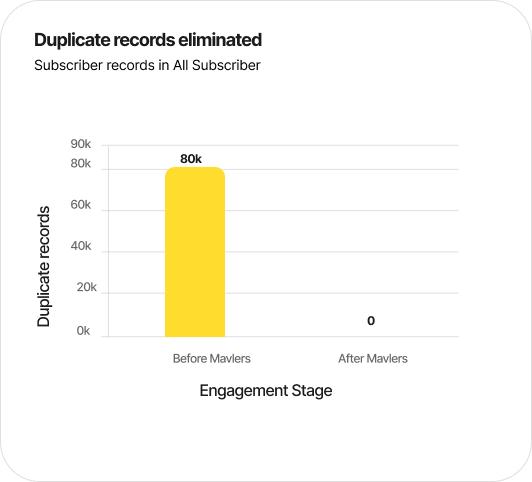
Duplicate records eliminated
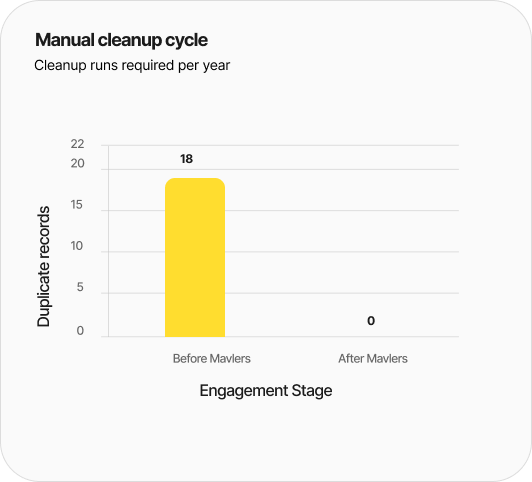
Manual cleanup cycles needed
SFMC pillars re-architected
Embedded specialists
The same email address could carry multiple Subscriber Keys. This flooded the "All Subscribers" list with duplicate records. Inflated record counts ate through Salesforce billing limits. Engagement history sat scattered across fragments of the same customer. Leadership couldn't trust a single marketing report.
Every 15–30 days, the team was running manual subscriber removals just to keep the database in check. The cost: historical tracking data destroyed at each cycle, and a constant risk of deleting legitimate customers in the process.
Weekly, monthly, and ad-hoc campaigns ran on Journeys and Automation Studio workflows that lacked structured data relationships. Every setup turned into a time-consuming, error-prone effort. Bandwidth for strategy and optimisation had effectively disappeared.
Data Extension structures were inconsistent. There were no preventive controls stopping duplicates from being created in the first place. Segmentation accuracy suffered. Bounce rates climbed. The platform was running on hygiene that didn't scale.
Overlapping targeting was hitting the same subscribers repeatedly. Without the engagement-based suppression or optimized send timing. Domain and IP configuration gaps were hurting inbox placement.
A comprehensive audit ran across All Subscribers, Data Extensions, Journeys, and Automations. Email Address was standardized as the single unified Subscriber Key. Records with multiple keys were resolved. Recurring journeys and their Data Extensions were redesigned so consistent Subscriber Key relationships held from the ground up.
Structured backup Data Extensions captured engagement, bounce, and unsubscribe data before any cleanup ran. It preserved the historical record that manual deletions had been destroying. Non-aligned Subscriber Keys were removed. Validation rules and governance controls went in to prevent the problem from returning.
Workflows for recurring, weekly, monthly, and ad-hoc campaigns were reviewed and rebuilt for efficiency. Journey entry sources were restructured to control record injection logic. Data Extension relationships and naming conventions were aligned to support scalable, structured execution.
Einstein Send Time Optimization was deployed. IP warming, domain alignment, and authentication standardization closed the configuration gaps hurting inbox placement. Engagement-based segmentation and suppression logic replaced overlapping targeting.
A half-time dedicated team - 1 SFMC SME and 1 Campaign Manager & Developer - became part of Acima's marketing operations. Continuous oversight, strategic and technical work happened in parallel, not in conflict.
With historical engagement data preserved through structured backup before cleanup.
Previously running every 15–30 days, now zero.
Restoring historical engagement tracking and reporting accuracy.
Billing limits no longer absorb the cost of duplicates.
Duplicate sends fixed, open and click-through rates lifted with Send Time Optimization.
With manual dependency reduced across recurring and ad-hoc work.
Supporting growth instead of working against it.


Marketing manager

Successful migration of 9,000+ pages across 12+ languages, with no critical downtime.

Multi-channel strategy driving 50%+ monthly registration growth.

Ogilvy needed to scale SEO delivery across multiple markets without expanding headcount. Mavlers stepped in as their invisible production partner.
We'll get back to you within 4 business hours.

