




Table of contents
Get in touch
Expect response in 4 hours.
.png)
Placement in AI answers and citations are new visibility signals that help Shopify stores in the moments when decisions are being shaped. The obvious question: how do you optimize your Shopify store for AI search?
You have spent years mastering the art of the "blue link." Thanks to which, your Shopify store ranks on Google. Traffic arrives. And yet, when a user asks ChatGPT or Perplexity for a product recommendation, your store doesn’t get cited.
It’s understandable to feel that an AI search failure to recommend your store is dismissive, particularly when a lot of effort has been put into building your brand.
Equally frustrating is doing everything right and seeing the traffic freeze into a plateau. Most of us in the agency world have tried the "more is better" approach to content, only to find that AI crawlers are summarizing our hard work without giving us the credit, a direct link to our site, or the conversion.
However, from a technical perspective, this usually denotes a lack of machine-readability, not an intentional snub. Whether Google is predating over content it didn’t create without returning traffic is a discussion worth having, just not this one. For this blog, the focus is on Shopify AI SEO.
At Mavlers, we've been tracking across 100+ Shopify stores as to how AI-driven discovery is changing the rules for Shopify merchants. Based on that, let’s understand how to build citation-worthy, AI-visible content that strengthens both traditional SERP rankings and AI recommendations of your Shopify store.
How do AI assistants find and recommend Shopify stores?
Before optimizing your Shopify store for LLMs, it helps to understand how AI models surface information.
Traditional search engines crawl the web, index, and rank in near real-time. AI assistants like ChatGPT and Gemini don't operate the same way.
LLMs in these AI models are trained on a mix of public data, licensed content, and third-party integrations.
Plus, they pull from search engine results and knowledge panels when generating answers. This means your Google presence still feeds into your AI visibility, but it's not the whole picture.
What AI models prioritize is:
- Structured data and schema markup: machine-readable product information.
- Entity clarity: how clearly AI can understand who you are and what you sell.
- External references: mentions in sources that AI models consider credible.
- Customer reviews: signals that show up across multiple platforms.
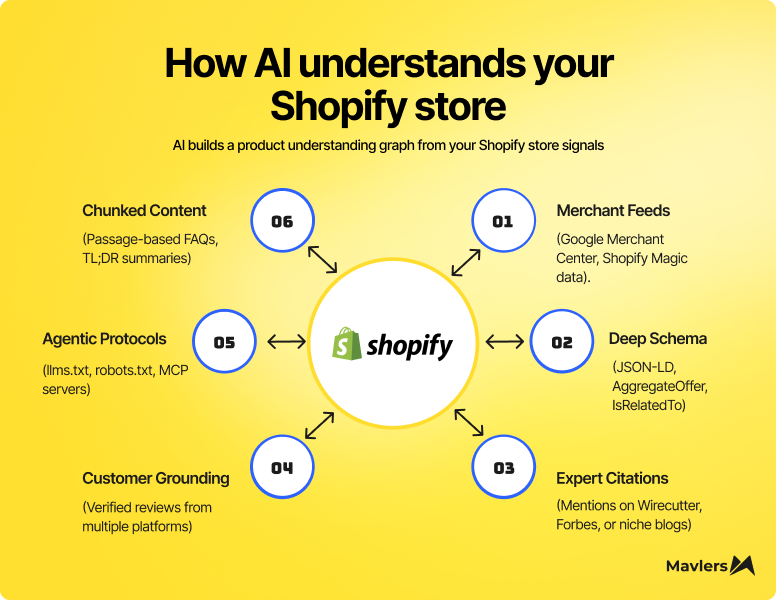
That’s why, for AI-led e-commerce discovery, it’s essential that your store sends clear signals across these areas. If not, AI tools default to more established brands or aggregators. The data leaves no room for doubt:
Shoppers are leaning on AI across the full pre-purchase journey, not just for discovery.
- More than half use it specifically to hunt for the best price.
- 57% use AI to compare competing products head-to-head.
- 48% use AI to get a fast digest of reviews.
Meaning, AI isn't a top-of-funnel tool anymore. It's involved at every stage before customers click "buy."
Most importantly, you stop treating these optimizations as a chore until you see their impact on business performance. According to Shopify, AI-powered product recommendations can triple revenue, more than double conversion rates, and increase average order value by up to 50%.
Another good news: most Shopify stores haven't started optimizing for getting recommended when LLMs propose products. Which means there's a first-mover advantage right now.
Shopify AI SEO optimization to ensure your Shopify stores show up when AI recommends products
1. Demand ownership (where agencies actually create value)
This is the most common mistake, and it renders every other Shopify AI SEO practice useless.
A Shopify community member checked 10 Canadian stores and found 9 out of 10 were blocking GPTBot, ClaudeBot, and PerplexityBot without realizing it.
If your robots. txt. liquid doesn’t permit crawling for all user agents, the crawler is blocked, your schema and content do not matter. You aren’t visible to the LLM. Period.
How do you fix your robots.txt?
- Go to yourstore.com/robots.txt.
- Look for those bot names under any Disallow rules.
- You can edit it in Shopify Admin under:
Online Store → Preferences → Edit robots.txt
Once that's fixed, create an llms.txt file at your site root.
Llms.txt is an emerging convention, a plain-text summary of your business, products, and key pages. Its job is to give AI agents a clear, structured overview of what your store is about. Basically, a signal of "AI-readiness."
Some Shopify SEO apps now support adding this directly from the admin.
2. Structure your content so AI can summarize it
AI models don't read your pages the way humans do. They extract passages — chunks of content that answer a specific question. If your pages aren't structured to support this, you're invisible even when a crawler can reach you.
Two practices that make a measurable difference:
- Use question-based H2s and H3s. "How long do these leather boots last in wet conditions?" makes it much better than an H2 that says "Leather Boot Durability," This matches the natural language patterns users use with AI assistants.
- Place a 30-word TL;DR summary directly under major headings. AI crawlers prioritize these short, dense summaries when generating featured answers. Think of them as knowledge nuggets, pre-packaged, citable content. This approach increases your "citable surface area." You’re simplifying the task for AI systems.
- Optimize your content for AI by using a one-question-per-paragraph structure. This 'chunking' method allows AI to pull the needed information without scanning the whole page.
3. Go beyond basic schema, use the full depth of your catalog
Schema markup has always mattered for SEO. For Shopify AI SEO, it matters even more because structured data is one of the primary ways AI models understand what your store sells and how your products relate to each other.
That said, most Shopify stores still use basic product schema. If you want to stay visible in AI-led e-commerce discovery, you need to show the AI the full depth of your catalog in a single crawl. This is where AI-powered Shopify SEO becomes technical.
Move beyond basic Product Schema and implement:
- AggregateOffer and ProductVariant schema: This shows AI the full depth of your catalog in a single crawl, including pricing, availability, and variant-level details.
- FAQPage schema on product and collection pages: Use the actual questions customers ask before buying. AI assistants pull from these directly when generating shopping recommendations.
- Organization schema: Shopify doesn't generate this by default, but it's what tells AI who you are, where you're based, and what you sell.
- IsRelatedTo schema: Links complementary products together, so AI agents can suggest add-ons (e.g., linking boot care products to leather boots) within a single conversational response.
All schemas should be implemented as JSON-LD. Validate it after adding to make sure it's being read correctly.
4. Use Shopify's native AI tools to generate AI-ready content
We’ve gotten over the era of manual FAQ updates. In 2026, AI content optimization for Shopify relies on real-time data. Shopify has built AI tooling directly into the platform that's worth using for this purpose.
- Shopify Magic now allows for the generation of "Contextual FAQs" for every product page.
- Contextual FAQs are worth adding to your Shopify AI SEO best practices. Why do they matter more than keywords?
- An AI agent does not just look for "black boots." It looks for "black boots I can wear to a professional office and also on a hike." Standard product descriptions might miss these nuances.
- By utilizing Shopify Magic, you can generate FAQs that answer these specific, multi-intent questions.
- Another tool you must have on hand is Shopify Sidekick. It monitors what we call "traffic drift."
- If a sudden influx of users starts asking AI agents about the sustainability of your materials, Sidekick flags this gap. It suggests specific optimizations to your product descriptions to ensure your store remains the primary source for those queries.
- This is a shift from reactive SEO to proactive, AI-driven adjustments to nail AI SEO for Shopify.
5. Prepare your Shopify store for agentic commerce
Agentic commerce means a user's personal AI agent can check stock, verify pricing, and complete a purchase — without the user ever visiting your site. This is further out but moving faster than most merchants expect.
Shopify's collaboration with OpenAI, announced in late 2025, is a clear signal that agent-based commerce is being productized. The stores that prepare now will be in a much better position when native AI purchasing rolls out at scale.
In its recent earnings call, Shopify shared that traffic coming from AI tools has grown 7× in just a few months and orders influenced by AI-driven discovery have jumped 11× over the same period.
The implication: traffic will increasingly be measured by agentic API calls, not just page views.
Exposing tools like stock checkers or discount calculators via an MCP (Model Context Protocol) server is how you make your store accessible to these agents. This is technical groundwork, but it's the direction the ecosystem is moving.
Why should you care about API calls?
When an AI agent "negotiates" a purchase via an API call, it counts as high-intent traffic. In 2026, your Shopify AI tools for SEO should include these agentic endpoints.
This allows for a frictionless transaction where the AI does the work, and you get the sale. The September 2025 Shopify-OpenAI collaboration already paved the way for these native purchases inside the ChatGPT interface.
6. Build the external signals AI models trust
Structured data is foundational, but it's not sufficient on its own. AI models build confidence in your brand through repeated external signals.
A brand mentioned across multiple credible sources has a better and more consistent shot at being the source feeding the AI more than one that only signals from its own site.
47% shoppers say AI influences which brands they trust.
and when AI generates a recommendation, it doesn't hand the buyer a list of twenty options. It hands them a handful of names, and a built-in explanation of why. Brands that don't surface in that shortlist may never exist to the customers.
So, what builds external AI authority:
- Customer reviews: Encourage genuine reviews on multiple platforms. These carry weight across both search and AI discovery.
- Mentions in authoritative, AI-referenced publications: Wirecutter-style roundups, niche expert blogs, and comparison articles are the content AI models synthesize when making shopping recommendations. If your brand isn't in those articles, structured data alone won't get you retrieved into AI search results.
- Comparison and "alternatives to" content: AI models rely on "comparison" and "alternatives to" content to understand market hierarchy. Creating these guides yourself helps define your brand's place in the Knowledge Graph.
- When an AI is asked for "the best alternative to [Competitor]," it looks for existing comparison content. If you don't distinguish yourself from the competition, AI-generated insights will invent a comparison that may not favor you.
- How do you structure "Brand vs. Brand" content?
- Create detailed, objective guides on your Shopify blog. Use the H2 question format: "How does our sustainable coffee compare to [Major Brand]?" Why does this help with LLM SEO? By providing this data, you are feeding the model the exact relationship logic it needs.
How do you know if your Shopify AI SEO is working?
The traditional "Position 1-10" metric is losing relevance. Page views won't tell you if you're being recommended by AI. You need to test directly. Here’s how:
- Run structured commercial-intent prompts on ChatGPT, Gemini, and Perplexity, the same queries your target customers would actually use.
- Track how often your brand appears across 50 to 100 prompts, across fresh sessions, different accounts, and multiple regions. If you appear consistently in clean environments, that's a strong signal of AI visibility.
One practical metric: your LLM Visibility Score. This is a measure of how often an AI recommends your store when asked a relevant commercial question.
Your Shopify store’s LLM visibility score is calculated as the percentage of relevant prompts where your brand is cited.
This isn't an official platform metric yet, but tracking it manually is a good baseline while measuring progress as you implement changes.
Also, monitor whether competitors are being cited when you're not. That gap tells you exactly where your signals are weaker.
Important>> While conducting this cross-validation testing, it’s safe not to rely on a single prompt from your own computer. Results are personalized. To get a real score, you must run structured prompt sets across:
- Different user accounts.
- Multiple geographic regions.
- Fresh, "clean" conversation contexts.
Where AI SEO for Shopify is heading, and what to do next
AI-driven discovery isn't replacing search. It's adding a layer on top of it. The fundamentals, clean site structure, strong schema, genuine reviews, and helpful content, aren’t going anywhere while Shopify AI SEO is cementing its position.
What's changed is how that content needs to be structured, and which signals now influence whether AI assistants recommend your Shopify store products.
Paid AI placements are likely coming. Merchants who build organic AI visibility now will have a head start when that happens, both in organic recommendations and in the credibility signals that will affect how those placements perform.
If you're not sure where to start: check your robots.txt today. If GPTBot or ClaudeBot are being blocked, fix that first. Then add llms.txt, audit your schema, and start building question-based content into your product pages.
If you want a team that's already doing this for Shopify merchants, Mavlers' AI/LLM optimization services are built for exactly this kind of work, helping stores get structured, get cited, and get found by the AI discovery channels that are already influencing purchase decisions.

.png)
.png)